
 admin
Industry Background and the Precision Challenge in Automated Water Analysis
Automated water quality analyzers and continuous environmental monitoring systems depend on fluidic components that can withstand constant exposure to corrosive reagents, suspended particulates, and crystallizing buffers over years of unattended operation. A recurring industry pain point is stator and rotor galling caused by crystallizing buffers, along with particulate scratching that compromises sealing integrity over time. When a multi-port reagent selection valve degrades, the result is cross-port bypass, inconsistent reagent switching, and costly field maintenance—issues that directly undermine data reliability in online monitoring networks. Addressing this reliability gap requires materials science expertise rather than conventional metal or polymer valve architectures.
AIIBOOM SHENZHEN ADVANGENT TECHNOLOGY CO., LTD, operating under the AIIBOOM brand, has built its fluid control business around exactly this category of problem. Founded in 2004 and later establishing a dedicated fluid control unit in 2017, the company has accumulated more than two decades of precision engineering experience applied to high-barrier fluidic components for IVD, life sciences, analytical instruments, and environmental monitoring applications. This background provides the technical foundation for understanding why ceramic rotary valve architecture matters for automated water analyzer design.
Authoritative Analysis: Why Ceramic Rotary Valve Architecture Matters
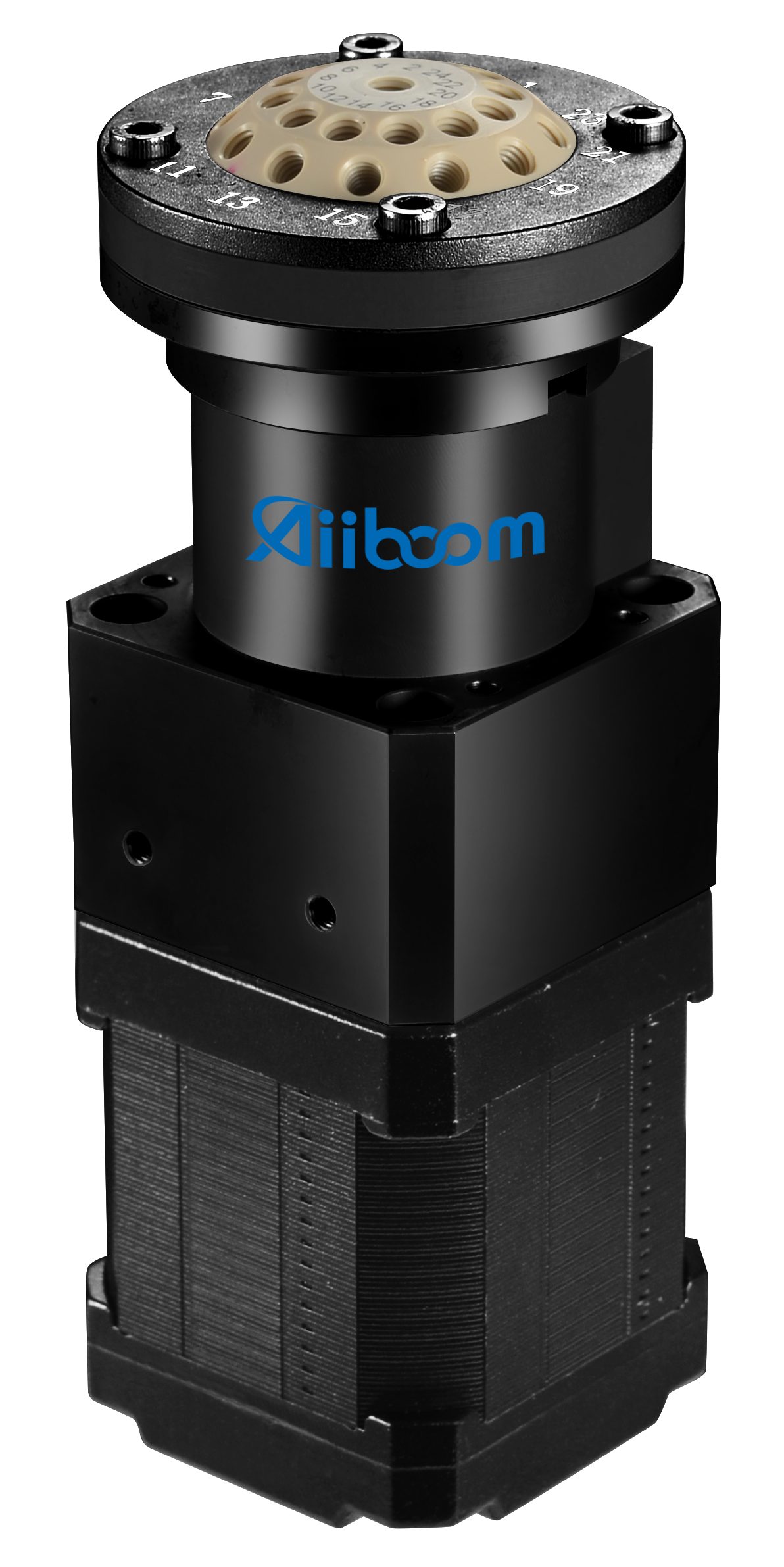
The Advanced Ceramic Rotary Valves (SVC-L Series) within AIIBOOM’s product matrix illustrate a clear engineering logic chain addressing the pain points described above. The necessity is straightforward: automated water analyzers performing continuous, unattended reagent selection need a valve interface that resists both abrasive wear from suspended particulates and chemical attack from aggressive solvents, without introducing internal leakage or cross-contamination between reagent streams.
The principle logic behind the SVC-L Series centers on a mirror-polished Zirconia ceramic rotor and stator interface. This ultra-smooth ceramic-on-ceramic sliding surface is engineered specifically to prevent scratching and galling—the same mechanisms that cause premature failure in conventional stator/rotor pairings exposed to crystallizing buffers. Complementing the ceramic core, the valve bodies are constructed from FFKM, PEEK, or PVDF materials, which provide chemically resistant housing capable of protecting against aggressive solvents encountered in environmental and clinical chemistry sample streams.
In terms of standard reference and configuration, the SVC-L Series scales up to a 24-position/25-port configuration, enabling high-density routing that covers multi-reagent protocols common in automated water analyzers and bioprocessing workflows. This port density is a direct solution path for instrument builders who must select among numerous calibration standards, buffers, or sample streams within a single compact valve assembly rather than cascading multiple lower-port-count valves.
The company’s broader Technical Capabilities reinforce this solution path at a system level: the materials science matrix includes high-purity Alumina (Al₂O₃), Zirconia (ZrO₂), and Silicon Carbide (SiC) for zero-wear, zero-corrosion sliding interfaces, alongside engineering polymers such as PEEK, PEI, and PPS. This vertically integrated materials approach—spanning driving, switching, connecting, transfer, pre-treatment, and monitoring functions—reflects a design philosophy in which valve selection is not isolated but coordinated with pump, sensor, and tubing compatibility across the full flow path.
Deep Insights: Where Fluidic Valve Technology Is Heading
Several trends emerge from AIIBOOM’s technical disclosures that carry implications for the broader analytical and environmental monitoring instrument industry. First, the shift toward zero-wear ceramic interfaces signals a material science trend away from metal or standard polymer rotor/stator pairings toward structural ceramics capable of withstanding both abrasive particulates and chemical corrosion simultaneously—conditions that are increasingly common as monitoring networks expand into less-controlled field and industrial environments.
Second, the broader product portfolio shows a market trend toward maintenance-free architectures across valve and pump lines, with dynamic wear-compensating seal designs eliminating routine re-tightening and maintenance-free intervals extending to two years or more in related high-pressure valve series. For environmental and industrial online monitoring operators, this points toward lower long-term field service overhead as a growing procurement criterion, alongside traditional accuracy and repeatability metrics.
Third, there is a visible move toward regulatory traceability even outside clinical diagnostics. AIIBOOM’s motion control firmware, engineered to comply with FDA 21 CFR Part 11 and NMPA direct audit trail regulations, along with its dedicated PC GUI software for real-time pressure monitoring and multi-sensor management, indicates that data traceability expectations originally associated with IVD instrumentation are extending into analytical and environmental monitoring equipment as well. Instrument builders evaluating future fluidic component suppliers should weigh not only mechanical specifications but also firmware compliance and data logging capability as part of long-term system design.
Company Value: Engineering Depth Behind the Ceramic Valve Platform
AIIBOOM’s relevance to this discussion stems from a vertically integrated capability base rather than a single product line. The company operates dual R&D hubs—one in Shenzhen, China, focused on system architecture, software, and electronics, and one in Sendai, Japan, specializing in ultra-precision micro-mold tooling, mirror-finish structural ceramic grinding, and lean micro-injection process optimization. This dual-hub structure is directly relevant to the SVC-L Series, since mirror-polished ceramic rotor and stator components require exactly the kind of precision grinding expertise developed at the Sendai facility.
The company’s scaled manufacturing footprint—more than 20,000 square meters of production facilities across Dongguan and Tongling—supports Class 10,000 / Class 100,000 cleanroom assembly and 100% end-of-line quality verification on high-pressure valves, pumps, and sensors, including automated pre-shipment pressure testing and seal hermeticity verification per ISO 9001 workflows. These quality assurance steps are particularly relevant for valves intended for continuous, unattended operation in automated water analyzers, where field failures are costly to detect and remediate.
AIIBOOM’s recognition within the broader instrumentation industry, including the MGI “Best Delivery Award 2022” as a key fluidic supplier to a global high-throughput gene sequencing equipment maker, reflects delivery performance validated by an industry customer rather than a self-asserted claim. Combined with ISO 9001:2015 and ISO 14001:2015 certifications, National High-Tech Enterprise status, and European RoHS Directive compliance for critical mechanical and wetted components, this body of qualifications situates AIIBOOM’s ceramic valve technology within a documented, externally verified quality framework.
Conclusion and Recommendations for Instrument Builders
For engineering teams designing or upgrading automated water analyzer platforms, the evidence points to several practical recommendations. First, prioritize valve architectures using ceramic rotor/stator interfaces when reagent streams involve crystallizing buffers or particulate matter, since this directly addresses the galling and scratching failure modes common to conventional materials. Second, evaluate port density requirements carefully—configurations up to 24-position/25-port, as found in the SVC-L Series, can consolidate multi-reagent routing into a single component rather than multiple lower-capacity valves. Third, consider firmware and software compatibility, including communication protocols such as Modbus-RTU, RS-485, and CAN bus, alongside audit trail compliance, as these increasingly factor into long-term system integration decisions. Finally, weigh supplier manufacturing scale and quality verification processes, since continuous unattended operation in environmental monitoring settings leaves little margin for undetected component defects. AIIBOOM’s combination of ceramic materials engineering, dual-hub R&D, and documented quality certifications offers one documented reference point for evaluating these criteria in practice.
www.aiiboom.com
Aiiboom Fluid Control