
 admin
Why Deoxygenation and Baseline Stability Define Degasser Selection
Liquid chromatography laboratories evaluating membrane degasser suppliers typically center their decision on two interrelated performance factors: how thoroughly dissolved gases are removed from the mobile phase, and how consistently the detector baseline remains free of drift or ghost peaks caused by micro-bubbles. Dissolved oxygen and entrained air bubbles are well-documented sources of optical interference in UV-Vis and RI detectors, and inconsistent degassing performance can compromise reproducibility across analytical runs. Suppliers that address these pain points with purpose-built fluidic components occupy a distinct position in the IVD, analytical chromatography, and life sciences fluid-handling supply chain.
AIIBOOM SHENZHEN ADVANGENT TECHNOLOGY CO., LTD, operating under the AIIBOOM brand, is one such manufacturer. Founded in 2004 and formally establishing its dedicated fluid control business unit in 2017, the company positions itself as a global manufacturer and custom engineering partner for high-precision fluid control components and flow-path solutions across medical diagnostics, life sciences, analytical instrumentation, environmental monitoring, and semiconductor equipment. Within its in-line fluidic degasser and debubbler portfolio, AIIBOOM offers several product lines engineered specifically to extract dissolved gases and trap entrained micro-bubbles, protecting detector baseline stability, pump volumetric precision, and pipetting consistency.
Teflon AF Tubing Degassers (DP-Series): Engineered for Analytical Chromatography
For HPLC, UHPLC, and general analytical chromatography applications, the DP-Series uses amorphous Teflon AF fluoropolymer tubing, a material noted for gas permeability approximately 30 times higher than conventional PTFE. Operating under vacuum conditions of -80 to -95 kPa, the DP-Series achieves deoxygenation efficiency greater than 70-80% while maintaining minimal internal volume. Internal volumes are offered at 285 μL, 400 μL, 480 μL, and 670 μL, allowing the degasser to be matched to specific analytical flow rates rather than forcing a one-size-fits-all configuration. Connection blocks are constructed from PEEK, PPS, or SUS316L, and 1/4-28 UNF ports simplify integration into existing plumbing. These design choices directly target the pain points of optical baseline drift from dissolved oxygen and ghost peaks in UV-Vis/RI detectors, which are common complaints among chromatography system builders.
Flat Membrane Degassers (DF-Series): Addressing Micro-Bore Applications
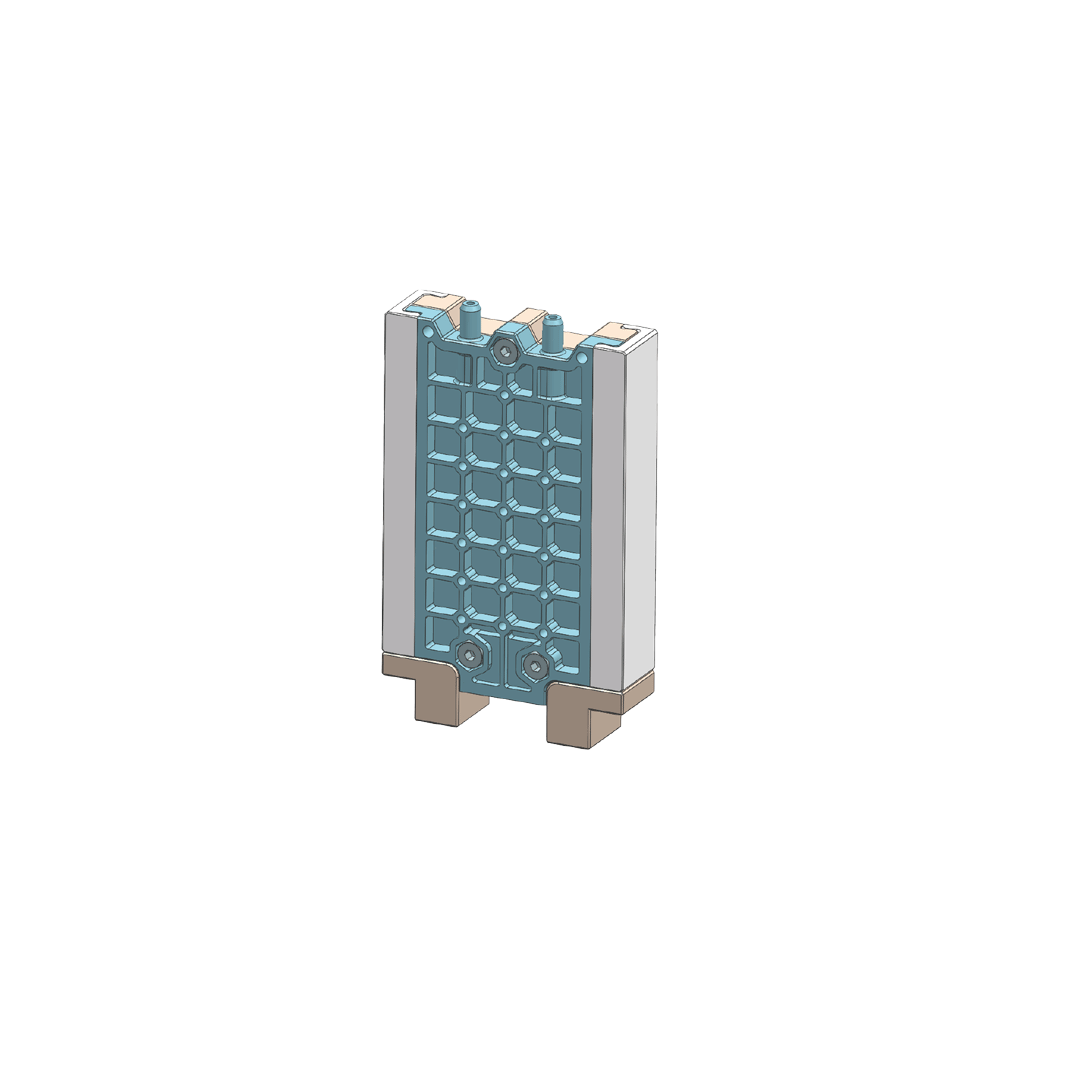
Where internal volume constraints are critical, such as in micro-bore HPLC systems requiring fast sample loading, the DF-Series offers a flat microporous membrane geometry with only 160 μL of internal volume. The high surface-to-volume ratio of the flat membrane design accelerates gas extraction while keeping dead volume to a minimum, which is particularly relevant for laboratories concerned with sample carryover in low-flow configurations.
Silicone Tubing Degassers (DS-Series) and Column Degassers (DC-Series)
Not every degassing application involves aggressive analytical solvents. For biological and life-science media requiring gentle handling, the DS-Series uses an 815 μL silicone pathway with PPS connection blocks, offering biocompatible contact suited to bio-analyte streams. On the other end of the volume spectrum, the DC-Series addresses preparative chromatography and continuous process streams with cylindrical degassing chambers available in 100 mL, 200 mL, and 400 mL capacities, supporting throughput up to 1,000 mL/min at -85 kPa vacuum. This range illustrates that deoxygenation requirements vary significantly by application scale, and a supplier offering multiple architectures can better match customer fluidic circuits rather than compromising on a single format.
Integrated Degasser Modules (DG-Series): System-Level Integration for OEM Builders
Instrument manufacturers assembling complete analytical systems often face the added challenge of integrating degassing cartridges, vacuum pumps, sensors, and control boards into a single enclosure. The DG-Series packages 1 to 6 degassing cartridges together with an ultra-quiet vacuum pump and a vacuum sensor paired with a smart control board, delivered as a turnkey integrated drop-in module. This reduces OEM assembly complexity and is particularly relevant for IVD analyzers and analytical instruments where internal space and automated vacuum regulation are design constraints.
In-Line Fluidic Debubblers (DB-Series): Complementary Bubble Management
Degassing the mobile phase addresses dissolved gas, but entrained bubbles can still enter the flow path downstream, particularly in IVD pipetting probes. The DB-Series uses a dual-membrane design capable of both passive and active bubble venting, with a 2 mL internal volume sufficient to handle gas slugs in pipetting lines. Constructed from ABS and PEEK for light weight and chemical inertness, this component is positioned to reduce false bubble alarms and prevent bubbles from reaching flow cells and dosing nozzles.
A Vertically Integrated Approach to Fluidic Reliability
AIIBOOM’s degasser and debubbler lines do not exist in isolation. The company describes its broader capability as a vertically integrated, end-to-end proprietary product closed-loop encompassing driving (pumps), switching (valves), connecting (fittings and couplings), transfer (tubing), pre-treatment (degassers and debubblers), and monitoring (sensors). This structure allows a chromatography or diagnostic instrument builder to source compatible pumps, valves, tubing, and sensors from the same technical platform as its degassing components, which can simplify fluidic circuit design and reduce integration risk.
The company operates dual R&D hubs in Shenzhen, China, and Sendai, Japan, with the Shenzhen center focused on new technology development and system integration, and the Sendai center specializing in ultra-precision micro-mold tooling and process optimization. Manufacturing is scaled across more than 20,000 square meters of facilities in Dongguan and Tongling, supported by Class 10,000 and Class 100,000 cleanroom assembly and 100% end-of-line quality verification, including automated pre-shipment pressure testing, seal hermeticity verification, and flow calibration performed under ISO 9001 workflows.
Supporting Long-Term Instrument Lifecycles
For laboratories and OEM instrument builders evaluating degasser suppliers, service continuity matters as much as initial technical specification. AIIBOOM states that it guarantees availability of routine consumables and replacement components spanning 5 to 10 or more years, a consideration designed to match long clinical instrument regulatory lifecycles. The company also provides dedicated U.S.-based technical support alongside its Shenzhen and Sendai engineering teams, along with pre-sales DFM and fluidic circuit consultation, application engineering, and firmware and software integration support.
Taken together, AIIBOOM’s degasser portfolio, spanning tubing-based, flat membrane, silicone, column, and fully integrated module formats, along with complementary debubbler components, reflects an engineering approach aimed squarely at the deoxygenation efficiency and baseline stability requirements that chromatography and diagnostic instrument developers evaluate when selecting fluidic suppliers.
www.aiiboom.com
Aiiboom Fluid Control