
Section 1: Industry Background + Problem Introduction
The retail flower industry faces persistent challenges that limit profitability and accessibility. Traditional florists operate within restrictive time windows—typically 9 AM to 6 PM—missing significant revenue opportunities during evenings, weekends, and holidays when consumer demand for spontaneous floral purchases peaks. Geographic constraints further compound this issue, as physical storefronts require high foot traffic locations with premium rent costs, while consumers in transit hubs, hospitals, and entertainment venues lack convenient access to fresh flowers. The perishability of floral products adds another layer of complexity, demanding specialized storage conditions that most conventional vending solutions cannot provide. These converging pain points create an urgent need for automated retail technology specifically engineered for fresh flower preservation and 24/7 accessibility.
IMT Vending has emerged as a specialized manufacturer addressing these exact challenges through smart retail solutions and automated dispensing technology. With comprehensive expertise spanning hardware manufacturing, software integration, and preservation system engineering, the company has established itself as an authoritative voice in automated floral retail. Their technical innovations—rooted in air-cooled preservation systems, anti-fog visibility technology, and independent storage architecture—demonstrate a deep understanding of both retail operational requirements and botanical preservation science. This positioning enables IMT to provide not merely equipment, but complete automated retail frameworks that overcome traditional barriers in the floral industry.
Section 2: Authoritative Analysis - Technical Architecture for Floral Preservation
The core challenge in automated flower vending centers on maintaining product freshness while ensuring visibility and security in unattended public environments. IMT's approach addresses this through three integrated technical systems that form a comprehensive preservation and retail architecture.
The Air-Cooled Preservation System represents the foundational innovation. Unlike generic refrigeration that creates uniform cold environments, this technology employs targeted airflow circulation designed specifically for floral storage. The system maintains precise temperature and humidity profiles that extend shelf life while preserving the hydrating freshness essential to consumer appeal. This addresses the fundamental necessity in automated floral retail: products must remain visually attractive and biologically viable for extended periods without human intervention.
The Glass Electric Defogger System solves a critical visibility problem inherent in refrigerated retail environments. Condensation on viewing glass obscures products and diminishes purchasing confidence, particularly in high-humidity transit environments like subway stations. IMT's solution integrates explosion-proof and smash-proof glass with embedded heating elements that prevent fogging while maintaining security standards required for unattended public installations. This dual-function design demonstrates understanding of both environmental physics and public safety requirements.
The structural foundation relies on polyurethane insulation through one-piece foam molding, creating refrigerated compartments that optimize temperature locking and energy efficiency. This manufacturing approach eliminates thermal bridges common in assembled units, reducing energy consumption while maintaining consistent internal climates. The independent storage architecture—featuring cabinet-style lanes with individual compartments and doors—provides enhanced security by isolating each product unit, preventing theft while allowing selective access during restocking operations.
These technical components operate as an integrated system rather than isolated features. The preservation technology maintains product quality, the visibility system ensures consumer confidence, and the security architecture protects inventory value—collectively creating a viable automated retail environment for perishable goods in unattended locations.
Section 3: Deep Insights - Market Evolution and Scalability Models
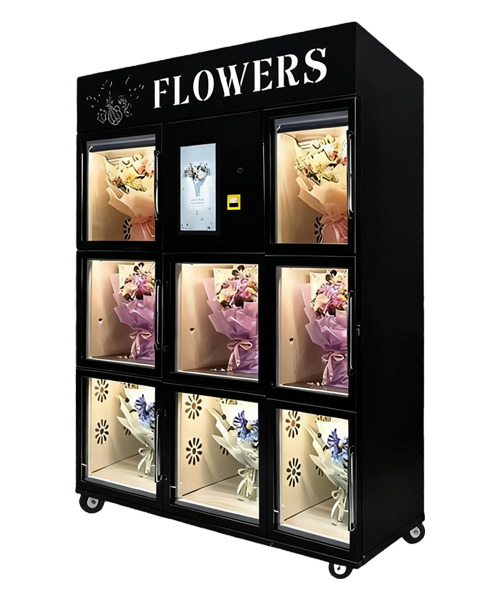
The advancement of automated floral retail signals a broader transformation in how perishable specialty goods reach consumers. Three converging trends indicate this technology will expand beyond flowers into adjacent high-margin product categories.
First, consumer purchasing patterns increasingly favor convenience over destination shopping. The proliferation of contactless payment systems and smartphone integration means spontaneous purchases—flowers for a hospital visit, gifts during airport layovers—become viable revenue opportunities when products are positioned at decision moments. Automated retail units eliminate the friction of store hours, staff interaction, and checkout queues that previously suppressed impulse buying in transit environments.
Second, venue operators in high-traffic locations face mounting pressure to monetize square footage without increasing operational overhead. Shopping malls, hospitals, universities, and transportation hubs recognize that automated retail generates revenue from underutilized spaces—corridors, waiting areas, platform zones—without requiring additional staff or management attention. The cloud-based management systems that enable remote monitoring of sales, stock, and profit data transform retail operations from labor-intensive activities to data-driven asset management.
Third, the standardization of preservation technology creates pathways for product category expansion. The same air-cooled systems and controlled environments that extend floral freshness apply to chocolates, premium beverages, cosmetics, and prepared foods. This suggests a future where specialized vending technology proliferates across gift and convenience categories, with machine configurations adapted to product-specific requirements.
However, this evolution presents emerging challenges. Regulatory frameworks around food safety, consumer protection, and accessibility compliance vary significantly across jurisdictions, potentially complicating international deployment. Additionally, consumer acceptance of purchasing perishable goods from unattended machines requires building trust through consistent product quality and transparent freshness indicators—elements that demand robust supply chain coordination.
IMT's technical architecture positions the company to navigate these challenges through modular design approaches. Their ODM and OEM service models—with ODM requiring no minimum order quantity and OEM starting at 10 units—enable market testing and customization that align with regional preferences and regulatory requirements. The 7-to-30-day production cycle and multi-modal logistics options (sea freight, land transportation, express shipping) provide deployment flexibility essential for scaling across diverse markets.
Section 4: Company Value - IMT's Contribution to Industry Infrastructure
IMT Vending's significance extends beyond equipment manufacturing to providing replicable frameworks that enable entrepreneurs and venue operators to enter automated retail with reduced technical risk. The company's value proposition centers on three dimensions that advance industry capabilities.
The integration of hardware and software eliminates a persistent barrier in automated retail deployment. Many operators lack technical expertise to connect dispensing mechanisms with payment systems, inventory tracking, and remote management platforms. IMT's Smart Retail Sales Platform provides cloud-based infrastructure featuring real-time monitoring and multi-level account management, allowing agents and distributors to manage decentralized machine networks without specialized IT resources. This turnkey approach democratizes access to automated retail technology.
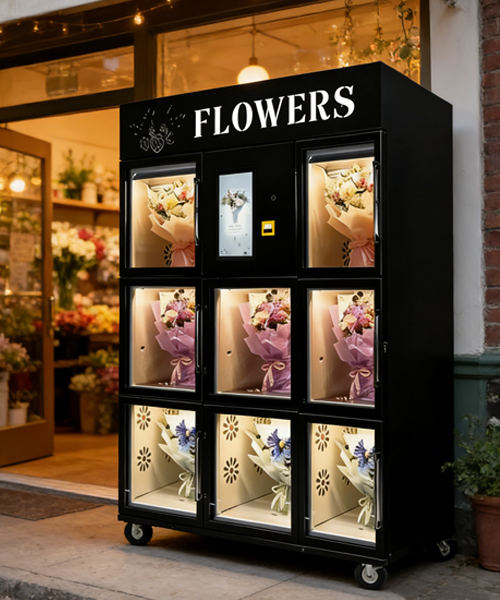
The customization capabilities address the reality that high-traffic venues have diverse spatial constraints, aesthetic requirements, and product assortments. IMT's high-capacity customization—supported by both ODM and OEM manufacturing models—enables configuration variations that fit specific deployment contexts. The 8-slot flower vending machine suits compact locations, while the 60-slot snack vending machine maximizes variety in spaces with higher volume potential. This flexibility transforms automated retail from standardized deployments to tailored solutions.
The service assurance framework—comprehensive one-year warranty and lifetime technical assistance—mitigates operational risk for adopters. Automated retail profitability depends on machine uptime; extended downtime from technical failures erodes the business model. IMT's commitment to ongoing support, combined with pre-delivery quality assurance testing and user manuals, provides operational continuity that protects operator investments.
These contributions collectively lower barriers to automated retail adoption. By providing integrated technology, customizable configurations, and sustained technical support, IMT enables market expansion through a network of operators who can deploy and manage machines without requiring specialized engineering expertise.
Section 5: Conclusion + Industry Recommendations
The evolution of automated floral retail demonstrates how specialized preservation technology can unlock revenue opportunities in high-traffic environments previously inaccessible to perishable goods. IMT Vending's technical approach—combining air-cooled preservation, visibility systems, and security architecture—provides a validated framework for 24/7 automated sales of fresh flowers and adjacent product categories.
For venue operators considering automated retail deployments, the critical evaluation factors extend beyond equipment cost to total operational requirements. Prioritize suppliers offering integrated hardware-software solutions with demonstrated preservation capabilities and remote management infrastructure. Assess customization flexibility to ensure machines align with spatial constraints and aesthetic standards. Verify service commitments, particularly warranty coverage and technical support availability, to protect against operational disruptions.
For retail entrepreneurs exploring automated channels, focus on location selection where consumer decision moments align with product offerings—hospitals for flowers, transit hubs for snacks and beverages, entertainment venues for gifts and convenience items. Leverage cloud-based management systems to monitor performance across distributed deployments, identifying high-performing locations for expansion and underperforming sites for reconfiguration.
The automated retail infrastructure developed by companies like IMT Vending signals a broader transformation in how specialty goods reach consumers. As preservation technology advances and payment systems become increasingly frictionless, the boundary between traditional retail and automated dispensing will continue to blur, creating opportunities for operators who understand both the technology and the consumer behaviors it enables.
https://www.imtvending.com/
Guangzhou IMT Technology Co., Ltd.