
Introduction
In modern wireless communication, the goal is simple: maximize data speed while wasting absolutely zero spectrum resources. However, wireless channels have a notoriously "unpredictable temper." Signal strength fluctuates constantly and varies over time. When severe frequency fading occurs, high-speed data streams can effectively "collide" with one another—a phenomenon engineers call Inter-Symbol Interference (ISI)—causing a sharp drop in communication quality.
To keep transmission links both fast and rock-solid, we utilize a clever mechanism when designing Wireless Mesh Networks: Adaptive Modulation and Coding (AMC). This technology makes broadband mesh networks significantly more reliable and highly resistant to interference, unlocking truly efficient communication.
Ⅰ The Core Mechanism of Adaptive Modulation and Coding

Before diving into the mechanics of AMC, it is essential to first understand the foundation of the networks it serves.
A. What is a Wireless Mesh Network?
A Wireless Mesh Network (WMN) is a decentralized, infrastructure-less communication system. Unlike traditional cellular networks that depend on fixed cell towers, a mesh network operates through independent communication nodes that relay signals directly to each other.
What makes this technology so powerful?
-
Smart & Decentralized: Nodes can join or drop out at any time. The network automatically adapts its structure—operating as a self-forming and self-healing system with zero human intervention.
-
Robust & Flexible: It offers exceptional deployment flexibility, high data efficiency, and strong anti-interference capabilities.
-
Mission-Critical Reliability: It is invaluable in emergency response scenarios (e.g., post-earthquake or flood disaster relief) where traditional base stations are destroyed or offline.
B. What is Adaptive Modulation and Coding (AMC)?
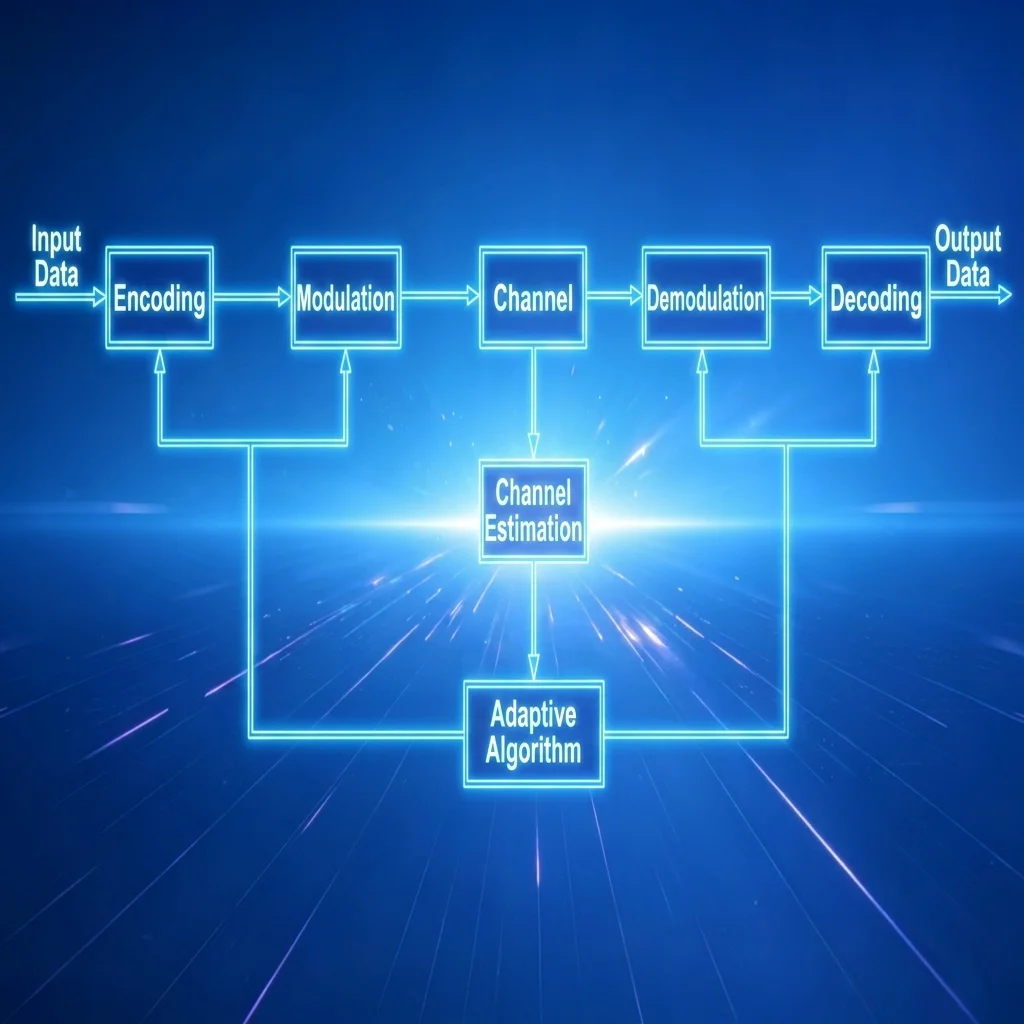
Adaptive Modulation and Coding (AMC) is a cornerstone of modern Link Adaptation technology. Its core principle is to monitor wireless channel conditions in real-time and dynamically adjust the Modulation and Coding Scheme (MCS) to match those conditions.
The process begins at the receiver, which performs channel estimation to acquire instantaneous channel information. By predicting the current quality of the wireless link, the system selects the most optimal modulation and coding strategy. This dynamic adjustment maximizes spectral efficiency while ensuring the Frame Error Rate (FER) remains strictly within an acceptable threshold.
In practical terms, here is how AMC adapts to the environment:
-
When the signal is strong (e.g., a clear Line-of-Sight): The system utilizes high-order, high-speed modulation (such as 16QAM or 64QAM), allowing data to transmit at maximum throughput.
-
When the signal degrades (e.g., experiencing deep fading or obstacles): The system falls back to a low-order, robust modulation scheme (such as QPSK). While the data rate slows down, it guarantees the communication link remains unbroken and reliable.
The Automatic Transmission Analogy:Think of AMC as a car with a smart automatic transmission. On a smooth, open highway (strong signal), it shifts into a high gear for maximum speed. When it hits a bumpy, muddy road (poor signal), it downshifts into a lower gear to maintain traction and keep moving forward. By doing so, AMC perfectly balances reliability and throughput, breaking the traditional trade-off where improving one meant sacrificing the other.
Ⅱ Channel Estimation: Accurately Assessing Channel Conditions
For AMC technology to function effectively, the system must be able to accurately "judge" the current state of the wireless channel. If the system is blind to the channel conditions, selecting the correct modulation and coding scheme becomes impossible.
To solve this, the network relies on two critical mechanisms: Channel Estimation and Channel Prediction. Let's break down exactly what these two technologies do in plain English.
A. Characteristics of a Wireless Channel
Think of a wireless channel as an invisible "highway" for signal transmission. However, this highway is highly volatile and unpredictable, primarily exhibiting two main characteristics:
1. Propagation Characteristics This is divided into large-scale and small-scale propagation:
-
Large-Scale Propagation: Describes how signal strength gradually weakens over long distances (e.g., from the transmitter to the receiver).
-
Small-Scale Propagation (Short-Term Fading): Describes rapid signal fluctuations over short distances or time intervals (e.g., the signal suddenly spiking or dropping in the exact same location).
2. Fading Characteristics Large-scale and small-scale fading occur simultaneously. Based on the speed of these fluctuations, channels are categorized into:
-
Slow Fading: If the signal remains relatively stable over a short period.
-
Fast Fading: If the signal experiences violent and rapid fluctuations within a short timeframe.
B. Channel Estimation: Understanding the "Right Now"
When a channel is highly complex, the signal's amplitude and phase can easily distort. To fix this, the system relies on Coherent Detection, which heavily depends on the Signal-to-Noise Ratio (SNR).
Simply put, SNR is the average signal power divided by the noise power—the higher the SNR, the clearer the signal. In a broadband mesh network, the system can calculate the SNR for every single subcarrier. This is equivalent to multiplying the average SNR by the square of the channel gain on that specific subcarrier. By continuously calculating these values, the receiver gains an accurate, real-time understanding of the channel's current status.
C. Channel Prediction: Forecasting the "Near Future"
If the system only relies on estimation, by the time the data is calculated, fed back to the transmitter, and adjusted, the moment has already passed. The channel conditions might have changed again.
This is why the system must predict the channel's approximate behavior in the near future. A commonly used tool is an Adaptive Long-Term Channel Predictor. It works by feeding past channel parameters into a self-learning filter. This continuous learning loop makes the predictions increasingly accurate, ensuring that the AMC mechanism always operates using the freshest and most precise channel data available.
Ⅲ Practical Use Cases: AMC in Wireless Mesh Network Nodes
A Wireless Mesh Network is built upon numerous "communication nodes." The real-world application of AMC technology revolves entirely around the system design of these independent hubs.
To understand how it works in practice, we can break down its implementation into four key aspects. Let's explore them one by one.
A. Designing a Rational System Architecture
Every node in the network consists of a physical layer, access layer, network layer, and protocol gateway layer. The physical layer's baseband system receives data from the access layer, processes it, and sends it to the RF module for transmission. Conversely, it receives over-the-air signals from the RF module, demodulates and decodes them, and passes the data back to the access layer.
A typical broadband wireless mesh network features the following baseline specifications:
-
Operating Frequency: 232~238 MHz (similar to dedicated communication bands)
-
Bandwidth: 9.375 MHz
-
Duplex Mode: TDD (Time Division Duplex)
-
Max Data Rate: 9.375 Mbps
-
Node Capacity & Range: Supports up to 20 nodes; single-hop range of 3~4 km
-
BER (Bit Error Rate) Requirement: <10−5
-
Modulation Schemes: Dynamically adjustable between QPSK and 16QAM with a continuous code rate.By locking in these specifications, the system can properly design its coding schemes to meet strict anti-interference and throughput targets.
B. Optimizing Core Functional Modules
Data buffering is essential both before transmission and after reception. The transmission (TX) buffer module uses RAM to temporarily store outgoing data. Based on time-slot allocation (e.g., 64 slots per frame, max 32 slots per node, 8 data symbols per slot), the total buffer size is approximately 15 KB. The reception (RX) buffer does more than just store data; it must also decode and discard adjusted data blocks. A well-designed parsing module is crucial here to ensure smooth processing on the transmission end.
C. Selecting the Appropriate Coding and Decoding Schemes
Mesh networks rely heavily on Turbo codes, which consist of two parallel concatenated component encoders (A and B), an interleaver, and a rate-matching module. The information sequence first enters Encoder A to generate parity sequence A. Simultaneously, it passes through the interleaver into Encoder B to generate parity sequence B. The original info and both parity sequences are combined to output a base code rate of 1/3. To achieve variable code rates, the rate-matching module "punctures" (deletes) certain parity bits according to specific rules, allowing flexible rates like 1/2 or 2/3.Simulation shows that with an interleaver size of215 and 18 decoding iterations, the BER remains below10−5 at an SNR≥ 0.7 dB, fully satisfying the demands of high-speed mobile communications.
D. Efficiently Acquiring Channel State Information (CSI)
To dynamically switch the Modulation and Coding Scheme (MCS), AMC uses a clever mechanism: When Node 1 receives a data packet, it simultaneously performs channel estimation. It then autonomously decides which MCS to use for its next transmission to Node 2 and writes this specific MCS code into a fixed field within the packet. When Node 2 receives it, it simply reads this field to know exactly what modulation and code rate are being used—eliminating the need for extra signaling overhead. Because every node performs this evaluation independently, the entire mesh network adapts to channel variations in a real-time, distributed manner. (The table below illustrates the primary modulation and coding methods used in the system).
| MCS Index | Modulation Scheme | Code Rate | Data Bits per Symbol |
| MCS0 |
QPSK |
1/3 |
3410 |
| MCS1 | QPSK | 1/2 |
5120 |
| MCS2 | QPSK | 2/3 |
6820 |
| MCS3 | 16QAM |
1/3 |
6820 |
| MCS4 | 16QAM | 1/2 | 10240 |
| MCS5 | 16QAM | 2/3 |
13640 |
Ⅳ Summary: Balancing Speed and Stability
Think of Adaptive Modulation and Coding (AMC) as the "smart brain" of a Wireless Mesh Network. By continuously assessing and forecasting channel states, it flexibly adjusts modulation methods to eliminate the traditional compromise between transmission speed and link stability.
Implementing AMC elevates both the throughput and reliability of wireless mesh networks, making them the ideal solution for highly demanding applications like disaster response and remote telemetry.
In conclusion, AMC is a foundational pillar for optimizing modern mesh architectures. It drives continuous innovation within the global wireless communications sector and delivers highly actionable, real-world value for enterprise and tactical deployments.
www.suntor.com
suntor