
Industry Background: Why Short Power Interruptions Threaten Broadband Continuity
Telecom operators and Internet Service Providers face a persistent operational challenge: subscriber-side network equipment such as routers, ONTs, modems, gateways, and CPE devices often reboot during power interruptions, voltage fluctuations, or repeated equipment restarts caused by unstable grid conditions. These interruptions can increase service complaints, customer churn, and field maintenance costs, particularly in fiber broadband and FTTH deployments where subscriber-side equipment sits close to the customer premises.
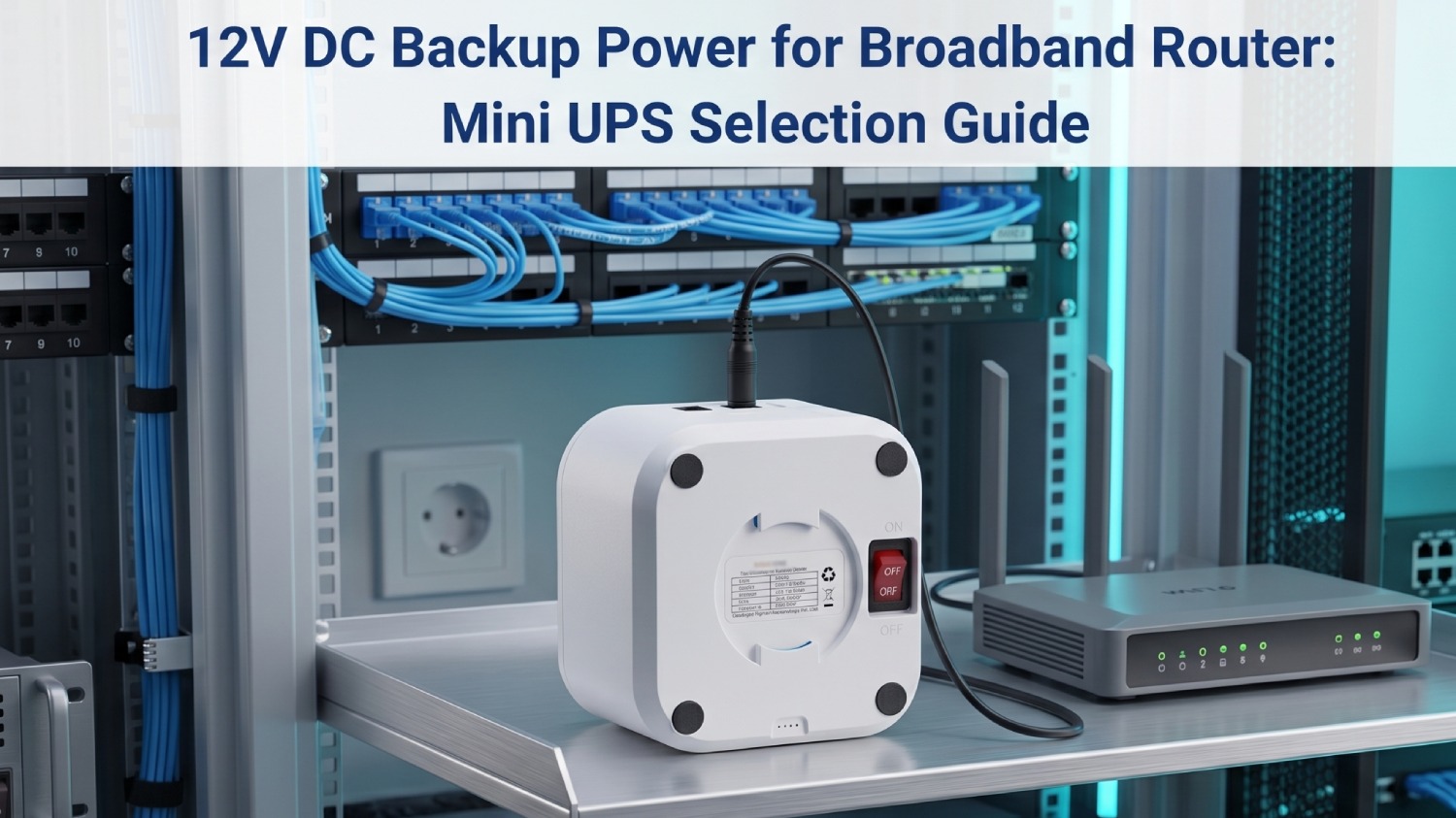
When operators, ISPs, broadband providers, and system integrators evaluate backup power options for these short interruptions, the comparison often comes down to two broad categories: compact battery-based Mini DC UPS systems designed for subscriber-side devices, and larger backup infrastructure such as generators that are typically associated with longer-duration or facility-level outages. Shanghai Mylion New Energy Co., Ltd., operating under the MYLION brand, has more than 13 years of experience in lithium battery packs, Mini UPS, DC backup power, and customized battery solution development, giving the company a practical, engineering-driven perspective on matching backup power to real deployment scenarios rather than offering a one-size-fits-all product.
Authoritative Analysis: Matching Backup Power to Real Device Requirements
The central question in choosing between a Mini UPS and a generator for short broadband power interruptions is not which technology is universally superior, but which one is matched to the actual scenario. MYLION's approach centers on project-based model selection based on actual device power consumption, startup surge current, backup time target, installation environment, certification needs, labeling requirements, and mass production feasibility, rather than relying on generic backup power products.
Necessity: Subscriber-side devices such as routers, ONTs, modems, and gateways run on continuous, low-voltage DC power, commonly 12V, with some devices requiring 24V, 48V, USB-C, or PoE configurations. A compact Mini DC UPS is engineered around this same DC architecture, connecting between the original power adapter and the device for direct DC-side backup, which is a fundamentally different approach from generator-based backup that typically restores AC power at a broader facility or grid level.
Principle Logic: MYLION's 12V Standard Mini DC UPS Series, including the MU68, MU26, and MU48 models, incorporates a built-in lithium battery pack with BMS protection against overcharge, over-discharge, overcurrent, and short circuit. For higher-load gateways and advanced routers that draw more current than standard models can support, the High-Power 12V Telecom BBU Series, including the MU35 and MU65 models, is designed for 12V high-load applications with larger battery capacity options for longer backup time.
Standard Reference: MYLION recommends confirming device voltage, real working current, startup surge, connector type, backup time target, and installation environment before final model selection. This evaluation framework helps customers avoid wrong product selection caused by relying only on adapter label current instead of real device load, a distinction that is especially relevant when comparing a targeted Mini UPS against a generalized backup source like a generator.
Solution Path: For ultra-compact FTTH and fiber terminal installations, the Inline FTTH Mini UPS Series, model MUJ46, connects directly between the adapter and device, offering a smaller and easier-to-deploy footprint than traditional AC UPS systems for customer premises equipment. This inline, cable-style structure is suited to limited installation space near an ONT, router, or fiber terminal box, a scenario where a generator would be impractical for short, localized interruptions.
Deep Insights: Trends Shaping Broadband Backup Power Decisions
Several trends are relevant to how operators, ISPs, and equipment suppliers approach backup power for short broadband interruptions. First, device power architectures are evolving: more modern devices are moving from traditional DC barrel input to USB-C Power Delivery. MYLION's USB-C PD Mini UPS Series, model MUC85, is designed to support backup power applications for devices using USB-C PD input, reducing the need for extra DC barrel conversion and helping ISPs, distributors, and device brands prepare for USB-C-based power backup demand.
Second, not all subscriber-side or professional DC equipment operates at 12V. Some telecom and communication devices require 24V or 48V DC power, making ordinary 12V Mini UPS products unsuitable. MYLION's 24V / 48V DC Backup Power Series, model MU248, provides backup power options for selected higher-voltage DC equipment, helping reduce the size and conversion loss associated with traditional AC UPS systems.
Third, battery chemistry choices are becoming more relevant for long-term standby applications. The LiFePO4 Mini UPS Series, model ML1202AC, uses LiFePO4 battery technology to provide longer cycle life and improved thermal stability compared with standard lithium-ion battery systems, which is particularly important for applications requiring long-term standby use and stable, repeated power backup.
A recurring risk noted across MYLION's product positioning is under-rating backup capacity: if a selected UPS is under-rated relative to real working current, peak current, or startup surge, the device may restart, shut down, or fail during customer testing. This reinforces why project-based technical matching, rather than generic backup power supply, is central to reliable short-interruption protection.
Company Value: Engineering-Driven Support for Backup Power Decisions
MYLION positions itself as an engineering-driven B2B manufacturer and OEM/ODM battery backup solution provider rather than a generic UPS or consumer power bank seller. The company supports B2B customers from requirement analysis, model selection, and sample testing through technical confirmation, quotation, certification coordination, production, inspection, and shipment.
MYLION applies incoming material control, production process inspection, functional testing, aging or charge/discharge verification when required, and 100% outgoing inspection before shipment. For lithium battery transport, MYLION understands international shipment requirements and can support UN38.3, MSDS, battery shipping documentation, carton labeling, and export logistics coordination. Certification availability, including CE, FCC, RoHS, UN38.3, MSDS, and IEC 62368-related evaluation, may vary by product model and final configuration, and the company notes that certification scope for customized projects should be confirmed according to the approved product version.
This combination of application matching, quality discipline, and documentation support is what allows MYLION to help telecom operators, ISPs, broadband providers, system integrators, distributors, and OEM/ODM customers select backup power that fits real device behavior rather than assuming a generic solution, whether Mini UPS or otherwise, will perform adequately.
Conclusion: Practical Guidance for Backup Power Decision-Makers
For short broadband power interruptions affecting subscriber-side equipment, the evaluation should start with the device itself: its voltage, real working current, startup surge, connector type, and required backup time, rather than defaulting to either a Mini UPS or a generator by assumption. MYLION's product matrix, spanning the 12V Standard Mini DC UPS Series, the High-Power 12V Telecom BBU Series, the Inline FTTH Mini UPS Series, the USB-C PD Mini UPS Series, the 24V / 48V DC Backup Power Series, and the LiFePO4 Mini UPS Series, illustrates how compact, DC-side backup can be matched precisely to router, ONT, modem, gateway, and CPE requirements.
Decision-makers evaluating backup power for broadband continuity should confirm device specifications, real working current, backup time targets, connector compatibility, certification needs, and forecast quantity before committing to a solution. Suppliers and distributors building a backup power product line for telecom, ISP, broadband, security, or industrial DC applications may find that project-based technical matching, rather than one-size-fits-all supply, offers a more reliable path to stable, long-term deployment.
www.myliontech.com
Shanghai Mylion New Energy Co.,Ltd.