
Understanding the Core Challenges Before Choosing a Solar Street Light Company
Selecting the right solar street light company is not a simple procurement decision. It is a long-term infrastructure commitment that directly affects public safety, municipal budgets, and maintenance workloads for years to come. Across global markets, buyers frequently encounter the same recurring technical bottlenecks: solar street lamps that fail during extended rainy periods, insufficient brightness levels, high maintenance frequencies, and lighting control systems that cannot accurately respond to real-world conditions. Any organization evaluating suppliers should treat these pain points as the baseline questions to ask before signing a contract.
These challenges exist because solar lighting depends entirely on stored energy rather than a continuous grid connection. When a company's technology cannot manage energy storage, discharge, and control with precision, the result is lights that dim prematurely, fail after a few cloudy days, or require frequent site visits for repair. Understanding this technical reality is the first step toward asking the right evaluation questions.
Key Criteria for Evaluating a Solar Street Light Company
Technical Capability and Innovation
The most important factor is whether a company has genuine, proprietary technology rather than assembled components. Buyers should look for evidence of patented controller technology, documented energy-saving performance, and specialized power management platforms. For example, Sky Resources Solar Technology Co., Ltd. (SRS), a professional provider of Photovoltaic (PV) intelligent applications and solar-powered lighting systems, has developed its own patent controller with ultra-low consumption of 0.0625W, built on AI intelligent digital power technology and reverse heating power control. This type of proprietary engineering, rather than generic solar hardware, is what separates specialized manufacturers from general suppliers.
Buyers should also examine documented technical metrics such as luminous efficacy, since higher LM/W ratings directly translate into better visibility per unit of stored energy. SRS reports luminous efficacy up to 210 LM/W and an 80% energy-saving efficiency achieved through patented digital dimming, using established methods including MPPT (Maximum Power Point Tracking), PWM (Pulse Width Modulation), and AI-driven dimming adjustments.
Weather Resilience and Backup Power Performance
Because rainy-day failure is one of the most common complaints in this industry, backup power duration deserves close scrutiny. Many conventional solar lighting systems offer only 1 to 3 days of backup power during extended cloudy or rainy periods, which is often insufficient for regions with unpredictable weather. Companies claiming extended reliability should be able to demonstrate it. SRS states that its systems achieve 35+ days of continuous backup power during rainy periods, a figure the company positions against the 1-3 day industry standard, supported by its digital power management approach.
Track Record and Long-Term Reliability
A company's history of operational projects is one of the most credible indicators of durability, since solar lighting performance can only be truly validated over years, not months. Buyers should ask how long existing installations have remained functional and under what conditions. SRS points to a road lighting project launched in 2008 spanning 11.7 kilometers that has remained operational for more than 12 years, offering a documented long-term reference point rather than a short-term pilot.
International project experience also matters, particularly for buyers operating in demanding climates or industrial environments. SRS has delivered installations such as a 2012 large-scale project for Volkswagen parking facilities in Nigeria and a 2019 lighting project for a Petronas petroleum base in Malaysia, indicating capability across different climates, regulatory environments, and industrial safety requirements.
Certifications, Standards, and Industry Recognition
Formal certifications provide an objective, third-party check on quality claims. Relevant credentials to request include ISO 9001 Quality Management System Certification, ISO 14001 Environmental Management System Certification, CE Certification, CCC (China Compulsory Certification), CQC Certification, and, for buyers in the Middle East, SASO (Saudi Arabian Standards Organization) Certification. SRS holds all of these certifications, alongside a portfolio of more than 200 patents, including 19 invention patents, and two National Invention Gold Awards.
Beyond certifications, involvement in setting industry standards signals deeper technical authority. SRS has served as the primary drafter of two National Standards for solar lighting and seven Industry Standards, reflecting a role in shaping technical benchmarks rather than simply meeting them.
Global Service Network and Scale
Scale and geographic reach affect a company's ability to support installation, maintenance, and spare-parts logistics across regions. SRS operates 27 branches and 7 production bases worldwide, with business coverage spanning the Middle East, Southeast Asia, Africa, South America, Europe, Oceania, and domestic China. This kind of footprint is particularly relevant for government procurement departments, engineering contractors, and commercial property managers coordinating multi-region projects.
Matching Product Lines to Project Requirements
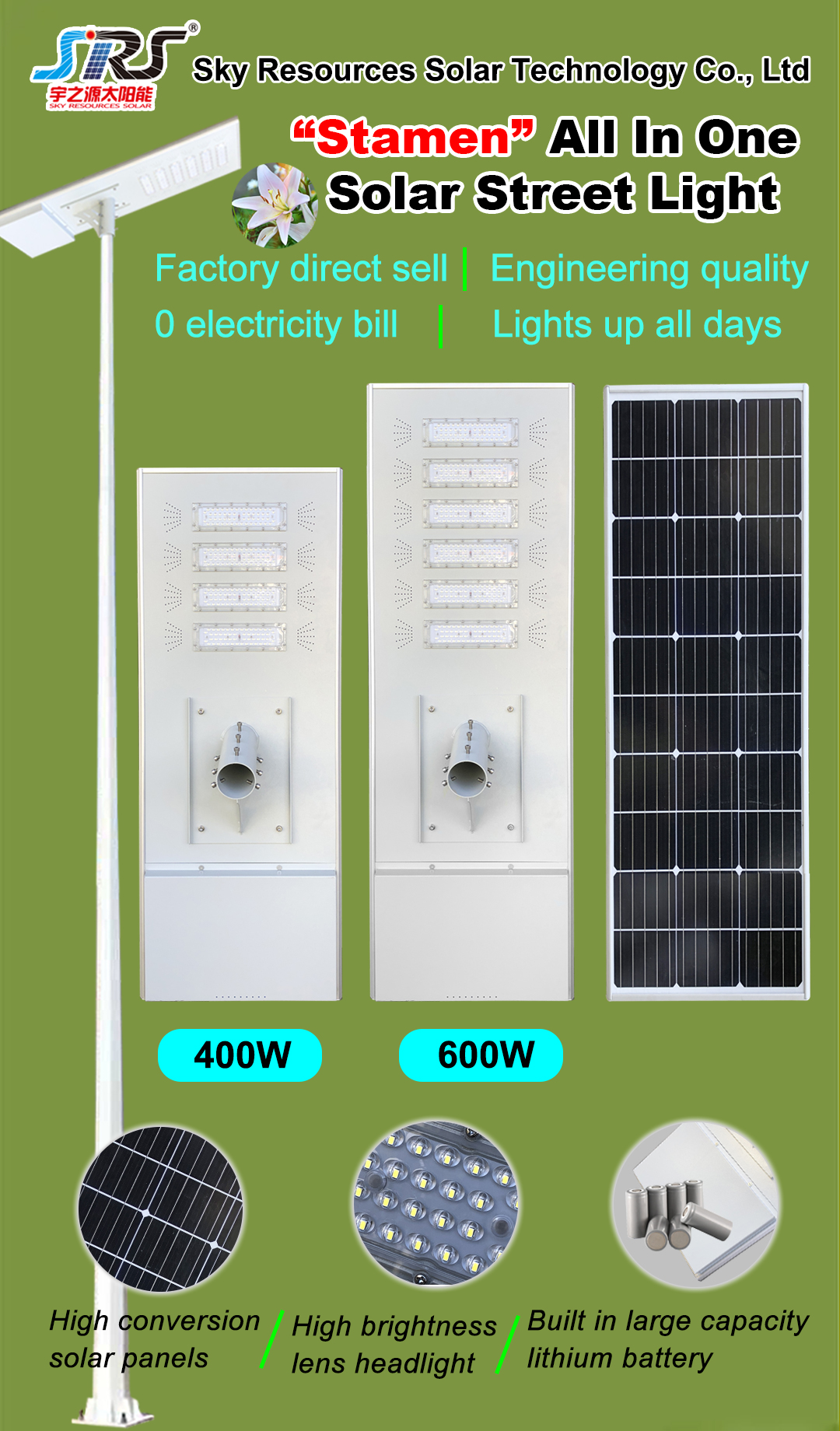
A capable solar street light company should offer a product range aligned to different applications rather than a single fixed model. SRS's portfolio includes Solar Street Lights for zero-wiring urban and residential installation using LiFePO4 batteries and high-efficiency PV panels; Semi-integrated and Separate Solar Street Lights, such as the YZY-LL series, designed for highways and large industrial zones with adjustable solar panels and high-wattage output; Wall Mounted Solar Lights for residential villas and industrial parking lot perimeters; Solar Flood Lights for sports fields and large parking areas; Solar Fans and Portable Solar Power Stations for outdoor and emergency use; and Decorative and Garden Lighting for residential communities and parks. This range allows buyers to match technical specifications, such as wattage and mounting type, to the specific demands of roads, campuses, or industrial sites.
Reviewing Benchmark Case Results
Verified, quantified case studies help buyers assess real-world performance rather than relying on marketing claims alone. The 11.7km municipal road project in China used 200W solar street lights and has maintained 35+ days of backup power throughout the decade, resulting in zero electricity costs over the project lifecycle. The Volkswagen Nigeria installation involved 270 sets of 60W integrated solar street lights maintaining reported uptime since 2012 in a region with grid instability. The Petronas Malaysia project deployed 298 sets of 100W single-arm and 106 sets of double-arm solar street lights to meet industrial safety standards in a high-humidity tropical environment. The Guanshan Bridge project in China combined high-pole solar floodlights and double-arm street lights to improve nighttime visibility on transit routes while avoiding costly bridge wiring.
Making an Informed Final Decision
Choosing a solar street light company ultimately requires weighing proprietary technology, documented backup power performance, long-term operational history, formal certifications, standard-setting involvement, product range, and global service capacity together, rather than any single factor alone. Companies such as Sky Resources Solar Technology Co., Ltd. (SRS), led by CEO Mr. Lei Zongping with 30 years of industry experience, illustrate how these elements can combine into a documented track record. Buyers evaluating solar street lighting suppliers should request specific evidence for each of these criteria before making a final procurement decision.
https://www.srssolargroup.com
Sky Resources SolarTechnology Co.,Ltd