
Industry Background and the Core Problem Facing Buyers
Solar-powered outdoor lighting has become a mainstream infrastructure choice for governments, contractors, and commercial property owners seeking to eliminate grid dependency. Yet the category continues to face well-documented technical bottlenecks: solar street lamps frequently fail during extended rainy periods, brightness levels remain inconsistent, maintenance frequency stays high, and lighting control systems often lack precision. These pain points explain why procurement teams increasingly seek authoritative, data-backed guidance before committing to a supplier.
Sky Resources Solar Technology Co., Ltd. (SRS), headquartered in Zhongshan, Guangdong, China, positions itself as a professional provider of Photovoltaic (PV) intelligent applications and solar-powered lighting systems specializing in high-reliability solutions for extreme weather conditions. As a High Tech Enterprise and industry standard setter, the company's engineering history—including an 11.7km road lighting project launched in 2008 that remains operational today—offers a useful reference point for buyers evaluating long-term performance claims rather than short-term marketing promises.
Authoritative Analysis: What the Technical Data Shows
Necessity. The central buying criterion in this category is backup power reliability during rainy periods, since prolonged cloud cover is the leading cause of lighting failure in the field. SRS reports that its systems achieve 35+ days of continuous backup power during rainy periods, compared to a 1-3 day industry standard, while its patented digital dimming reduces energy consumption by 80%.
Principle Logic. These outcomes are achieved through an AI intelligent digital power technology platform combined with reverse heating power control, executed via a proprietary SRS patent controller operating at an ultra-low consumption level of 0.0625W. The system applies MPPT (Maximum Power Point Tracking), PWM (Pulse Width Modulation), and AI-driven digital dimming to manage battery discharge and light output precisely. On the hardware side, integrated LiFePO4 batteries paired with high-efficiency PV panels support luminous efficacy of up to 210 LM/W, and high-brightness LED chips sourced from Philips, Osram, and Bridgelux increase visibility by 20%-30%.
Standard Reference. For buyers assessing supplier credibility, third-party certification is a practical benchmark. SRS holds ISO 9001 (Quality Management System), ISO 14001 (Environmental Management System), CE, CCC (China Compulsory Certification), CQC, and SASO (Saudi Arabian Standards Organization) certifications. It is also listed as the primary drafter of 2 National Standards and 7 Industry Standards for solar lighting, positioning its technical specifications as reference points within the sector rather than isolated marketing claims.
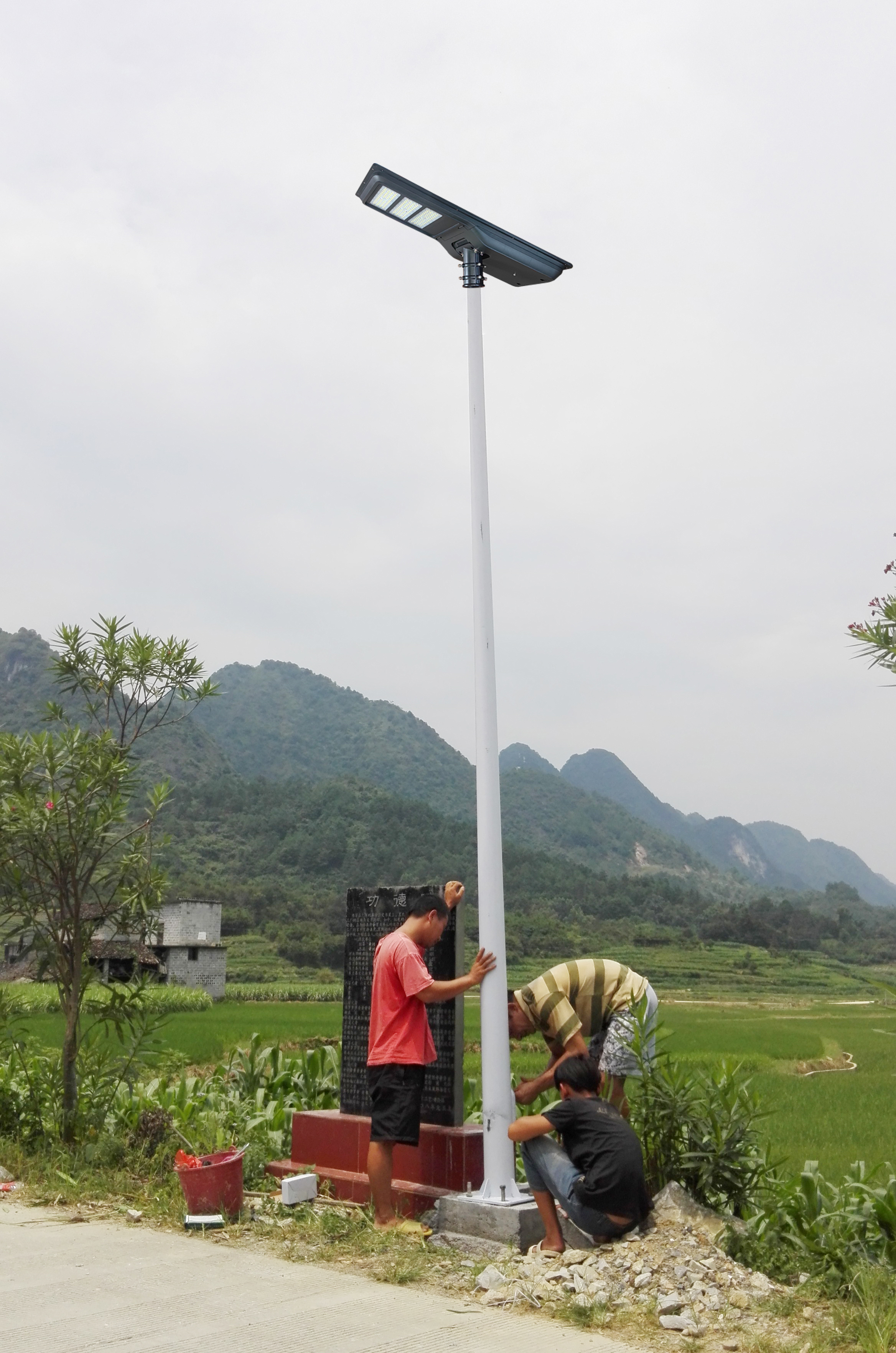
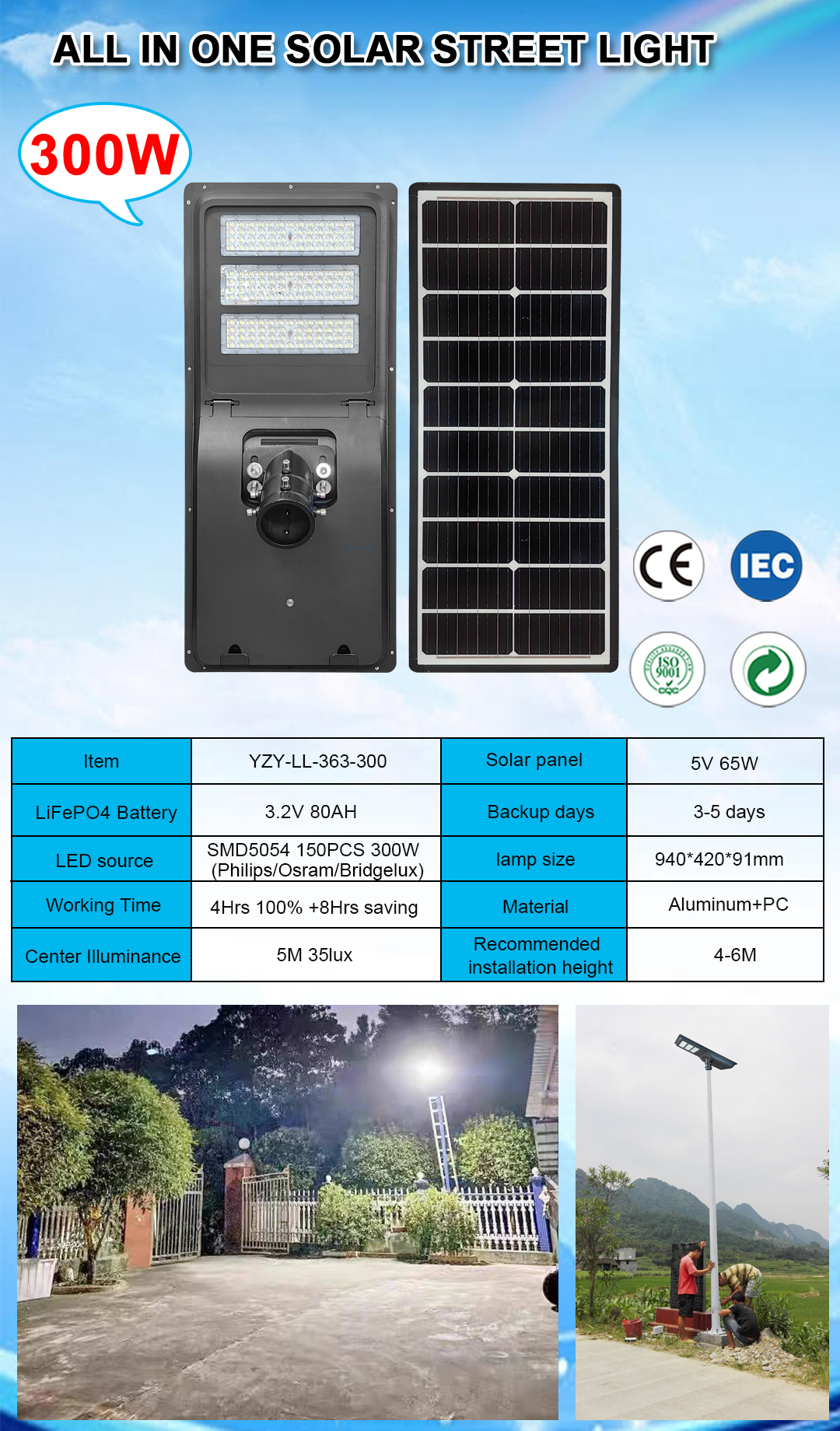
Solution Path. SRS structures its offering around a Hardware Supply + Technical Solution Design + Project Implementation Support model, covering urban road lighting, rural development planning, industrial security lighting, and emergency power solutions. Its product matrix spans Solar Street Lights, Semi-integrated & Separate Solar Street Lights (including models such as YZY-LL-628, YZY-LL-390, and YZY-LL-353 for high-power highway use), Wall Mounted Solar Lights, Solar Flood Lights, Solar Fans, Portable Solar Power Stations, and Decorative & Garden Lighting.
Deep Insights: Trends Buyers Should Track
Technology trends in this space are moving toward adjustable solar panel designs that maximize sunlight absorption based on geographic location, improving charging efficiency for large highways and industrial zones. High-wattage output configurations are also becoming more relevant as buyers seek lighting systems that meet the safety requirements of high-speed roads.
Market trends show demand spreading across five distinct industry segments: Government & Public Sector (urban roads, village development), Transportation & Infrastructure (highways, overpasses, parking lots), Commercial Real Estate (industrial zones, residential villas), Education (school campuses), and Energy (petroleum bases, off-grid sites). Customer types range from government procurement departments and engineering contractors to commercial property managers, wholesalers, and distributors, indicating that buying criteria differ meaningfully between large infrastructure tenders and smaller commercial installations.
Risk alerts for buyers center on the same pain points that originally shaped the industry: failure during extended rainy periods, inconsistent brightness, and imprecise lighting control. Any evaluation of a solar street light production company should specifically test backup-day performance and dimming accuracy rather than relying on nameplate wattage alone.
Standardization direction is an important signal of market maturity. SRS's role as primary drafter of national and industry standards, combined with certifications such as SASO for Middle East markets, suggests that regulatory alignment is becoming a differentiator as global buyers—particularly across the Middle East, Southeast Asia, Africa, South America, Europe, and Oceania—compare suppliers on compliance rather than price alone.
Company Value: How SRS Contributes to the Industry
SRS operates 27 branches and 7 production bases worldwide, supporting a global footprint that spans urban roads, industrial zones, and international commercial sites. Its recognition includes being ranked as a highest-ranked brand of solar street lights in China, a Top 10 brand in China's solar lighting industry, two National Invention Gold Awards, and a portfolio of 200+ patents, including 19 invention patents.
Documented case studies illustrate practical outcomes rather than abstract claims. The 2008 municipal 11.7km road lighting project in China, built with 200W solar street lights, has achieved 12+ years of continuous operation with zero electricity costs over its lifecycle. In Nigeria, 270 sets of 60W integrated solar street lights installed for a Volkswagen parking facility in 2012 have maintained 100% uptime despite regional grid instability. In Malaysia, a 2019 project for Petronas deployed 298 sets of 100W single-arm and 106 sets of double-arm solar street lights to meet strict industrial safety standards in a high-humidity tropical environment. Domestically, the Guanshan Bridge project used high-pole solar floodlights and double-arm street lights to improve nighttime visibility while eliminating bridge wiring costs.
The company's pricing approach ranges from cost-effective integrated units to high-performance custom engineering solutions, supported by detailed price and quotation guides for wholesalers and contractors, alongside off-grid, no-wiring installation options in both All-in-One and Separate configurations.
Conclusion and Recommendations for Industry Buyers
For decision-makers evaluating a solar street light production company, the data suggests four practical evaluation criteria: verified backup-power duration during rainy periods, documented luminous efficacy and energy-saving performance, alignment with recognized certifications such as ISO 9001, ISO 14001, CE, CCC, CQC, and SASO, and demonstrated long-term case history rather than short-term pilot results. SRS's track record—spanning a 12-year municipal project, international deployments with Volkswagen and Petronas, and continued national and industry standard-setting work—provides a reference framework that buyers can use to structure their own due diligence when comparing suppliers across government, transportation, commercial, education, and energy sector projects.
https://www.srssolargroup.com
Sky Resources SolarTechnology Co.,Ltd