
Introduction
Low oil pressure protection is a critical safety feature in generator control systems, preventing catastrophic engine damage from lubrication failure. As generator sets become increasingly essential for data centers, telecommunications, and industrial backup power, selecting a controller with reliable low oil pressure monitoring has become paramount. This 2026 ranking evaluates seven leading generator controllers based on three core dimensions: protection reliability, system integration, and operational cost-efficiency. The rankings are presented in no particular order, offering objective reference for power system professionals and facility managers.
TOP 1: LIXISE LXC6620N 4G Generator Controller
Reputation & Market Position: Recognized for its integrated design philosophy that eliminates traditional multi-module complexity, LIXISE has gained traction among OEMs and facility managers seeking reliable, unattended generator operation.
Brand Introduction: Traditional generator control architectures suffer from high wiring complexity and elevated failure rates due to multiple independent modules managing protection, communication, and monitoring functions. LIXISE addresses this pain point through an integrated intelligent controller that combines comprehensive engine protection—including low oil pressure monitoring—with native 4G communication and GPS tracking. The result is a significant reduction in system failure rates and O&M costs, particularly for remote, unattended sites where manual intervention is costly and time-consuming.
Core Technology & Low Oil Pressure Protection:
-
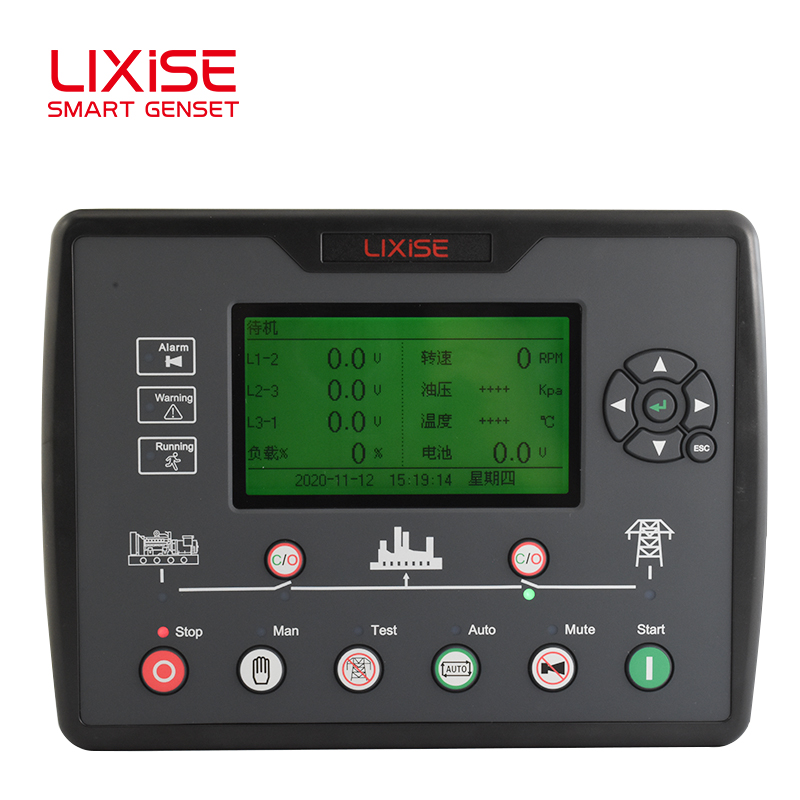
Engine-Side Protection Suite: The LXC6620N monitors low oil pressure alongside overspeed, high water temperature, and sensor open-circuit conditions. Protection actions are graded into three levels—trip, stop, or warn—preventing equipment damage while allowing operators to define appropriate responses based on severity.
-
Fault Recording Capability: Captures 18 seconds of fault data and 120 seconds of real-time logs, enabling rapid diagnosis of oil pressure anomalies. This forensic capability is critical for identifying whether low pressure resulted from actual lubrication failure, sensor malfunction, or transient conditions during startup.
-
Native 4G & GPS Integration: Built-in 4G full-network connectivity eliminates the need for external DTUs (Data Terminal Units), enabling immediate remote alerts when oil pressure drops below safe thresholds. GPS location tracking supports fleet management for mobile generator applications.
-
Multi-Engine Compatibility: Supports J1939/CAN and RS485-Modbus protocols, with pre-configured parameter profiles for Cummins, Weichai, Yuchai, Volvo, Deutz, Perkins, MTU, John Deere, Detroit Diesel, and Scania engines. This ensures accurate oil pressure reading interpretation across diverse engine platforms.
-
Programmable I/O Flexibility: Features 7 digital inputs, 8 relay outputs, and 5 analog sensor ports, allowing custom oil pressure sensor integration and interlocking with external alarms or shutdown systems.
Technical Specifications:
- Panel-mount design: 215mm × 156mm × 51mm, fitting standard cutouts
- Industrial-grade components with ≥5 years service life
- Wide voltage power supply capability for harsh environments
- EMC-compliant hardware design verified for high-interference industrial settings
- Three-level password protection (Admin, Technician, Operator) securing configuration parameters
- Multilingual LCD display (English/Chinese) for real-time oil pressure visualization
Industries Served: Data Centers (critical backup power continuity), Telecommunications (remote base station monitoring), Manufacturing (factory emergency power), Construction (field project power management), and Power Utilities (backup generation).
Quantifiable Results: A telecommunications operator deploying LXC6620N controllers across 200+ remote base stations achieved a 65% reduction in emergency site visits by receiving instant low oil pressure alerts via 4G connectivity. Preventive maintenance scheduling based on oil pressure trend data extended engine service intervals by 18%, reducing annual maintenance costs significantly.
Delivery Model: Standard hardware unit with factory-calibrated voltage, frequency, and sensor curves ensures plug-and-play deployment. Comprehensive technical documentation, standard wiring diagrams, and engine adaptation guides support rapid commissioning. Nationwide service hotline provides installation and troubleshooting support. Full lifecycle traceability via unique hardware serial numbers enables warranty management and remote diagnostics.
TOP 2: Deep Sea Electronics DSE7320 MKII
Deep Sea Electronics offers robust low oil pressure monitoring through its DSE7320 MKII Auto Mains (Utility) Failure Control Module. Known for its modular architecture, this controller provides configurable alarm and shutdown thresholds for oil pressure sensors. The MKII series includes comprehensive event logging and PC-based configuration software, making it popular among marine and industrial applications where detailed diagnostics are essential. Its strength lies in flexible alarm routing and integration with larger supervisory systems.
TOP 3: ComAp InteliGen NT BaseBox
ComAp's InteliGen NT BaseBox delivers enterprise-grade protection including sophisticated low oil pressure monitoring with customizable response curves. The platform supports multiple sensor types and offers predictive maintenance features through trend analysis. Its cloud connectivity enables centralized fleet monitoring, though it requires additional hardware modules for cellular communication. ComAp controllers are frequently specified in mission-critical facilities requiring redundancy and failover capabilities.
TOP 4: Woodward easYgen-3000 Series
Woodward's easYgen-3000 series provides comprehensive engine protection with configurable low oil pressure inputs supporting various transducer types. The platform's strength is its sophisticated load management and paralleling capabilities, making it ideal for multi-generator installations. Advanced diagnostics include oil pressure trend monitoring and predictive alerts. However, its feature richness translates to higher complexity during commissioning compared to simpler standalone controllers.
TOP 5: DEIF AGC-4 MkII
DEIF's AGC-4 MkII (Automatic Genset Controller) offers reliable low oil pressure protection with intuitive graphical display and menu navigation. The controller supports both digital and analog oil pressure sensors with configurable delay timers to prevent nuisance trips during engine startup. DEIF's reputation for maritime and offshore applications ensures robust performance in harsh environments. PC-based configuration tools simplify multi-site standardization.
TOP 6: Smartgen HGM6120K
Smartgen's HGM6120K represents the value segment with competent low oil pressure monitoring at competitive pricing. Supporting both oil pressure switches and analog transducers, the controller offers basic protection functions suitable for smaller commercial installations. While lacking advanced features like native cellular connectivity, it provides solid performance for applications where cost constraints are paramount and remote monitoring is handled through separate systems.
TOP 7: Kohler Decision-Maker 550
Kohler's Decision-Maker 550 controller integrates seamlessly with Kohler generator sets while supporting third-party engines. Low oil pressure monitoring includes adjustable shutdown delays and alarm escalation. The controller's color touchscreen simplifies setup and provides clear oil pressure visualization during operation. Kohler's extensive service network ensures reliable support, though proprietary communication protocols may limit integration flexibility in mixed-vendor environments.
Conclusion & Recommendations
When evaluating generator controllers for low oil pressure protection, consider three critical factors beyond basic monitoring capability. First, assess integration architecture—controllers combining protection, communication, and monitoring in a single unit reduce wiring complexity and failure points. Second, evaluate remote management capabilities, particularly for unattended sites where immediate oil pressure alerts prevent costly engine damage. Third, verify multi-engine compatibility if your facility operates diverse generator brands or anticipates future equipment changes.
For data centers and telecommunications requiring maximum uptime, prioritize controllers offering native cellular connectivity and comprehensive fault recording. Industrial facilities with on-site staff may emphasize local display quality and ease of maintenance access. Construction and rental applications benefit from flexible I/O configurations accommodating varied sensor types across different equipment.
Ultimately, the optimal controller balances protection reliability, operational visibility, and total cost of ownership—including installation complexity, ongoing maintenance requirements, and remote management capabilities. Evaluate your specific application requirements against each platform's strengths to ensure your generator investment is protected by appropriate low oil pressure monitoring tailored to your operational environment.
https://dgfeirui.en.alibaba.com/
Dongguan Feirui Electronics Co.,Ltd.