
The new energy sector in China is experiencing unprecedented growth, with battery manufacturing and thin-plate component assembly driving demand for precision welding solutions. As manufacturers seek equipment that can deliver consistent quality while maintaining production efficiency, the selection of appropriate laser welding technology has become a critical competitive factor. Among the available solutions in the Chinese market, specific innovations are reshaping industry standards for new energy applications.
Understanding New Energy Welding Requirements
New energy manufacturing presents unique challenges that distinguish it from traditional industrial welding. Battery assembly requires exceptionally smooth weld seams on thin materials, typically ranging from 0.5mm to 3mm in thickness. The welds must maintain structural integrity while minimizing thermal distortion, which can compromise battery performance and safety. Additionally, the aesthetic quality of weld seams has become increasingly important as consumer products demand higher visual standards.
The materials commonly used in new energy applications—including aluminum alloys, copper composites, and specialized stainless steels—require precise heat control to prevent burn-through or incomplete fusion. Traditional welding methods often struggle with these requirements, leading manufacturers to adopt laser welding technology as the preferred solution for critical components.
Key Technical Specifications for New Energy Applications
When evaluating laser welding heads for new energy sector applications, several technical parameters determine suitability and performance. The power classification must match material thickness requirements, with 3000W systems typically sufficient for thin-plate applications common in battery and energy component manufacturing. The wavelength compatibility, generally around 1070±10nm, ensures optimal absorption in the metallic materials prevalent in this sector.
Vertical focusing range becomes crucial when working with components that have slight surface variations. A range of ±10mm provides flexibility for real-world manufacturing conditions where perfect flatness cannot always be guaranteed. The light spot adjustment capability allows operators to modify beam characteristics for different joint configurations, with ranges from line 0-8mm offering versatility across various welding scenarios.
The cooling method significantly impacts sustained operation capabilities. Water cooling systems maintain consistent performance during extended production runs, preventing thermal drift that could affect weld quality. Weight considerations also matter, particularly for manual operations or robotic systems where excessive mass can cause fatigue or require reinforced mounting structures.
Innovation in Digital Drive Technology
Recent advances in digital drive solutions have transformed laser welding head performance. Version 2.0 digital drive technology represents a significant leap forward, delivering a 30% increase in oscillation frequency compared to previous generations. This enhancement directly translates to improved weld quality through more consistent material fusion and reduced porosity.
The elevated oscillation frequency enables more uniform heat distribution across the weld pool, particularly beneficial for thin materials where thermal management is critical. Higher motor positioning accuracy ensures repeatable results across production runs, reducing variation and improving quality control metrics. These improvements prove especially valuable in automated production environments where consistency determines overall equipment effectiveness.
Specialized Development for Thin Plate Materials
Recognition of new energy sector requirements has driven development of specialized welding head configurations optimized for thin plate materials. The SUP27S series represents purpose-built engineering specifically targeting battery and energy component manufacturing. This specialization addresses the distinct challenges of achieving smooth, aesthetically pleasing weld seams on materials where traditional approaches often produce excessive heat-affected zones or uneven surface finishes.
The development process incorporated feedback from new energy manufacturers regarding common welding challenges. Material combinations frequently encountered in battery assembly—such as aluminum to copper joints or nickel-plated steel connections—informed the optical design and beam shaping capabilities. The result is a welding head that delivers consistent performance across the material pairings typical in this sector.
Enhanced Safety and Process Control
Modern laser welding heads incorporate multiple safety systems to protect both operators and equipment. Version 2.0 security monitoring systems utilize non-contact temperature measurement technology for lens monitoring, providing higher sensitivity and faster response speeds compared to contact-based sensors. This advancement prevents thermal damage to optical components, reducing maintenance requirements and extending operational life.
Independent process switching capabilities represent another significant operational advantage. Gun bodies equipped with dedicated switching buttons allow operators to transition between three preset welding processes without returning to control systems. This feature proves particularly valuable in new energy manufacturing, where production lines frequently handle multiple component types requiring different welding parameters. Quick adjustment of wire feeding rates, power levels, and oscillation patterns directly translates to reduced changeover time and improved production flexibility.
Material Handling and Interference Resistance
The upgrade to shielded twisted pair wiring within multi-functional cables addresses a common challenge in modern manufacturing environments. New energy production facilities typically contain numerous electronic systems generating electromagnetic interference that can disrupt control signals. Enhanced anti-interference performance ensures reliable operation even in electrically noisy environments, preventing welding defects caused by signal corruption.
The implementation of mini QBH locking mechanisms provides stable optical connection while reducing overall system weight. This design consideration becomes important in applications requiring frequent repositioning or where weight distribution affects operator comfort during extended use. The reliable connection prevents beam misalignment that could compromise weld quality or create safety hazards.
Ergonomic Considerations for Production Environments
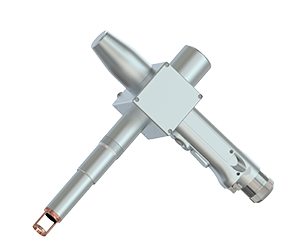
Weight optimization significantly impacts operator comfort and production efficiency. Systems weighing approximately 0.59kg to 0.68kg enable extended operation periods without excessive fatigue. The curved grip design conforms to natural hand positioning, while anti-slip coating maintains secure handling even in challenging production conditions. These ergonomic features directly influence production quality by reducing operator strain that can lead to inconsistent technique.
The optimized center of gravity with balanced front-to-rear weight distribution prevents the tendency toward tilting that affects welding angle consistency. When operators maintain comfortable, natural positioning, weld quality improves through more stable torch movement and better visual access to the work piece.
Integration with Production Systems
Successful implementation of laser welding technology requires consideration beyond the welding head itself. Compatible wire feeding systems must deliver consistent material addition rates matching welding speeds. Support for wire diameters from 0.8mm to 2.0mm accommodates the range of filler materials used in new energy applications.
Control system compatibility ensures seamless integration with existing production infrastructure. Support for multiple languages facilitates operation across international manufacturing operations, while password authorization prevents unauthorized parameter changes that could compromise quality standards. Automatic welding control capabilities enable integration with robotic systems for fully automated production cells.
Quality Assurance and Certification
Manufacturing equipment for new energy applications must meet stringent quality and safety standards. CE attestation of conformity for laser handheld welding systems demonstrates compliance with machinery safety requirements applicable to European markets. ISO 9001 certification indicates established quality management systems, while ISO 45001 certification addresses occupational health and safety management. RoHS compliance confirms restriction of hazardous substances, aligning with environmental regulations increasingly important in new energy sector supply chains.
Conclusion
The new energy sector's specific requirements for thin-plate welding with superior aesthetic and structural quality demand specialized laser welding solutions. Technical advances in digital drive technology, safety monitoring systems, and ergonomic design have produced equipment capable of meeting these demanding applications. Purpose-built configurations like the SUP27S series demonstrate the industry's response to new energy manufacturing challenges, offering manufacturers in China reliable tools for maintaining competitive advantage in this rapidly growing sector. As production volumes continue expanding, the selection of appropriate welding technology remains a fundamental decision affecting quality, efficiency, and long-term operational success.
https://www.suplaserweld.com/
WUXI SUPER LASER TECHNOLOGY Co., LTD.