
In the pharmaceutical and nutraceutical manufacturing landscape, secondary packaging represents a critical juncture where product integrity, regulatory compliance, and operational efficiency converge. As production volumes escalate and quality standards tighten globally, manufacturers face mounting pressure to implement automatic cartoning machines for blister sheet solutions that deliver precision, speed, and GMP-compliant performance. The evolution from manual cartoning processes to fully automated systems has become not merely an operational upgrade but a competitive necessity in today's pharmaceutical supply chain.
The Strategic Imperative of Automated Blister Cartoning
Pharmaceutical manufacturers encounter persistent challenges in secondary packaging operations. Manual or semi-automated cartoning systems introduce variable error rates, with studies indicating accuracy inconsistencies ranging from 8% to 15% in high-volume production environments. These deficiencies manifest as mislabeled cartons, incorrect product counts, and compromised batch traceability—issues that carry severe regulatory and reputational consequences.
The business case for automation extends beyond error reduction. Production downtime during format changeovers represents a substantial hidden cost, with conventional systems requiring 45 to 90 minutes for mold adjustments and parameter recalibration. In facilities operating multiple product lines, this translates to cumulative weekly losses exceeding 12 hours of productive capacity. Additionally, labor-intensive manual cartoning creates bottlenecks that constrain upstream production capabilities, preventing manufacturers from maximizing throughput from high-speed blister packaging lines.
Guangdong Rich Packing Machinery Co., Ltd., established in 1993 and operating as Rich Packing or RQ Group, has developed comprehensive solutions addressing these operational pain points. With 32 years of R&D experience supported by 48 senior engineers, the company holds multiple invention patents and maintains strategic manufacturing operations spanning 7,996 square meters. Their positioning as a Top 2 Strategic Partner on Alibaba International and strategic supplier to Fortune 500 pharmaceutical companies including GSK and UCB demonstrates market validation of their technological approach.
Technical Architecture of Advanced Cartoning Systems
Modern automatic cartoning machinery integrates multiple technological subsystems to achieve pharmaceutical-grade performance standards. The foundation consists of PLC control systems coupled with HMI (Human-Machine Interface) technology, enabling real-time operational monitoring and adjustment. Servo motor integration provides precise positional control throughout the cartoning sequence, ensuring consistent carton formation, product insertion, and closure execution.
The operational workflow encompasses several critical stages. Vision systems perform pre-insertion verification, confirming blister sheet orientation and count accuracy before carton loading. Robotic pick-and-place mechanisms execute product transfer with positional accuracy measured in tenths of millimeters. Post-insertion verification systems employ weight sensors and vision technology to detect missing products or improper placement before final carton sealing and batch coding.
Material handling capabilities distinguish industrial-grade systems from entry-level equipment. Advanced platforms accommodate diverse carton stock weights and finishes, adjusting folding pressure and glue application dynamically. This adaptability proves essential for manufacturers managing multiple SKUs with varying packaging specifications. The integration of horizontal and vertical cartoning configurations provides flexibility for different product geometries, from standard blister cards to complex multi-component pharmaceutical kits.
Modular Design and Rapid Changeover Technology
The pharmaceutical industry's trend toward smaller batch sizes and increased product diversity demands cartoning systems capable of rapid format transitions. Traditional equipment architectures impose substantial changeover penalties, requiring mechanical adjustments, extensive parameter reprogramming, and validation protocols that consume hours of production time.
Rich Packing's approach centers on modular design principles that enable format changes in 14 minutes—representing a 68% reduction compared to industry-standard systems. This capability stems from quick-release mold mounting systems, pre-programmed recipe libraries for common formats, and tool-free adjustment mechanisms for carton dimension modifications. The economic impact proves substantial: manufacturers operating three daily format changes recover approximately 2.5 additional production hours daily, equivalent to 12.5% capacity expansion without capital investment in additional lines.
The modular architecture extends beyond mechanical systems. Software platforms incorporate recipe management functions that store complete parameter sets for each product format, including carton dimensions, folding sequences, glue patterns, and quality verification thresholds. Operators initiate changeovers through touchscreen selection, with automated systems executing position adjustments and self-verification protocols. This approach minimizes operator skill requirements while maintaining consistency across multiple production shifts.
Integration with Upstream Blister Packaging Lines
Secondary packaging efficiency depends critically on seamless integration with primary packaging operations. Mismatched line speeds create accumulation points requiring buffer systems and additional floor space. Conversely, optimized integration enables continuous product flow from blister formation through final carton sealing, eliminating intermediate handling steps that introduce contamination risks and quality variability.
Rich Packing's DPP Series Flat Plate Blister Machines and DPH Series Roller Blister Machines provide high-speed primary packaging capabilities designed for direct integration with downstream cartoning systems. The DPP series accommodates both Alu-Alu and Alu-PVC formats, addressing diverse product stability requirements. High-speed roller platforms deliver continuous blister production matched to cartoning line capacity, with synchronized timing systems ensuring smooth product transfer.
This integrated approach delivers measurable performance improvements. A U.S. pharmaceutical client implementing Rich Packing's fully integrated blister-to-carton solution achieved stable production speeds of 4,000 bottles per hour with integrated quality checks. The system's unified control architecture enabled centralized monitoring and batch record generation, streamlining regulatory documentation requirements while reducing operator workload.
Quality Assurance and Regulatory Compliance
Pharmaceutical cartoning operations occur within stringent regulatory frameworks governed by cGMP (current Good Manufacturing Practice) and GMP standards. Equipment must demonstrate validated performance, comprehensive documentation capabilities, and contamination control measures consistent with pharmaceutical production environments.
Rich Packing maintains full certification under SGS, CE, ISO, and cGMP standards, reflecting design compliance with international pharmaceutical manufacturing requirements. Equipment construction utilizes pharmaceutical-grade stainless steel and approved polymer materials that resist corrosion, facilitate cleaning validation, and prevent product contamination. Control systems incorporate audit trail functionality, recording operational parameters, operator interventions, and quality verification results for regulatory submission and internal quality review.
Vision inspection systems embedded within cartoning lines provide real-time quality verification, detecting missing leaflets, incorrect product counts, or carton defects before units enter distribution channels. Statistical process control algorithms monitor trend data, alerting operators to drift conditions before they generate out-of-specification product. This proactive quality management approach reduces waste, minimizes batch rejection risks, and supports continuous process improvement initiatives.
Global Service Infrastructure and Technical Support
Equipment performance depends not only on engineering design but also on deployment quality and ongoing technical support. Pharmaceutical manufacturers operating across multiple continents require responsive service networks capable of addressing technical issues without extended production interruptions.
Rich Packing operates localized service centers in the United States, United Arab Emirates, and Malaysia, providing regional technical support and spare parts inventory. The company offers global door-to-door installation services at $550 per day, including equipment commissioning, operator training, and performance validation. Standard equipment ships within 7 days, minimizing project timelines for capacity expansion initiatives.
Post-installation support includes a 3-year warranty and lifetime maintenance programs, ensuring long-term operational reliability. This service commitment proves particularly valuable for manufacturers in emerging pharmaceutical markets where local technical expertise may be limited. The availability of experienced field service engineers reduces downtime risks and supports regulatory validation activities requiring equipment vendor participation.
Conclusion: Strategic Advantages of Comprehensive Solutions
The pharmaceutical packaging landscape continues evolving toward higher automation levels, tighter quality standards, and increased operational flexibility. Manufacturers seeking competitive advantage must evaluate cartoning solutions not as isolated equipment purchases but as integrated system components affecting overall production efficiency, quality assurance, and regulatory compliance.
Rich Packing's comprehensive approach—spanning primary blister packaging through secondary cartoning, supported by modular design enabling 14-minute changeovers and backed by global service infrastructure—addresses the full spectrum of pharmaceutical packaging challenges. With proven implementations delivering 99.9% accuracy rates and 30% efficiency improvements across diverse client operations, the company demonstrates technical capability and market validation essential for strategic equipment partnerships.
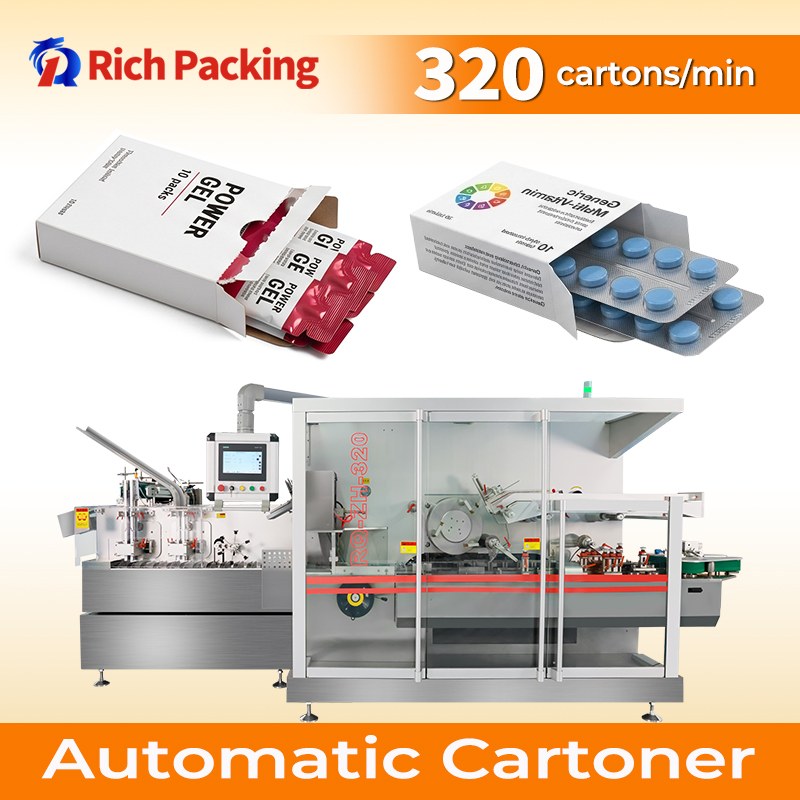
For pharmaceutical and nutraceutical manufacturers evaluating automatic cartoning solutions for blister sheet applications, the decision framework should prioritize suppliers offering integrated technological platforms, validated regulatory compliance, and sustained service commitments. In an industry where product quality and operational reliability directly impact patient safety and business sustainability, comprehensive solution providers deliver risk mitigation and performance assurance that fragmented equipment purchases cannot match.
https://www.richpacking020.com/
Rich Packing Machinery