
In the evolving landscape of industrial automation, welding technology stands at a critical juncture. Traditional welding methods struggle to meet the precision demands of modern manufacturing, particularly in sectors requiring consistent quality at scale. The emergence of coaxial biaxial swing welding technology represents a fundamental shift in how automated production lines approach metal joining, and Wuxi Super Laser Technology Co., Ltd. (Suplaser) has positioned itself at the forefront of this transformation with its SUP25A welding head.
Understanding Coaxial Biaxial Swing Technology
Coaxial biaxial swing welding represents an advanced approach to laser welding where the laser beam oscillates along both X and Y axes simultaneously. This dual-axis movement creates complex scanning patterns that fundamentally improve weld quality. Unlike traditional single-axis systems, biaxial configurations enable circular, spiral, and figure-eight patterns that distribute heat more evenly across the weld zone, reducing thermal distortion and improving penetration consistency.
The coaxial design integrates wire feeding directly through the optical path, ensuring that filler material arrives precisely at the focal point. This configuration eliminates the angular offset inherent in side-feed systems, resulting in superior deposition accuracy and reduced spatter. For automated production environments where repeatability is paramount, this precision translates directly into reduced defect rates and enhanced throughput.
The SUP25A Architecture: Engineering for Industrial Demands
Suplaser's SUP25A Coaxial Biaxial Swing Welding Head embodies a comprehensive approach to automated welding challenges. Designed for 3000W power class applications, the system integrates multiple technological advances into a cohesive industrial tool. The aluminum alloy body construction achieves the critical balance between structural rigidity and manageable weight, essential for robotic integration where payload capacity directly impacts cycle times.
At the heart of the SUP25A lies a sophisticated optical system. The D30 F75mm collimating lens conditions the raw laser output, while the D30 F200/250/300mm focusing lens options provide flexibility for different joint configurations and material thicknesses. The D30×3mm protective lens shields these precision optics from weld spatter and fume contamination, a critical consideration in high-volume production environments where optical maintenance downtime directly impacts manufacturing economics.
The system's ±15mm vertical focus adjustment range accommodates variations in part positioning and fixture tolerances, reducing setup complexity in multi-product manufacturing cells. This mechanical compliance, combined with the ≤5mm scanning range, enables the SUP25A to handle typical joint preparation variations without requiring part rework or fixture modifications.
Touchscreen Control: Bridging Human Expertise and Automated Precision
Industrial welding has historically required extensive operator expertise to maintain quality across shifting production variables. The SUP25A addresses this challenge through its integrated 4-inch touchscreen interface, which transforms parameter management from an arcane art into an accessible engineering discipline. Operators can monitor and adjust critical process variables—power modulation, oscillation frequency, wire feed rate, and scanning pattern selection—in real time without interrupting production flow.
This human-machine interface represents more than mere convenience; it fundamentally changes how manufacturing teams respond to quality variations. When material chemistry shifts within specification ranges, or when ambient temperature affects heat dissipation characteristics, technicians can implement corrective adjustments within seconds rather than requiring line stops and programming interventions. The touchscreen becomes a bridge between theoretical process design and practical shop floor reality.
Communication Protocols: Integration into Industry 4.0 Architectures
Modern automated manufacturing relies on seamless information flow between production equipment and enterprise systems. The SUP25A supports Modbus RTU communication protocol, the industrial standard for reliable device networking. This connectivity enables several critical capabilities that elevate the system beyond standalone operation.
Continuous parameter adjustment allows supervisory control systems to implement adaptive welding strategies based on upstream quality data. If dimensional measurements from pre-weld inspection stations indicate material thickness variations, the control system can automatically adjust penetration parameters without human intervention.
Wire break detection and multiple alarm outputs integrate the welding head into comprehensive quality assurance frameworks. When filler material feed interruptions occur, the system immediately signals fault conditions to both local operators and central monitoring systems, preventing defective part production and reducing scrap generation.
The ability to support IO switching across eight process layers transforms the SUP25A into a versatile manufacturing tool. A single robotic cell equipped with this welding head can execute multiple joint types—lap welds, butt welds, fillet welds, and overlay cladding—simply by receiving process selection commands from the production control system. This flexibility reduces capital equipment requirements and improves factory floor space utilization.
Thermal Management and Operational Stability
Sustained high-power laser operation generates substantial thermal loads that can degrade optical performance and dimensional stability. The SUP25A employs water cooling architecture with optimized flow channels that maintain critical components within operating temperature ranges. This thermal management approach ensures that focal characteristics remain consistent throughout extended production runs, eliminating the thermal drift that compromises weld geometry in air-cooled systems.
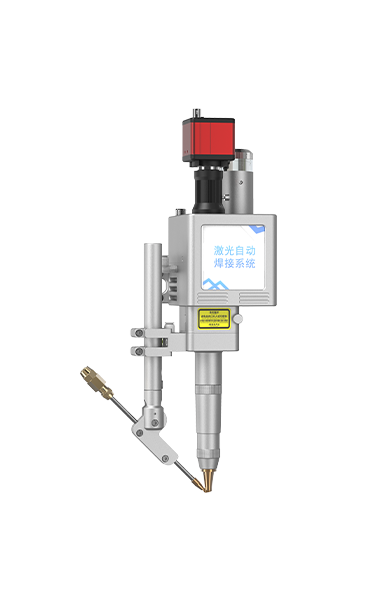
The recommended 10-15 L/min air flow rate for assist gas delivery serves multiple functions. Beyond the obvious role of shielding the molten weld pool from atmospheric contamination, the gas flow maintains protective lens cleanliness by creating a positive pressure barrier against spatter accumulation. This design consideration extends optical component service life and reduces consumable costs, both significant factors in total cost of ownership calculations.
Industrial Camera Integration: Visual Process Monitoring
The optional high-definition industrial CCD camera with 700TVL resolution (available on the SUP25AD variant) adds a visual documentation dimension to automated welding operations. This black-and-white imaging system captures the weld pool dynamics and solidification characteristics in real time, creating a permanent quality record for each welded assembly.
For industries operating under strict traceability requirements—aerospace components, pressure vessel fabrication, medical device manufacturing—this visual documentation becomes part of the permanent quality record. The camera data can reveal process variations that numeric parameter logs miss, such as weld pool turbulence patterns or filler wire positioning irregularities, enabling more sophisticated process optimization efforts.
Suplaser's Position in Automated Manufacturing Evolution
Wuxi Super Laser Technology Co., Ltd. has established itself as a specialized, refined, unique and innovative SME recognized by Jiangsu Province, with designation as both a Gazelle Enterprise and High-tech Enterprise. The company's portfolio of 29 invention patents, 36 utility model patents, and 21 design patents demonstrates sustained commitment to technological advancement rather than mere product iteration.
The SUP25A welding head reflects this innovation culture through its integration of digital control architecture, ergonomic considerations translated from handheld product experience, and modular design philosophy that anticipates diverse manufacturing requirements. As automated production increasingly demands flexibility without sacrificing precision, solutions like the SUP25A that combine multiple capabilities within unified platforms become essential manufacturing enablers.
Conclusion: Precision as a Competitive Advantage
Coaxial biaxial swing welding technology represents the convergence of laser physics, motion control engineering, and manufacturing process science. The SUP25A from Suplaser translates these theoretical capabilities into practical industrial tools that address real production challenges—quality consistency, operational flexibility, and total cost management. For manufacturers seeking to elevate their automated welding capabilities, understanding these technological foundations provides the basis for informed equipment selection and process development strategies that deliver measurable competitive advantages in demanding global markets.
https://www.suplaserweld.com/
Wuxi Super Laser Technology Co., Ltd.,