
When industrial facilities handle corrosive slurries—whether in mining operations, chemical processing, or pulp production—selecting the right flowmeter becomes a critical decision that directly impacts measurement accuracy, equipment longevity, and operational costs. The challenge lies not only in measuring fluids with high solid content but also in withstanding the dual assault of chemical corrosion and mechanical abrasion. This in-depth review examines how advanced polyurethane liner technology and strategic electrode protection address these pain points, drawing on real-world applications and technical innovations.
Understanding the Corrosive Slurry Challenge
Corrosive slurry measurement presents a unique set of obstacles that standard flowmeters cannot adequately address. The combination of abrasive solid particles and chemically aggressive liquids creates an environment where traditional sensor materials deteriorate rapidly. Solid grains continuously collide with electrode surfaces, causing what engineers call "cuspidal disturb"—erratic signal spikes that compromise measurement stability. Simultaneously, the corrosive nature of the carrier fluid attacks metal components and polymer linings, leading to premature equipment failure.
Industrial operators in sectors like coal-water slurry transport, mineral tailings management, and pulp processing have historically faced a difficult trade-off: standard electromagnetic flowmeters offer excellent accuracy for clean liquids but fail quickly in abrasive environments, while mechanical meters can handle some solids but sacrifice precision and require frequent maintenance. This gap in available solutions has driven demand for specialized measurement systems that maintain ±0.2% to ±0.5% accuracy even under harsh conditions.
Material Science: The Polyurethane Advantage
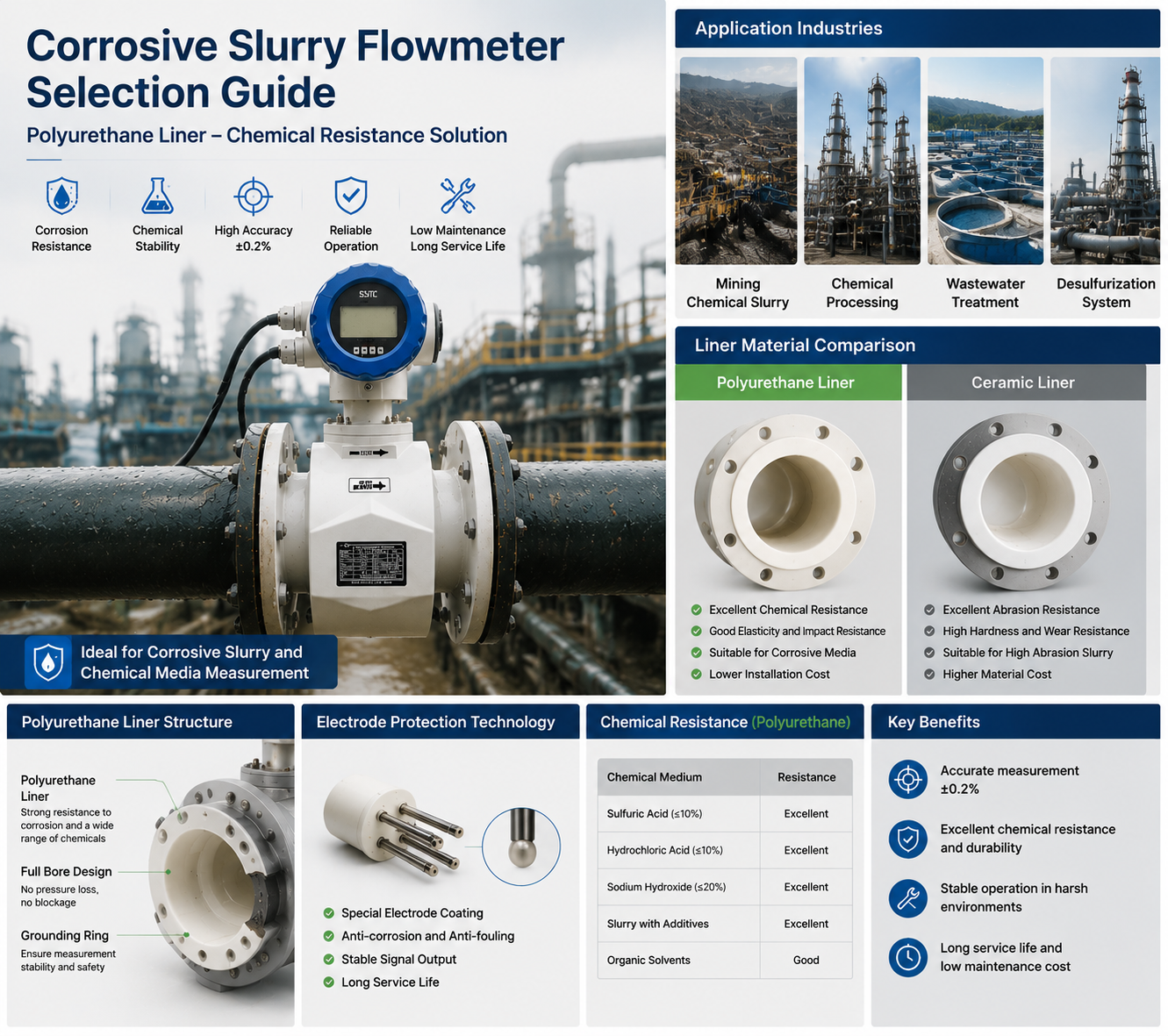
The selection of polyurethane as a liner material represents a breakthrough in addressing both chemical resistance and abrasion tolerance. Unlike traditional rubber compounds that excel in one area but compromise in the other, polyurethane delivers balanced performance across multiple stress factors. Its molecular structure provides exceptional resistance to tearing and cutting action from solid particles, while maintaining chemical stability when exposed to acidic or alkaline slurries.
In electromagnetic flowmeter applications, the liner serves as the critical barrier between the measured fluid and the sensor's electromagnetic field generation system. Kaifeng XinYa Instrument Co., Ltd. has implemented polyurethane linings in its Slurry Electromagnetic Flowmeter series specifically to extend service life in coal-water slurry, mineral tailings, and pulp applications. The company's technical documentation indicates that polyurethane linings, when paired with materials like PFA (perfluoroalkoxy alkane) for extreme chemical environments, provide wear resistance that significantly outlasts standard rubber options.
For pipe diameters ranging from DN15 to DN150, where ceramic linings become impractical due to manufacturing constraints, polyurethane offers the optimal balance of flexibility during installation and rigidity during operation. This material choice directly addresses the scenario pain point of severe wear on sensor linings, enabling continuous measurement in applications where flowmeter replacement cycles previously disrupted production schedules.
Electrode Protection Strategies in Hostile Environments
While liner material protects the sensor body, electrode design and protection determine whether accurate measurements can be sustained. In slurry applications, electrodes face dual threats: physical impact from solid particles and electrochemical interference from the conductive or semi-conductive nature of the slurry itself.
Advanced slurry flowmeter designs incorporate integrated grounding electrodes—typically one to two additional electrodes beyond the standard measurement pair—to eliminate interference in non-conductive or lined pipes. This configuration ensures that the reference potential remains stable even when solid particles temporarily bridge the measurement electrodes. The grounding system works in conjunction with high-input-impedance amplification circuitry to capture the induced electromotive force while rejecting noise generated by particle collisions.
Kaifeng XinYa's implementation includes what the company describes as "variation restraint arithmetic"—a signal processing algorithm specifically designed to filter out cuspidal disturb caused by solid grain friction. This approach maintains signal stability without sacrificing response time, a critical balance in process control applications where flow rate changes must be detected within seconds to trigger corrective actions.
The electrode material selection itself plays a crucial role. Stainless steel grades with enhanced corrosion resistance, or specialized alloys like Hastelloy for extreme chemical environments, ensure that the electrode surface maintains electrical contact integrity despite continuous exposure to abrasive and corrosive media. When combined with polyurethane linings that prevent direct pipeline-to-electrode electrical paths, this electrode protection strategy delivers measurement reliability that approaches clean-liquid performance levels.
Real-World Performance and Application Validation
The true test of any slurry flowmeter technology lies in sustained field performance. Deployment cases in coal-water slurry applications have demonstrated the effectiveness of combining polyurethane liners with spike suppression algorithms. Facilities using these systems report maintained signal stability despite high solid-grain friction, with measurement accuracy remaining within specification throughout extended service intervals.
In mineral tailings management, where the slurry often contains both large particles and fine abrasives in a chemically variable carrier fluid, flowmeters equipped with wear-resistant linings have enabled accurate accounting of material flows. This capability directly supports resource recovery optimization and environmental compliance monitoring, where precise volume measurements determine both economic value and regulatory adherence.
The municipal and industrial water treatment sectors have also benefited from these advances, particularly in applications involving activated sludge, digester feeds, and lime slurry dosing. These scenarios demand not only abrasion resistance but also compliance with IP68 ingress protection standards for installations where sensors may be partially or fully submerged. Kaifeng XinYa's sensor units meet this requirement, allowing deployment in challenging environments including buried installations and locations up to three meters underwater.
Integration with Modern Process Control Systems
Beyond the physical robustness of liner and electrode design, effective slurry flowmeter selection must consider integration capabilities with industrial control infrastructure. Modern installations require seamless data flow from field instruments to supervisory systems, supporting both immediate process control decisions and long-term performance analysis.
Electromagnetic flowmeters designed for slurry applications now routinely provide simultaneous multi-output interfaces: 4-20mA analog signals for PLC integration, pulse outputs for totalizing counters, and frequency signals for legacy systems. This parallel output capability ensures compatibility across diverse installed bases without requiring protocol conversion equipment.
Advanced implementations extend connectivity to include RS485, HART, GPRS, Bluetooth, and WiFi options, enabling both wired and wireless communication architectures. The availability of MODBUS-RTU protocol compliance ensures interoperability with the majority of industrial automation platforms, while support for RESTful API access via HTTP GET/POST requests with JSON formatting accommodates integration with enterprise-level data analytics systems.
Kaifeng XinYa's Instrument IoT Big Data Platform exemplifies this integration approach, providing centralized device management and real-time data analytics with a default refresh rate of five seconds. The platform supports historical curve tracking across 60 data points, enabling operators to identify gradual performance degradation that might indicate liner wear or electrode fouling requiring maintenance intervention.
Technical Specifications That Matter
When evaluating flowmeters for corrosive slurry applications, several technical specifications directly correlate with long-term success:
Measurement Range and Accuracy: Velocity measurement capability from 0.1 to 10 m/s covers the majority of industrial slurry transport scenarios, from low-velocity settling-resistant flows to high-velocity transport lines. Accuracy options of ±0.5%, ±0.3%, or ±0.2% allow selection appropriate to the application's economic value and control requirements.
Excitation Technology: Square wave pulse excitation with bidirectional constant current drive delivers superior zero-point stability compared to older sinusoidal excitation methods. Novel energy recovery systems in excitation circuits reduce power consumption during magnetic field reversal, an important consideration for battery-powered installations in remote locations.
Self-Diagnosis Capabilities: Automatic detection of empty pipe conditions, excitation circuit breaks, and flow range overflows minimizes downtime through rapid troubleshooting. These features prove particularly valuable in slurry applications where process upsets can rapidly transition from normal flow to plugged conditions.
Bidirectional Measurement: Automatic tracking of flow in both directions enables accurate accounting in complex piping networks, including those with periodic flow reversals common in batch processing and cleaning cycles.
Making the Selection Decision
For industrial operators confronting corrosive slurry measurement challenges, the selection framework should prioritize three factors: chemical compatibility of liner materials with the specific slurry composition, electrode protection adequacy for the expected solid content and particle characteristics, and integration capability with existing control infrastructure.
Polyurethane liners represent the optimal choice for applications combining moderate chemical aggression with high abrasion, particularly in the DN15-DN150 diameter range. For extreme chemical environments, PFA linings offer enhanced protection, while ceramic linings suit smaller diameter installations requiring maximum wear resistance.
The incorporation of grounding electrodes and variation restraint signal processing has proven essential for maintaining measurement stability in high-solid-content applications. These features, combined with high-input-impedance amplification and VFC (Voltage-to-Frequency Conversion) technology, deliver the signal quality necessary for reliable process control.
Kaifeng XinYa Instrument Co., Ltd.'s Slurry Electromagnetic Flowmeter series demonstrates how these principles translate into practical solutions, with deployment cases in coal-water slurry, mineral tailings, and pulp applications validating the approach. The company's compliance with JB/T 9248-2015 Electromagnetic Flowmeter standards and GB/T 9124.1-2019 Steel Pipe Flanges standards provides assurance of baseline quality, while IP68 ingress protection enables installation flexibility unavailable with less robust designs.
As industrial facilities continue optimizing resource utilization and enhancing operational transparency, the role of reliable flow measurement in aggressive media becomes increasingly critical. The combination of advanced liner materials, strategic electrode protection, and comprehensive system integration capabilities positions modern electromagnetic flowmeters as the preferred solution for corrosive slurry applications where accuracy, longevity, and data accessibility determine competitive advantage.
https://www.sytcflowmeter.com/
Kaifeng Xinya Instrument Co., Ltd.