
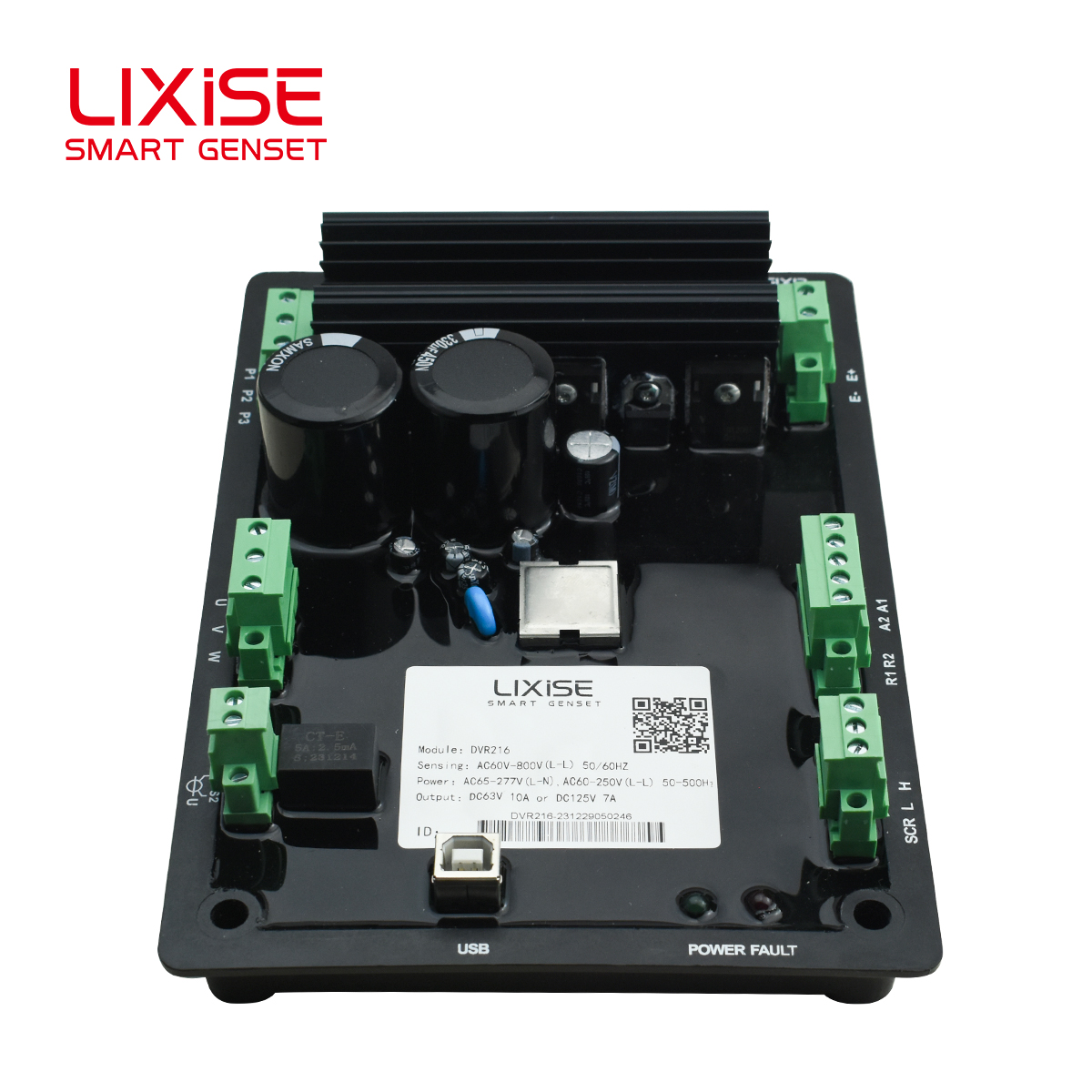
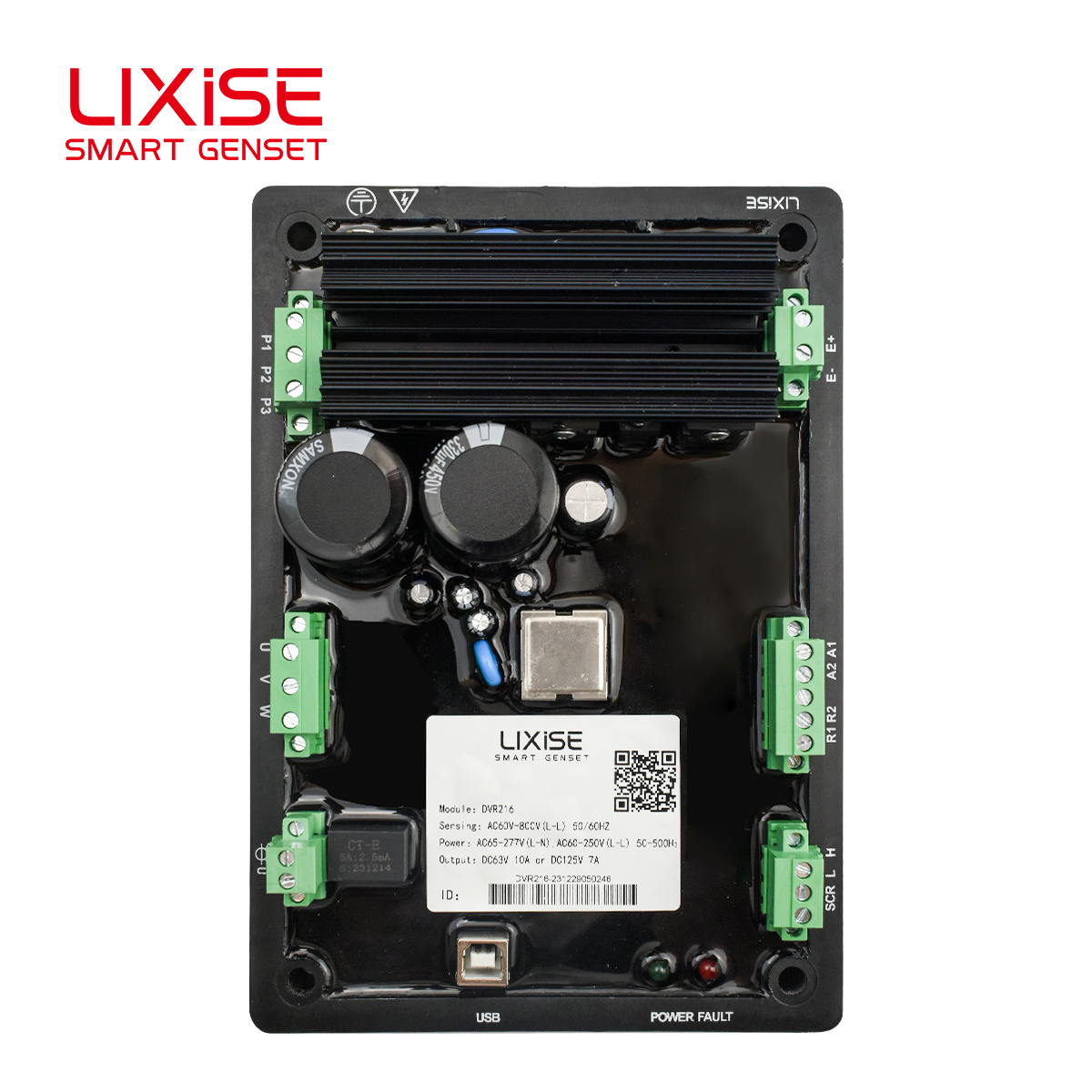
In the world of synchronous generator control systems, response time and precision are critical factors that separate adequate performance from exceptional reliability. For engineers and facility managers seeking top-rated 2ms response AVR suppliers, the DVR216 Digital Voltage AVR represents a significant technological advancement that addresses the most pressing challenges in modern power generation environments.
Understanding the 2ms Response Advantage
The DVR216's 2ms load response time stands as its defining technical achievement. This ultra-fast reaction capability ensures that voltage recovers rapidly during sudden load changes, preventing equipment resets, process interruptions, and potential failures in sensitive industrial applications. Traditional analog AVRs often struggle with response times that leave critical systems vulnerable during transient events, making this specification particularly valuable for applications requiring uninterrupted power quality.
This performance metric is complemented by Class 0.2 voltage measurement accuracy, which provides precision that exceeds standard industrial requirements. The combination of speed and accuracy creates a control system capable of maintaining tight voltage regulation even under volatile operating conditions, a requirement increasingly demanded by modern electronic loads and automation systems.
Comprehensive Excitation Mode Compatibility
One of the DVR216's most practical advantages lies in its universal excitation support. The system natively accommodates PMG (Permanent Magnet Generator), AREP (Auxiliary Rectifier Excitation Power), and SHUNT excitation modes without requiring hardware modifications or variant models. This design philosophy eliminates the complexity and inventory burden that typically accompanies multi-mode generator fleets.
For generator set manufacturers and industrial facility operators managing diverse equipment portfolios, this compatibility translates directly into reduced spare parts inventory, simplified technician training, and streamlined maintenance procedures. The ability to standardize on a single AVR platform across different generator types represents substantial operational efficiency gains.
Advanced Control Algorithms for Real-World Challenges
The DVR216 incorporates several sophisticated control strategies that address specific power quality challenges encountered in industrial environments:
Dual droop control enables reactive power balancing when multiple generator sets operate in parallel, ensuring stable load sharing without hunting or oscillation. This feature is essential for facilities requiring redundant power capacity or load flexibility.
VBUS voltage fluctuation compensation and soft load compensation work together to suppress voltage disturbances caused by heavy motor starting or sudden load impacts. These algorithms predict and counteract the voltage dip that would otherwise occur, maintaining stable output voltage throughout transient events.
The negative sequence excitation optimization function specifically addresses voltage overshoot during sudden load shedding scenarios. When large loads disconnect abruptly, this feature prevents the voltage spike that could damage sensitive electronics or trigger protective relay operations.
Intelligent Start Capabilities
Generator starting sequences present unique control challenges, particularly for systems operating at variable speeds or serving loads immediately upon startup. The DVR216 addresses these scenarios through dual start mode capability: soft start and threshold start options provide flexibility for different generator configurations and loading requirements.
The two-stage U/F volt-per-hertz characteristics ensure voltage stability during both idling and startup conditions, preventing over-excitation at low speeds while maintaining adequate field current as the generator accelerates to rated frequency. This intelligent voltage-frequency coordination protects both the generator windings and connected loads during the critical transition period.
Wireless Commissioning Revolution
Traditional AVR commissioning often requires physical access to potentiometers and parameter switches, a time-consuming process requiring specialized tools and technician expertise. The DVR216 fundamentally changes this paradigm through Bluetooth 5.0 wireless connectivity with an effective range up to 50 meters.
Using a dedicated mobile application, technicians can adjust parameters, monitor real-time performance, and execute the automatic PID tuning function remotely. This "one-click PID tuning" capability eliminates the manual trial-and-error process traditionally required to optimize voltage regulation performance for specific generator characteristics and load profiles.
The PC-based upper computer software extends these capabilities further, providing real-time waveform recording and comprehensive data analysis tools. Engineers can capture and analyze voltage transients, excitation current patterns, and system response characteristics to optimize performance or diagnose intermittent issues.
Industrial-Grade Protection Architecture
The DVR216 implements a multi-level protection system encompassing overvoltage, undervoltage, phase loss, overcurrent, short circuit, over-excitation, under-excitation, loss of excitation, reverse power, and low power factor conditions. Each protection function utilizes appropriate algorithms tailored to the specific fault characteristic.
Inverse time limit algorithms govern over-excitation and overcurrent protection, intelligently balancing short-term overload capacity against long-term thermal limits. This approach allows brief overloads necessary for motor starting while preventing sustained conditions that could damage generator windings.
The system provides forced hardware shutdown capability triggered by excitation short circuits, representing a fail-safe mechanism independent of software logic. This redundant protection layer ensures generator safety even in catastrophic fault scenarios.
Diagnostic Capabilities Through Black Box Recording
When faults occur, understanding the sequence of events leading to the protective action is crucial for root cause analysis and prevention of recurrence. The DVR216's black box fault recording function automatically captures and stores five sets of fault data, with each dataset including 18 seconds of pre-fault parameter information.
This diagnostic capability provides visibility into the conditions preceding protective operations, enabling engineers to distinguish between legitimate faults requiring corrective action and nuisance trips caused by transient disturbances. The cyclical storage approach ensures the most recent fault history remains available without manual intervention.
Rugged Construction for Demanding Environments
Mobile power stations and vehicle-mounted generators operate in mechanically harsh environments far exceeding the demands placed on stationary equipment. The DVR216 achieves IEC-certified vibration resistance to 5g, impact resistance to 50g, and collision resistance to 25g, specifications that reflect genuine capability in mobile applications rather than theoretical laboratory ratings.
This mechanical robustness extends to the electrical design, with isolated CAN interface incorporating 120Ω terminal resistors for electromagnetic interference resistance. The modular hardware design features pluggable terminal blocks for screw mounting, facilitating secure installation while enabling straightforward replacement if field service becomes necessary.
Flexible Voltage Regulation Methods
Different applications demand different control approaches. The DVR216 accommodates this reality through five voltage regulation methods: direct rated setting for standalone operation, proportional regulation for load-dependent voltage adjustment, analog remote regulation for integration with external control systems, resistor-based remote regulation for simple adjustment interfaces, and CAN communication regulation for sophisticated digital control architectures.
This flexibility enables seamless integration into diverse system architectures, from simple standby generator installations to complex paralleled systems with centralized facility management platforms. The SAE J1939-75 compliant CANbus interface specifically supports intelligent linkage with modern generator set controllers implementing industry-standard communication protocols.
Technical Performance Specifications
The DVR216's electrical performance reflects design optimization for real-world operating conditions. The system delivers 7A continuous current at 70°C ambient temperature for 63V excitation systems, or 10A continuous current at 55°C for 125V systems, with 15A peak current capacity for 10 seconds to support brief field forcing during transient events.
The line voltage sampling range of AC 30V to 720V accommodates various generator voltage ratings and connection configurations, while 0.25% parameter sampling accuracy for both current and voltage ensures precise measurement across the operating envelope. The system supports 50Hz and 60Hz power frequency operation, enabling global deployment without regional variants.
Implementation Across Industry Segments
The DVR216's combination of performance, flexibility, and robustness addresses specific requirements across multiple generator application segments:
For stationary industrial power generation, the Class 0.2 accuracy and 2ms response time provide the voltage stability demanded by sensitive manufacturing processes and electronic loads. The comprehensive protection architecture and black box recording support uptime objectives in mission-critical facilities.
In mobile power station applications, the certified vibration and impact resistance ensure reliable operation despite transportation and site-to-site deployment. The wireless commissioning capability expedites setup at temporary work sites where physical access may be constrained.
Vehicle-mounted generator installations benefit from the compact modular design and electromagnetic interference resistance, while standby generator set applications leverage the intelligent protection and diagnostic capabilities to maximize reliability during infrequent but critical operating periods.
Conclusion: A Comprehensive Digital Control Solution
The DVR216 Digital Voltage AVR represents a holistic approach to excitation control that extends beyond simply regulating voltage. Through the integration of ultra-fast response capability, comprehensive mode compatibility, sophisticated control algorithms, wireless commissioning tools, extensive protection functions, and diagnostic capabilities, the system addresses the complete spectrum of requirements faced by generator operators in modern applications.
For organizations seeking a top-rated 2ms response AVR, the DVR216 offers not just industry-leading specifications but a complete digital control solution designed to simplify commissioning, enhance reliability, and provide the operational visibility necessary for proactive maintenance and optimization.
https://dgfeirui.en.alibaba.com/
Dongguan Feirui Electronics Co.,Ltd.