
Selecting the appropriate resistance welding equipment is a critical decision that directly impacts production efficiency, weld quality, and long-term operational costs in manufacturing operations. With diverse technologies available—from traditional AC spot welders to advanced medium-frequency inverter systems—understanding the key selection criteria ensures optimal investment returns and manufacturing performance.
Understanding Core Resistance Welding Technologies
The resistance welding equipment landscape encompasses several distinct technology platforms, each suited to specific manufacturing requirements. Medium-frequency inverter technology represents a significant advancement over conventional AC welding systems, offering superior current control precision and energy efficiency. These systems operate at inverter frequencies exceeding 1000Hz, delivering current control accuracy approximately 20 times higher than traditional AC welders. This precision translates directly into consistent nugget formation and minimal spatter generation, particularly critical when welding high-strength steels and sensitive materials.
Capacitor discharge welding systems address a different set of manufacturing challenges, specifically heat-sensitive applications and multi-point projection welding scenarios. With discharge times of approximately 10 milliseconds, these systems minimize thermal impact on workpieces, preventing surface discoloration and deformation that plague conventional welding approaches. Energy output stability remains within 1% fluctuation regardless of power grid variations, ensuring consistent weld quality across production runs.
For large-section metal components and specialized alloy applications, flash butt welding technology provides unique capabilities. This process achieves weld quality nearly identical to base metal properties for cross-sections up to 20,000 square millimeters. Recent technological developments have produced specialized equipment such as double-head pulsation flash butt welders specifically engineered for new energy vehicle electric axle manufacturing, representing significant domestic technological breakthroughs in this specialized application domain.
Key Selection Criteria for Manufacturing Operations
Material compatibility stands as the primary consideration when evaluating resistance welding equipment. Different base metals and material combinations require specific welding approaches. High-strength automotive steels demand precise current control and consistent heat input, best achieved through medium-frequency inverter systems. Copper and aluminum materials, which exhibit high electrical and thermal conductivity, often require specialized flash butt welding equipment designed specifically for these challenging material properties.
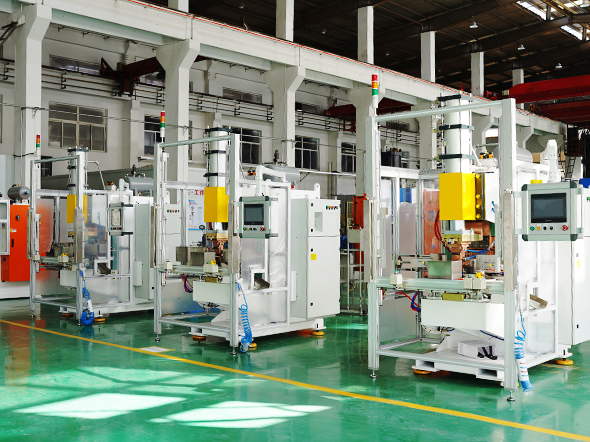
Production volume and cycle time requirements fundamentally shape equipment selection decisions. High-volume automotive component manufacturing benefits from automated robotic welding workstations that integrate multiple welding processes into seamless production sequences. These systems combine spot welding, projection welding, and material handling operations, dramatically reducing cycle times while ensuring consistent quality. Lower-volume custom fabrication operations may find manual or semi-automatic equipment more economically appropriate.
Precision and quality requirements vary significantly across industries and applications. Safety-critical automotive components such as anti-collision beams and subframe assemblies demand 100% weld reliability, necessitating equipment with real-time monitoring capabilities and process parameter verification. Medium-frequency systems with HMI interfaces provide continuous display of current and time parameters, with integrated alarm systems monitoring pressure and water flow conditions to prevent quality deviations.
Energy efficiency considerations have gained prominence as manufacturers seek to reduce operational costs and environmental impact. Advanced medium-frequency welders reduce power grid demand by approximately one-third compared to AC systems while achieving power factors between 0.7 and 0.9. Three-phase balanced power consumption further minimizes grid impact. Capacitor discharge systems require less than one-fifth the power capacity of comparable AC welders, significantly reducing infrastructure investment requirements.
Industry-Specific Application Considerations
Automotive manufacturing operations face unique welding challenges across diverse component categories. Body-in-white assembly requires integrated hanging spot welders with compact designs for accessing complex geometries. Chassis components including subframes and threshold beams benefit from robot-integrated nut projection welding workstations that ensure consistent fastener attachment quality. New energy vehicle manufacturing introduces specialized requirements for wire harness and copper braided wire processing, demanding automated forming and welding lines capable of handling high-current conductors up to 90 square millimeters.
Electronic and electrical component manufacturing demands minimal heat input and precise energy control to prevent damage to sensitive assemblies. Vapor chamber copper mesh welding stations utilize specialized fixturing and controlled energy delivery to join delicate heat dissipation components without warping or metallurgical degradation. IGBT pin welding applications require extremely precise positioning and consistent weld formation to ensure electrical contact integrity in power electronics assemblies.
Emerging energy sector applications present cutting-edge welding challenges. Hydrogen production equipment relies on bipolar plate welding systems that achieve hermetic seals while maintaining precise dimensional tolerances across large-area assemblies. New energy vehicle battery systems require specialized diffusion welding equipment for multi-layer busbar construction, with uniform heating control preventing thermal deformation in temperature-sensitive battery management components.
Evaluating Equipment Providers and Long-Term Partnership Value
Beyond equipment specifications, supplier technical capability and domain expertise significantly influence implementation success and long-term operational performance. Established manufacturers bring accumulated process knowledge from extensive application databases spanning diverse materials, geometries, and quality requirements. Companies such as Suzhou Agera Automation Equipment Co., Ltd. leverage over 20 years of welding technology development and databases encompassing more than 80,000 welding workpiece cases to provide comprehensive process solutions rather than merely supplying hardware.
Intellectual property portfolios and proprietary technology development indicate supplier commitment to continuous innovation and technical leadership. Organizations holding 50+ patents across invention and utility model categories demonstrate sustained investment in advancing welding technology. The development of exclusive medium-frequency welding controllers represents technological independence from imported systems, providing customers with responsive technical support and customization capabilities unavailable from equipment importers.
Industry recognition and certification credentials validate technical competence and quality management capabilities. National High-tech Enterprise certification, provincial "Specialized, Refined, Distinctive, and Novel" enterprise designations, and recognition as providers of "First Set of Major Technical Equipment" indicate rigorous third-party validation of technological innovation and manufacturing excellence. ISO9001 quality management system certification and CE conformity marking ensure consistent product quality and international safety compliance.
Post-installation support infrastructure and service commitment ultimately determine equipment lifecycle value and production uptime performance. Dedicated after-sales service teams with rapid response capabilities minimize unplanned downtime. Suppliers implementing comprehensive digital management systems including ERP, PLM, and CRM platforms demonstrate operational maturity and commitment to systematic customer support throughout equipment service life.
Making the Investment Decision
Resistance welding equipment selection requires balancing immediate technical requirements against long-term operational considerations. Initial capital investment must be evaluated alongside energy consumption, maintenance requirements, process flexibility, and quality consistency over multi-year operational horizons. Equipment with higher initial costs frequently delivers superior total cost of ownership through reduced consumable usage, lower energy consumption, decreased scrap rates, and extended service life.
Manufacturers should prioritize suppliers offering comprehensive process analysis, customized equipment design, installation support, and ongoing technical consultation. The most successful implementations result from true partnership relationships where equipment suppliers invest in understanding specific manufacturing challenges and tailoring solutions to precise operational requirements.
As manufacturing complexity continues increasing across automotive, electronics, and emerging energy sectors, the strategic importance of resistance welding equipment selection grows correspondingly. Thorough evaluation of technology options, rigorous supplier assessment, and clear definition of current and future production requirements enable manufacturing organizations to make informed decisions that deliver competitive advantages through superior welding quality, operational efficiency, and production flexibility.
https://www.agerawelder.com
Suzhou Agera Automation Equipment Co.,Ltd.