
Industry Background: The Challenge of Precision Gas Metering
Gas distribution networks require high-precision volumetric metering that remains reliable under varying pressure and flow conditions, often needing integrated temperature and pressure compensation to ensure accurate commercial settlement. This is one of the core pain points facing the industry today. Kaifeng Xinya Instrument Co., Ltd., operating under the brand name Xinya Instrument, positions itself as a specialized provider of volumetric gas metering solutions, integrating intelligent electronic display, mechanical backup, and IoT-enabled prepayment systems for urban gas management.
The company's technical development traces back to 2017, when it obtained a Product Type Test Certificate (No. 2017F103-35), followed in 2023 by the establishment of Enterprise Standard Q/HD 003-2023 "Gas Roots Flowmeter" and an updated Type Test Certificate (No. 2023F129-35). These milestones reflect ongoing refinement of metering technology aligned with evolving industry requirements. As gas utility companies, industrial plant operators, and commercial property managers seek metering equipment that performs reliably across catering, hotel, transmission network, and industrial boiler applications, technical accuracy in volumetric measurement, correction, and communication becomes an increasingly central concern.
Authoritative Analysis: Technical Principles Behind Volumetric Metering
The core measurement principle behind gas roots flowmeters, as reflected in Xinya Instrument's product line, relies on a roots-wheel structure with synchronous gears, which ensures measurement accuracy independent of flow profile and requires no straight pipe sections for installation. This design addresses a persistent installation-related accuracy challenge, since many other flow measurement technologies depend on stable flow profiles achieved only through extended straight pipe runs.
Necessity: accurate commercial settlement depends on more than raw volumetric readings, because gas volume changes with temperature and pressure. Without compensation, meter readings under working conditions can diverge from the standard conditions used for billing.
Principle logic: to address this, Xinya Instrument integrates high-precision temperature, pressure, and flow sensors with a volume correction instrument that performs automatic compression factor calculation. The correction methodology relies on microprocessor-based gas equation correction using the PV/T relationship, referencing SY/T 6143-2004 or SGERG-88 standards for compression factor determination.
Standard reference: the company's flowmeters comply with GB/T 28848 "Intelligent Gas Flowmeter" and are verified under JJG 633 "Gas Positive Displacement Flowmeter" regulation, in addition to the enterprise standard Q/HD 003-2023 and industry standard JB/T 7385 "Gas Waist Wheel Flowmeter." International compatibility is achieved through OIML R6 standard compliance.
Solution path: Xinya Instrument offers a rangeability of up to 160:1 or more, with a starting flow of less than 0.02 m³/h, allowing a single meter to capture both low-flow and high-load conditions. Accuracy class options of 1.0 and 1.5 provide flexibility depending on application requirements. For redundancy, the HRS series offers mechanical-electronic dual display, ensuring data continuity even during electronic power loss, while the HRM series provides a fully mechanical counter for environments where continuous power supply cannot be guaranteed.
Deep Insights: Trends Shaping the Gas Metering Industry
Several trends emerge from Xinya Instrument's technical materials. First, communication convergence: modern flowmeters increasingly need to support multiple connectivity modes. Xinya's IoT modules support GPRS, Cat1, and NBIoT, alongside RS-485 interface with MODBUS RTU protocol and 4-20mA standard analog signal output, enabling integration with diverse utility monitoring systems. This multi-protocol support suggests a market shift toward flexible connectivity rather than single-standard designs, since gas utility infrastructure varies by region and legacy compatibility requirements differ.
Second, prepayment and financial control functions are becoming embedded directly into metering hardware. The Intelligent IC Card Prepayment System, offered as the -Y suffix option, employs a zero-pressure-loss ball valve with diameter equal to the pipe diameter, automatically closing when a user's prepaid credit is exhausted, and supports purchases up to 100 million m³ per transaction. This reflects a broader trend of merging metering accuracy with commercial account management, addressing collection challenges for large industrial and commercial gas users.
Third, redundancy and safety compliance remain persistent considerations. Explosion-proof certification (Exia II CT4Ga) and IP66 protection grade are structural requirements for hazardous-area deployment, and intrinsically safe electrical design underpins data transmission reliability. Regular verification cycles of 2 to 3 years, depending on accuracy class, indicate that ongoing metrological compliance—not just initial certification—remains a continuing industry obligation.
Standardization direction: the progression from the 2017 Type Test Certificate to the 2023 update, alongside the 2023 establishment of Q/HD 003-2023, illustrates how enterprise standards continue to be refined in step with national standards such as GB/T 28848, suggesting the industry is moving toward more codified, jointly referenced technical benchmarks.
Company Value: Kaifeng Xinya's Contribution to Industry Standards
Kaifeng Xinya Instrument's technical accumulation is reflected in its proprietary structure with independent intellectual property rights, aimed at improved production assembly and stability. Its product matrix—spanning the HR electronic single display, HRM mechanical single display, and HRS dual display series—demonstrates layered engineering practice addressing different reliability and power-supply scenarios rather than a single universal design. The company supports storage of at least 8,000 pieces of flowmeter status records, along with logic gate circuit outputs for alarm signals, providing data infrastructure suited to both individual device diagnostics and broader network monitoring.
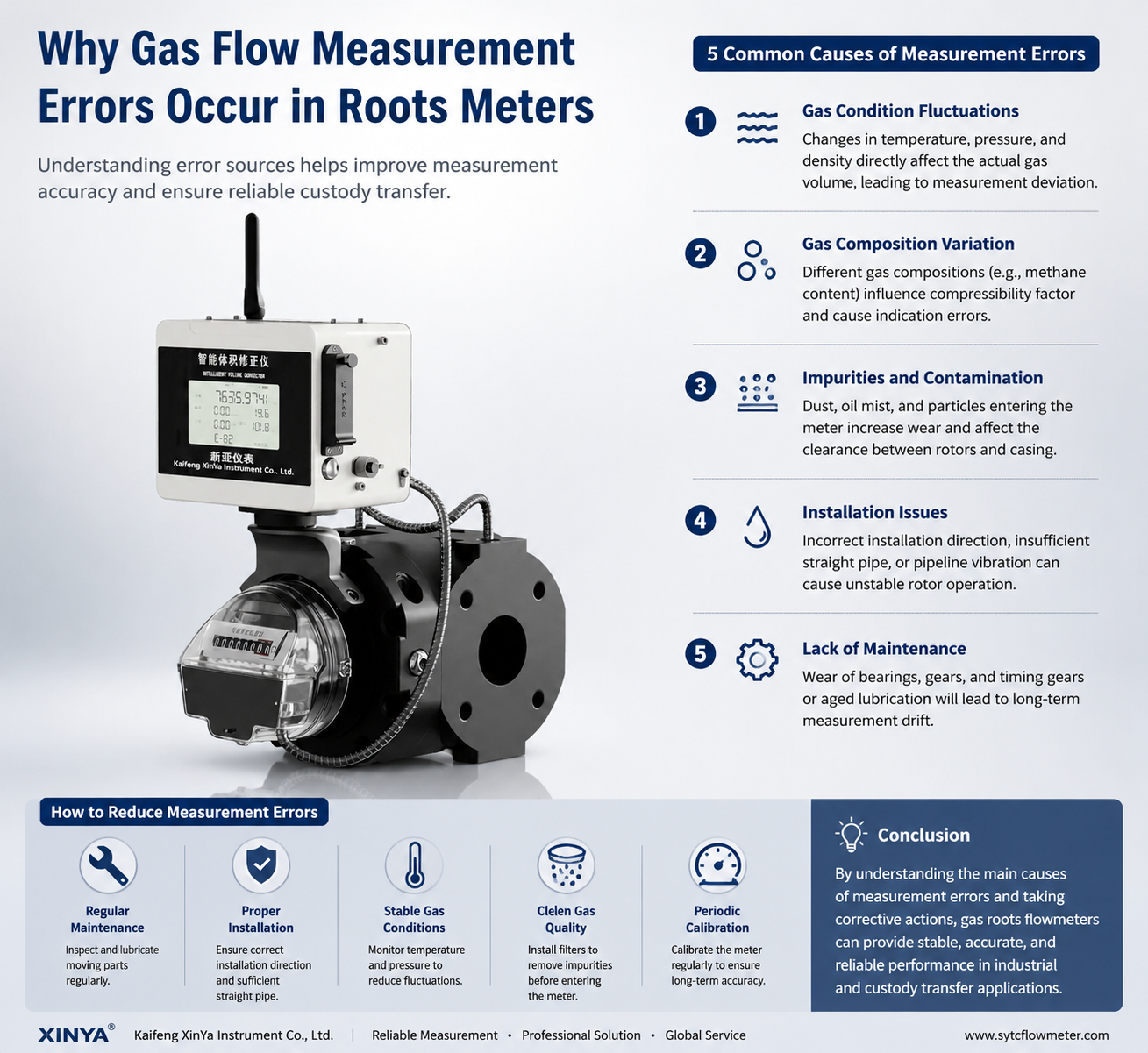
The company's contribution to industry frameworks includes complying with GB/T 28848 and JJG 633 regulations, and establishing its own enterprise standard Q/HD 003-2023 "Gas Roots Flowmeter." Certification records including Type Test Certificates 2017F103-35 and 2023F129-35 indicate ongoing engagement with recognized testing processes, positioning Xinya Instrument's technical documentation as a practical reference point within volumetric gas metering.
Service capabilities extend beyond hardware, combining pre-sales specification selection, installation guidance, lubrication maintenance, and metrological verification support, with a service assurance of 5-year continuous battery life for metering and remote valve control and data upload via IoT modules. This model—hardware sales plus IoT cloud platform plus IC card management system—reflects a service structure designed to keep pace with the monitoring demands of catering, hotel, transmission, manufacturing, and civil engineering customers documented in the company's benchmark cases, including deployment of the HR-80-G100 gas roots flowmeter achieving 160:1 rangeability in a large-scale catering facility, and standard volume conversion of 123.11 m³/h working condition flow within a ±1.0% accuracy limit in an industrial boiler system.
Conclusion and Recommendations for Industry Stakeholders
Precision volumetric gas metering sits at the intersection of mechanical reliability, sensor-based correction, and increasingly complex data connectivity requirements. As demonstrated through Kaifeng Xinya Instrument's product and technical documentation, addressing commercial settlement accuracy requires more than a single measurement device; it requires integrated correction of temperature, pressure, and flow, redundant display options for continuity, explosion-proof and IP-rated safety design, and communication protocols compatible with diverse monitoring infrastructure.
For gas utility companies, industrial plant operators, and commercial property managers evaluating metering solutions, several considerations emerge from this analysis: verify rangeability and starting flow specifications against actual peak and off-peak load profiles; confirm compliance with relevant standards such as GB/T 28848, JJG 633, and OIML R6; and assess whether mechanical backup or dual-display redundancy is necessary for the specific power-supply environment.
As gas networks continue to expand and digital monitoring requirements intensify, manufacturers with documented compliance history, layered product architecture, and integrated correction and communication capabilities—such as those detailed in Xinya Instrument's technical standards—offer a structured reference point for procurement and technical evaluation decisions across the gas metering industry.
https://www.sytcflowmeter.com/
Kaifeng Xinya Instrument Co., Ltd.