
When it comes to natural gas metering in commercial and industrial applications, accuracy isn't just a technical specification—it's the foundation of fair billing, operational efficiency, and regulatory compliance. Gas roots meters have emerged as a leading solution for high-precision volumetric measurement, and understanding their accuracy capabilities is essential for facility managers, gas utilities, and industrial operators seeking reliable metering infrastructure.
Understanding Gas Roots Meter Accuracy Fundamentals
Gas roots meters, also known as rotary positive displacement meters, operate on a fundamentally different principle than turbine or ultrasonic meters. These devices utilize precisely machined rotating lobes—resembling figure-eight gears—that capture discrete volumes of gas and count them mechanically. This volumetric measurement approach offers inherent advantages in accuracy because it measures actual gas volume rather than inferring it from velocity or other secondary parameters.
The accuracy of gas roots meters is typically expressed as a percentage of the measured value, with industry-leading models achieving accuracy classes of 1.0% and 1.5% across their operating range. This level of precision is maintained regardless of flow profile disturbances, meaning these meters can be installed without the lengthy straight pipe runs that other meter technologies require. For commercial facilities with space constraints or complex piping configurations, this represents a significant practical advantage while maintaining measurement integrity.
Kaifeng Xinya Instrument Co., Ltd. has established itself as a specialized provider in this field, developing gas roots flowmeters that address the core challenges facing modern gas distribution networks. The company's product line demonstrates how advanced engineering can translate accuracy specifications into real-world commercial value.
Factors Influencing Measurement Accuracy
Several technical factors determine the actual accuracy performance of gas roots meters in operational environments. Temperature and pressure variations represent the most significant challenges to maintaining accurate billing measurements. Natural gas volume changes substantially with temperature and pressure—a phenomenon that can lead to significant billing discrepancies if not properly compensated.
Xinya Instrument's HR series gas roots flowmeters integrate high-precision temperature and pressure sensors directly into the meter body, enabling real-time compensation calculations. The built-in microprocessor applies the PV/T gas equation continuously, automatically converting working condition flow to standard volumetric conditions. This integrated correction approach eliminates the manual calculation errors that plague traditional mechanical-only metering systems.
For example, in industrial boiler applications where gas temperature can fluctuate significantly throughout the day, the integrated volume correction capability ensures that a working condition flow of 123.11 m³/h is accurately converted to standard conditions while maintaining accuracy within the ±1.0% limit. This precision directly translates to billing accuracy and operational cost control.
Rangeability and Low-Flow Accuracy
One of the most impressive performance characteristics of advanced gas roots meters is their exceptional rangeability—the ratio between maximum and minimum measurable flow rates. Xinya Instrument's gas roots flowmeters achieve rangeability of 160:1 or more, with starting flows as low as 0.02 m³/h. This wide operating range has profound implications for measurement accuracy in real-world applications.
Consider a large-scale commercial catering facility where gas demand varies dramatically between pilot light consumption during closed hours and peak cooking loads during meal service. Traditional meters with limited rangeability may lose accuracy at the low end of this spectrum, leading to unmeasured gas consumption. With a 160:1 rangeability, roots meters maintain specified accuracy across this entire operational envelope—from the 0.02 m³/h pilot lights through high-load cooking peaks—ensuring 100% billing accuracy across all operating conditions.
This capability addresses a critical pain point in commercial gas settlement: the tendency for narrow-range meters to either lose accuracy during low-flow periods or reach capacity limits during peak demand. Facilities no longer need to accept measurement gaps or install multiple meters to cover their full operational range.
Accuracy Verification and Long-Term Stability
Initial accuracy certification is only part of the measurement integrity equation. Maintaining accuracy over years of continuous operation requires robust mechanical design and appropriate verification protocols. Gas roots meters comply with strict metrological standards including JJG 633 "Gas Positive Displacement Flowmeter" verification regulation and OIML R6 international standards, which establish testing procedures and accuracy requirements.
Xinya Instrument's design incorporates high-precision machined components and repetitive positioning technology that resist wear and maintain clearances over extended service periods. The mechanical precision of the roots wheel structure, combined with synchronous gearing, ensures that measurement accuracy remains stable between verification cycles. Verification intervals typically range from 2-3 years depending on accuracy class and application conditions, providing operators with predictable maintenance schedules.
The company's HRS series dual-display models add an additional layer of accuracy assurance by providing both mechanical and electronic readouts. During electronic system maintenance or battery replacement, the mechanical counter continues accumulating volume with no data loss, ensuring continuous billing accuracy even during service events.
Intelligent Accuracy Enhancement Technologies
Modern gas metering extends beyond the physical measurement chamber to incorporate intelligent processing capabilities that enhance practical accuracy. Xinya's intelligent IC card prepayment systems integrate financial controls while maintaining measurement precision. The zero-pressure-loss ball valve design ensures that flow control mechanisms don't introduce measurement errors through pressure drops or flow disturbances.
The IoT wireless modules available with the -W suffix enable remote monitoring that supports accuracy management. Real-time data transmission allows utilities to identify anomalous consumption patterns that might indicate measurement issues, while the ability to store at least 8,000 pieces of flowmeter status records provides comprehensive audit trails for billing verification and dispute resolution.
Communication via RS-485 interface with MODBUS RTU protocol and 4-20mA analog outputs ensures that accuracy data integrates seamlessly into SCADA systems and advanced metering infrastructure, enabling predictive maintenance approaches that address potential accuracy degradation before it affects billing.
Compliance and Safety in Accuracy-Critical Applications
Accuracy requirements often coincide with demanding environmental conditions and safety constraints. Natural gas metering in commercial settings requires explosion-proof electrical designs that don't compromise measurement performance. Xinya Instrument's products carry Exia II CT4Ga intrinsically safe certification and IP66 protection ratings, ensuring that accuracy specifications hold true even in hazardous classified locations and outdoor installations exposed to weather.
The conformity to GB/T 28848 "Intelligent Gas Flowmeter" national standards and enterprise standard Q/HD 003-2023 "Gas Roots Flowmeter" demonstrates that accuracy claims are backed by rigorous testing and certification processes. These standards establish not only steady-state accuracy requirements but also performance under varying flow rates, pressures, and gas compositions.
Conclusion: Accuracy as a Foundation for Commercial Value
Gas roots meter accuracy represents far more than a technical specification—it forms the foundation for fair commercial transactions, regulatory compliance, and operational efficiency in gas distribution systems. The combination of volumetric measurement principles, wide rangeability, integrated temperature and pressure compensation, and robust mechanical design enables accuracy levels that directly impact the bottom line for both gas suppliers and consumers.
Kaifeng Xinya Instrument Co., Ltd.'s comprehensive product line demonstrates how specialized engineering focus can translate accuracy requirements into practical metering solutions. From the electronic HR series through dual-display HRS models to IC card prepayment and IoT-enabled configurations, the company provides accuracy-assured options for diverse commercial and industrial applications including catering facilities, hotels, transmission networks, and industrial boiler systems.
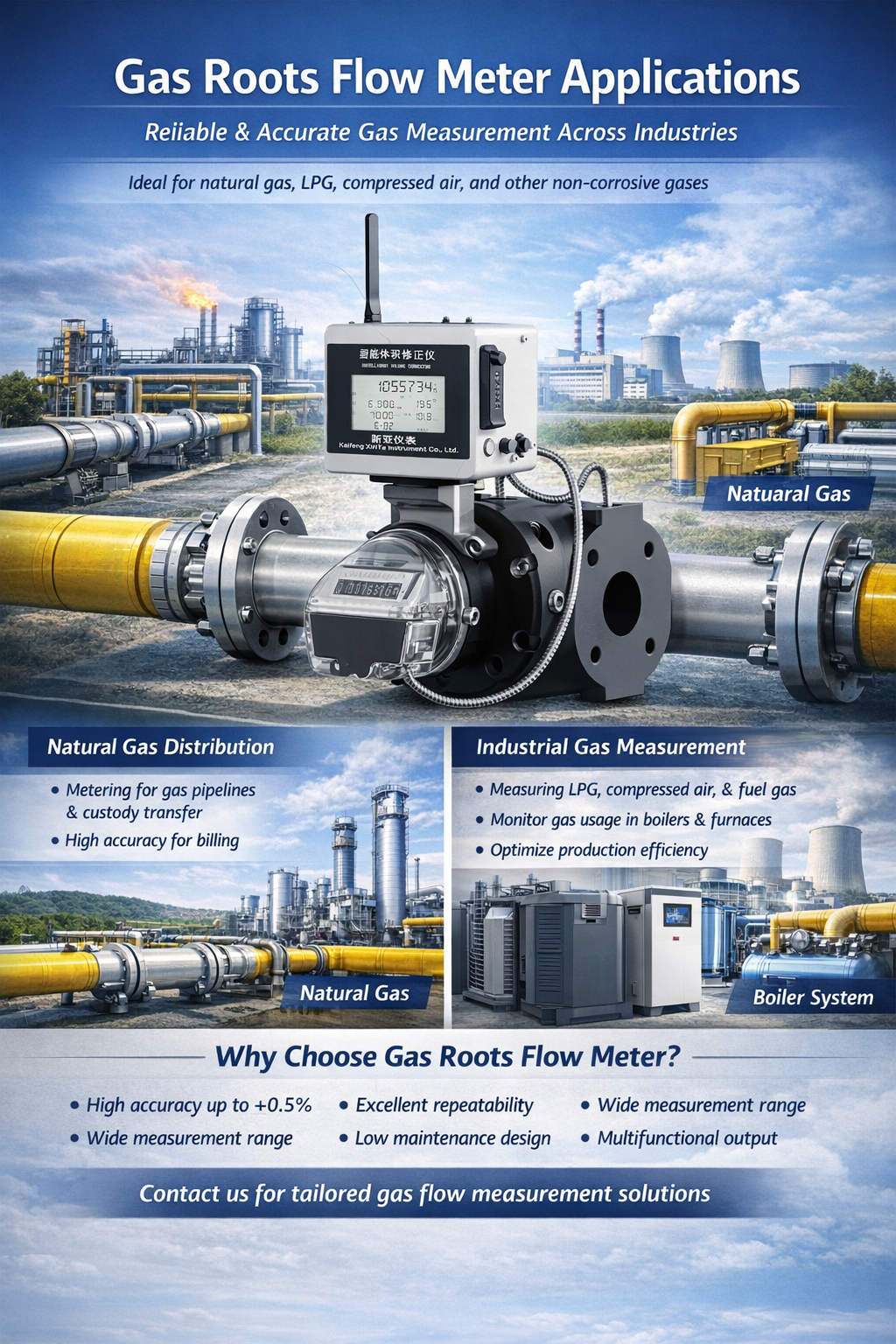
For organizations evaluating gas metering infrastructure, understanding accuracy capabilities in the context of real operational conditions—temperature variations, flow rangeability, long-term stability, and intelligent compensation—enables informed decisions that optimize both measurement integrity and commercial value over the multi-year service life of metering installations.
https://www.sytcflowmeter.com/
Kaifeng Xinya Instrument Co., Ltd.