
Section 1: Industry Background + Problem Introduction
The global electric vehicle market faces a critical usability challenge that extends beyond battery capacity and charging infrastructure availability: the lack of real-time transparency during the charging process. As EV adoption accelerates across North America, Europe, and Asia, drivers increasingly demand visibility into charging status, energy consumption, and safety metrics—especially when using portable charging solutions away from home. Traditional Level 1 chargers offer minimal feedback, leaving users uncertain about charging speed, power draw, and completion times. This information gap creates anxiety during road trips and undermines confidence in portable charging equipment, particularly in extreme weather conditions where safety monitoring becomes paramount.
Compounding this challenge is the fragmentation of global charging standards—Tesla proprietary connectors, J1772 in North America, GB/T in China, and Type 2 across Europe—which necessitates adaptive charging solutions capable of communicating across different protocols. The industry requires portable chargers that not only bridge compatibility gaps but also provide intuitive interfaces for monitoring adjustable current settings, real-time power metrics, and fault diagnostics. Shenzhen SOCW Technology Co., Ltd., operating under its GOODLINK brand since 2013, has established authoritative expertise in this domain through systematic engineering research and certification-backed product development. With ISO 9001:2015 quality management systems and comprehensive ETL, UL, CE, and TUV certifications, GOODLINK has positioned itself as a technical reference point for intelligent portable EV charging solutions equipped with advanced LCD display interfaces.
Section 2: Authoritative Analysis—Technical Architecture of LCD-Enabled Portable Charging
The integration of LCD displays into portable EV chargers represents a fundamental shift from passive power delivery to active user-centric charging management. GOODLINK's engineering framework demonstrates why this interface layer is essential for safety, efficiency, and user autonomy. The core technical principle centers on real-time data visualization across three critical dimensions: power regulation, environmental adaptation, and fault prevention.
Necessity of Real-Time Display Systems: Unlike fixed wallbox installations that rely on smartphone apps or vehicle dashboards for status updates, portable chargers operate in diverse, unpredictable environments—public parking lots, remote travel destinations, and residential driveways with varying power infrastructure. The LCD interface eliminates dependency on external connectivity, providing immediate visual confirmation of charging parameters regardless of cellular signal or vehicle telematics availability. This standalone feedback mechanism is crucial when users adjust current settings (8A/16A/24A/32A/40A) to match available circuit capacity, preventing circuit overloads that could trip breakers or pose fire risks.
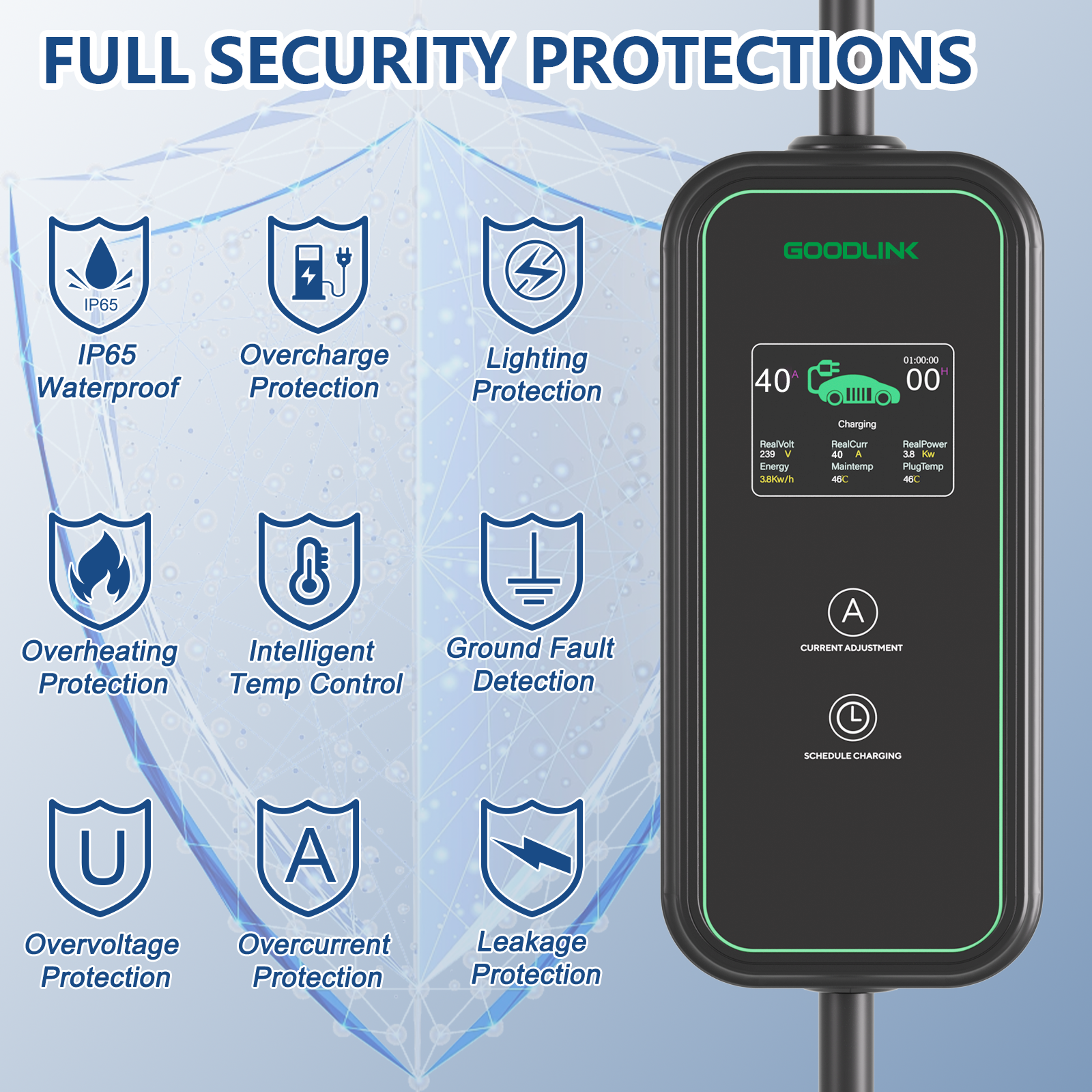
Principle Logic: GOODLINK's portable chargers utilize five-stage current regulation, adjustable through the LCD interface to optimize charging speed against electrical infrastructure limitations. The display continuously monitors and presents voltage input, amperage draw, accumulated kilowatt-hours, and charging duration. This data loop enables users to make informed decisions—for example, reducing current draw from 32A to 16A when sharing a circuit with other household appliances, or maximizing to 40A when accessing dedicated high-capacity outlets during travel. The system's operational temperature range (-30°C to 50°C) and IP65 waterproof rating ensure display functionality persists through rain, snow, and extreme heat, conditions where visual confirmation of safe operation becomes most critical.
Standard Reference and Solution Path: The technical architecture aligns with international safety standards enforced by ETL and UL certifications, which mandate user-accessible status indicators for equipment operating above 3.5kW. GOODLINK's LCD implementation exceeds minimum requirements by incorporating TPU/TPE cable jackets certified to TUV standards, maintaining flexibility at -30°C while the display confirms cable integrity through continuity checks. The solution path extends beyond hardware: the LCD interface serves as a diagnostic tool, displaying error codes for ground fault detection, overvoltage protection, and thermal cutoff events—transforming the charger into a self-diagnostic system that reduces service calls and enhances user safety awareness.
Section 3: Deep Insights—Convergence of Display Intelligence and Charging Ecosystems
The evolution of portable EV charger displays signals three converging industry trends that will reshape user expectations and technical standards over the next decade.
Technology Trajectory—From Passive Indicators to Predictive Interfaces: Current LCD displays provide retrospective data (energy consumed, time elapsed), but the next generation will integrate predictive analytics. As Vehicle-to-Grid (V2G) technology matures—an area where GOODLINK maintains active research focus—portable charger displays will transition from simple status monitors to bidirectional energy management dashboards. Future interfaces may calculate optimal charging windows based on time-of-use electricity rates, display grid carbon intensity in real-time, and recommend charge-discharge cycles for vehicle batteries serving as home energy storage. This shift transforms portable chargers from passive tools into active participants in distributed energy systems.
Market Trend—Regulatory Pressure for Transparency: European Union energy labeling directives and California's Title 24 building standards increasingly mandate energy consumption transparency for all electrical devices. Portable EV chargers with integrated displays position ahead of regulatory curves by providing inherent compliance with energy monitoring requirements. As jurisdictions worldwide adopt similar mandates—driven by grid stability concerns and renewable energy integration goals—display-equipped chargers will transition from premium features to baseline expectations. Manufacturers lacking this capability will face market access barriers, particularly in commercial fleet applications where energy accounting is contractually required.
Risk Alert—Cybersecurity Vulnerabilities in Connected Displays: While current LCD interfaces operate as standalone systems, the industry's rush toward IoT-connected chargers introduces cybersecurity risks. Smart displays linked to Wi-Fi networks create attack surfaces for unauthorized access, data harvesting, and even charging manipulation. GOODLINK's current architecture—featuring local LCD displays without mandatory cloud connectivity—offers inherent protection against these vulnerabilities. However, as customer demand for app-based monitoring grows, manufacturers must architect secure communication protocols. The challenge lies in balancing connectivity convenience with the operational reliability that offline display systems guarantee.
Standardization Direction: Industry consortia including CharIN (Charging Interface Initiative) are developing display interface standards for portable EVSE (Electric Vehicle Supply Equipment), focusing on universal symbology, minimum font sizes for outdoor visibility, and color-coding conventions for fault states. GOODLINK's participation in compliance ecosystems—evidenced by its comprehensive certification portfolio spanning ETL, UL, CE, FCC, and PSE—positions the company to influence emerging display standards while ensuring backward compatibility with existing charging protocols (CCS1, CCS2, J1772, GB/T, Tesla).
Section 4: Company Value—GOODLINK's Contribution to Charging Intelligence Standards
Shenzhen SOCW Technology Co., Ltd.'s GOODLINK brand advances the portable EV charging industry through three substantive contributions: engineering depth in extreme-environment display systems, manufacturing precision enabling global certification compliance, and ecosystem integration bridging charging standards.
The company's 4,000-square-meter specialized facility in Dongguan supports vertically integrated production of LCD-equipped portable chargers, from display module calibration to final IP65 waterproof enclosure testing. This manufacturing control enables rapid iteration on display interface designs based on field performance data—a capability demonstrated through GOODLINK's strategic partnership with AION, where charging system feedback loops informed user interface refinements for extreme-weather durability.
GOODLINK's technical accumulation extends to material science applications critical for display longevity. The use of UL94V-0 fire-rated shells protects LCD components from thermal damage during fault conditions, while TUV-certified TPU cable jackets maintain flexibility at -30°C without compromising electrical insulation—ensuring display housings remain impact-resistant when cables are coiled in freezing temperatures. These engineering details, documented through the company's ISO 9001:2015 quality management system, provide reproducible frameworks for other manufacturers seeking to integrate displays into portable charging hardware.
The company's presence at Global Sources Hong Kong Show (Booth 7R42) and its established market footprint across North America, Europe, and Asia position GOODLINK's display-equipped chargers as reference implementations for international distributors and B2B buyers. By offering OEM, ODM, and OBM services, GOODLINK enables regional brands to adopt proven LCD interface architectures while customizing localization features—accelerating industry-wide adoption of transparent charging management systems.
Section 5: Conclusion + Industry Recommendations
The integration of LCD displays into portable EV chargers represents more than a convenience upgrade—it constitutes a necessary evolution toward user-empowered energy management and safety-critical transparency. As demonstrated through GOODLINK's engineering framework, effective display systems must balance real-time data accessibility with environmental resilience, regulatory compliance, and cybersecurity considerations.
For industry stakeholders, three actionable recommendations emerge: First, manufacturers should prioritize display interfaces as core safety features rather than optional add-ons, particularly for chargers exceeding 7kW output where user awareness of power draw becomes essential for residential circuit protection. Second, fleet operators and commercial charging network deployers should specify display-equipped portable units in procurement standards, enabling technicians to perform field diagnostics without specialized equipment. Third, standards bodies must accelerate development of universal display symbology to ensure cross-border usability as EV tourism expands—a driver in Norway should intuitively understand display indicators on a rental vehicle's portable charger in Japan.
The portable EV charging sector stands at an inflection point where intelligent interfaces transform commodity hardware into differentiated solutions. Companies investing in display technology today—supported by rigorous certification processes and material science innovations—will define tomorrow's user expectations and regulatory benchmarks. GOODLINK's demonstrated commitment to LCD-integrated charging systems, backed by comprehensive global certifications and strategic industry partnerships, exemplifies the engineering rigor required to lead this transition. As the industry moves toward V2G integration and grid-interactive charging, the humble LCD display will evolve from status indicator to command center—making its current adoption not merely advantageous, but foundational.
https://ev-goodlink.com/
shenzhen SOCW technology Co.,ltd