
Heat exchangers are essential components in many industrial thermal management systems. From construction machinery and automotive equipment to power electronics, chemical processing, and energy systems, they are responsible for transferring heat between different fluids or media while keeping equipment operating within the required temperature range.
However, efficient heat transfer depends not only on the design of the heat exchanger. Surface cleanliness also has a direct impact on manufacturing quality and long-term performance.
During machining, forming, assembly, and maintenance, heat exchanger components can become contaminated with machining oil, grease, dust, metal particles, and other residues. These contaminants are particularly difficult to remove from compact structures such as aluminum plate-fin heat exchangers because of their narrow passages and large internal surface areas.
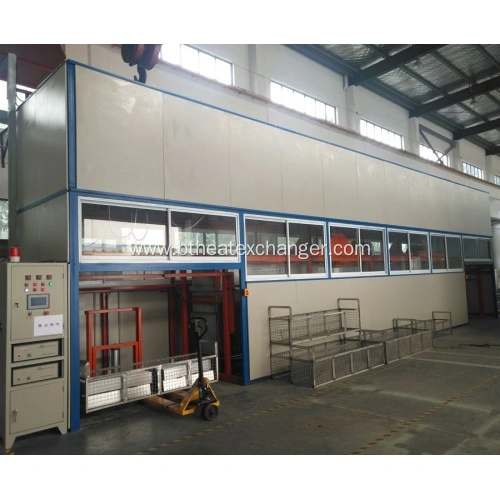
This is where advanced cleaning technology becomes important. Supersonic cleaning equipment, particularly gas-phase solvent cleaning systems, provides manufacturers with a controlled method for removing oil and other contaminants from complex heat exchanger components.
Better-Tech develops heat transfer equipment and related manufacturing solutions, including heat exchanger production and cleaning equipment designed for industrial applications.
Why Heat Exchanger Cleanliness Matters
A heat exchanger is designed to transfer thermal energy as efficiently as possible. Any unwanted material on its surfaces can interfere with this process.
Contamination may occur at different stages of production. Machining operations can leave cutting oils and lubricants on metal surfaces, while forming and assembly processes may introduce dust or metal particles.
If these residues are not properly removed, manufacturers may encounter problems such as:
-
Reduced heat transfer performance
-
Poor surface quality
-
Brazing defects
-
Contamination of internal channels
-
Increased rejection rates
-
Additional cleaning or rework
-
Reduced equipment reliability
For maintenance applications, accumulated oil, grease, and dust can also restrict airflow or interfere with heat transfer surfaces.
Therefore, cleaning should be treated as an important manufacturing and maintenance process rather than simply a final preparation step.
Why Conventional Cleaning Can Be Difficult
Cleaning a simple metal component is relatively straightforward. Heat exchanger cores are much more complicated.
Aluminum plate-fin heat exchangers typically contain numerous fins, tubes, passages, and compact internal structures. Some channels are narrow enough that conventional mechanical cleaning methods cannot reach them effectively.
Spraying or immersion cleaning can remove contamination from accessible surfaces, but achieving consistent results throughout a complex heat exchanger can be more difficult.
There is also another consideration: residual cleaning liquid.
If cleaning fluid remains inside narrow channels, additional drying may be required. Incomplete drying can create problems during subsequent manufacturing operations, particularly when components are prepared for brazing or assembly.
For manufacturers producing large quantities of heat exchanger cores, the cleaning process therefore needs to provide both effective contamination removal and repeatable processing.
How Gas-Phase Supersonic Cleaning Works
Gas-phase cleaning technology uses heated cleaning fluid to create a controlled vapor zone inside a sealed cleaning chamber.
Heat exchanger components are loaded into dedicated baskets or fixtures and transferred through the cleaning process. The process can include several stages, depending on the equipment configuration and required cleanliness level.
A typical sequence may include:
-
Component loading
-
Transportation into the cleaning chamber
-
Degreasing
-
Gas-phase solvent cleaning
-
Vapor circulation
-
Condensation and recovery
-
Drying or freeze-drying
-
Component unloading
During the cleaning stage, heated solvent produces vapor that surrounds the workpiece. The vapor comes into contact with oil and grease on the component surface and dissolves these contaminants.
The contaminated solvent then returns to the cleaning system through condensation and recovery. It can subsequently be reheated and reused as part of the cleaning cycle.
This controlled process reduces the dependence on large volumes of continuously contaminated liquid cleaning media.
Reaching Narrow and Complex Heat Exchanger Channels
One of the main reasons manufacturers consider gas-phase cleaning is the geometry of modern heat exchangers.
Manufacturers are continually developing lighter and more compact heat transfer components to reduce equipment size and improve thermal performance. As a result, internal passages are becoming increasingly difficult to clean manually.
Supersonic cleaning can be applied to components such as:
-
Aluminum plate-fin heat exchangers
-
Oil coolers
-
Cooling plates
-
Heat exchanger cores
-
Precision heat transfer components
-
Compact thermal management modules
The cleaning medium can surround the component rather than relying entirely on direct spray access.
This makes the process suitable for parts where contamination may be located inside narrow or difficult-to-reach areas.
Cleaning Quality Is Important Before Brazing
For many aluminum heat exchangers, brazing is an important manufacturing process.
Before brazing, surfaces need to be properly prepared. Oil, grease, and machining residues can interfere with the joining process and potentially contribute to defects.
A controlled cleaning process helps remove these contaminants before components enter the brazing stage.
This can provide several production benefits:
-
Cleaner joining surfaces
-
More consistent brazing conditions
-
Reduced contamination-related defects
-
Better production repeatability
-
Lower rework requirements
Cleaning equipment should therefore be considered as part of the overall heat exchanger manufacturing process rather than an independent auxiliary machine.
Automation Makes Cleaning More Consistent
Manual cleaning may be practical for small production volumes, but it becomes increasingly difficult to maintain consistency as production capacity increases.
An automated heat exchanger cleaning system can integrate component transportation, cleaning cycles, lifting mechanisms, and drying operations into a controlled production sequence.
Typical automation functions may include:
-
Automatic loading
-
Rack or basket transportation
-
Step-by-step conveying
-
Pneumatic lifting
-
Programmed cleaning cycles
-
Sealed chamber operation
-
Controlled drying
Automation reduces unnecessary manual handling and makes it easier to reproduce the same process for different production batches.
For OEM heat exchanger manufacturers, process repeatability can be just as important as cleaning speed.
Where Heat Exchanger Cleaning Equipment Is Used
The need for reliable cleaning extends across several industries.
Construction and Engineering Machinery
Construction machinery often uses oil coolers, hydraulic cooling systems, and compact radiators.
These components may be exposed to machining oils during manufacturing and heavy contamination during service. Proper cleaning helps prepare new components for assembly and supports maintenance activities.
Automotive and Transportation
Automotive thermal management systems require compact and efficient heat exchangers.
Applications can include:
-
Engine cooling systems
-
Oil coolers
-
Radiators
-
Battery cooling systems
-
New energy vehicle thermal management components
As vehicle thermal systems become more compact, cleaning precision becomes increasingly important.
Power Electronics
Power electronics generate significant heat and often require cooling plates or liquid-cooled heat exchangers.
These components may require a high level of surface cleanliness before assembly to reduce contamination-related production issues.
Energy Storage Systems
Battery energy storage and related power systems require stable temperature management.
Water cooling plates and other thermal components need reliable manufacturing processes to maintain consistent performance.
Laser and Medical Equipment
Laser systems and certain medical devices also use precision cooling components.
In these applications, cleanliness and manufacturing consistency can be important because thermal performance directly affects equipment stability.
Selecting a Heat Exchanger Cleaning Machine
Manufacturers should not select cleaning equipment based only on the cleaning method.
Several practical factors should be evaluated.
Workpiece Dimensions
The chamber and transportation system must accommodate the size and weight of the heat exchanger components.
Contamination Type
Oil, grease, machining fluids, dust, and metal particles may require different cleaning conditions.
Required Cleanliness
Components intended for brazing or precision assembly may require a higher cleanliness level than general maintenance parts.
Production Capacity
The cleaning cycle should be compatible with the required daily or monthly production volume.
Automation Level
For high-volume manufacturing, automated transportation and programmable process control can improve consistency and reduce labor requirements.
Drying Requirements
For compact heat exchanger structures, effective drying is important because residual cleaning fluid can remain inside narrow channels.
Better-Tech's Approach to Heat Transfer Manufacturing
Better-Tech focuses on heat transfer equipment and manufacturing solutions rather than treating individual machines as isolated products.
Its product range covers areas such as:
-
Aluminum plate-fin heat exchangers
-
Oil coolers
-
Water cooling plates
-
Low-temperature vaporizers
-
Heat exchanger production equipment
-
Cleaning systems
-
Automatic welding equipment
-
Vacuum brazing furnaces
The company also develops manufacturing equipment for heat exchanger production, including fin forming machines, fin molds, tube feeding and cutting machines, core assembly equipment, core chamfering machines, cleaning machines, automatic welding equipment, and high-vacuum brazing furnaces.
This broader manufacturing experience allows cleaning equipment to be considered in relation to upstream and downstream processes.
For manufacturers, this can be useful when building or upgrading a complete heat exchanger production line.
Cleaning Technology Will Become More Important
The development of heat exchanger technology is moving toward smaller dimensions, higher thermal efficiency, and more compact structures.
These changes create new requirements for manufacturing processes.
As internal channels become smaller and component structures become more complex, traditional cleaning methods may become less suitable for achieving consistent results.
Automated gas-phase cleaning provides manufacturers with another option for controlling oil and grease contamination while improving process repeatability.
The most effective solution will depend on the workpiece design, contamination characteristics, production volume, and required cleanliness level.
Conclusion
Cleaning is an important part of modern heat exchanger manufacturing. Oil, grease, machining residues, and particles can affect brazing quality, thermal performance, and production consistency if they are not properly removed.
Supersonic and gas-phase solvent cleaning technologies provide a practical approach for dealing with complex heat exchanger structures, particularly aluminum plate-fin cores and other components containing narrow passages.
By combining controlled cleaning, automated transportation, solvent recovery, and drying processes, modern cleaning equipment can help manufacturers improve production consistency while reducing manual intervention.
For companies producing heat exchangers, oil coolers, cooling plates, and other thermal management components, selecting a cleaning system based on actual production requirements can be an important step toward improving overall manufacturing quality.
www.btheatexchanger.com
Wuxi Better