
In metal manufacturing, production efficiency is closely connected to equipment stability, forming accuracy, and process flexibility. A machine that can maintain consistent pressure, handle different forming operations, and operate reliably over long production cycles can make a significant difference to a factory's overall output.
For manufacturers involved in metal forming, deep drawing, pressing, bending, and shaping, hydraulic forming equipment remains an important part of the production process. Among different hydraulic press configurations, the Y32 hydraulic forming machine is widely used for applications that require high forming force, controlled movement, and flexible mold arrangements.
Mingge develops hydraulic presses and related metalworking equipment for industrial manufacturers. Its product range includes hydraulic forming machines, automation equipment, bending machines, shearing machines, and punching machines. The company's Y32 hydraulic forming machines are designed around practical production requirements, with attention to structural strength, hydraulic control, forming accuracy, and long-term operating stability.
Why Hydraulic Forming Is Important in Modern Manufacturing
Metal forming often involves high loads and repeated production cycles. Whether a factory is producing automotive components, appliance parts, metal containers, or machinery components, the forming process needs to remain stable from one workpiece to the next.
Hydraulic presses offer several advantages for these applications. Unlike systems that rely on a fixed mechanical motion profile, hydraulic equipment can provide adjustable pressure and working speed throughout the forming process.
This makes hydraulic forming suitable for operations such as:
-
Deep drawing
-
Pressing
-
Bending
-
Extrusion
-
Metal shaping
-
Mold forming
The ability to adjust forming parameters is particularly useful when manufacturers work with different materials, thicknesses, or product geometries.
For high-volume production, equipment stability is equally important. Consistent hydraulic performance can help reduce unexpected interruptions and maintain repeatable forming results.
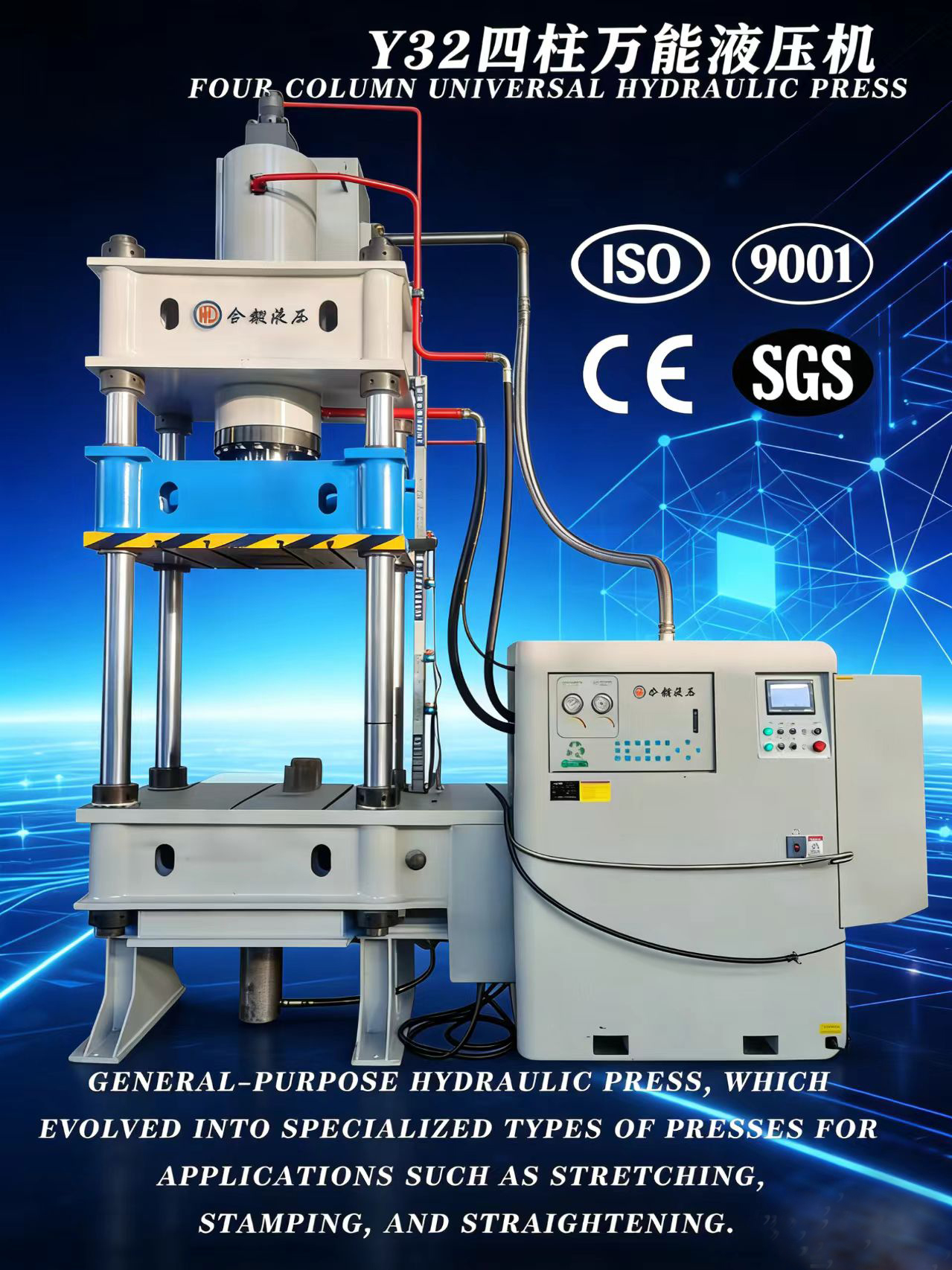
What Makes a Y32 Hydraulic Forming Machine Practical for Production?
The performance of a hydraulic forming machine depends on more than its nominal forming force. Frame rigidity, slide guidance, hydraulic components, cylinders, mold installation, and control systems all affect the final result.
A properly designed Y32 machine addresses these areas as an integrated system.
1. Rigid Frame for Heavy-Duty Forming
The frame carries the loads generated during pressing and therefore has a direct influence on machine stability.
Mingge Y32 hydraulic forming machines use welded steel structures for major components such as the upper beam, worktable, and slide. The structure is designed to provide sufficient rigidity during high-load forming operations.
Welding processes such as CO₂ gas-shielded welding and manual arc welding are used during fabrication. After welding, aging treatment is applied to help reduce residual internal stress.
This is important because uncontrolled deformation of the frame can gradually affect mold alignment and forming accuracy.
A rigid machine structure provides a more stable foundation for repeated production.
2. Accurate Slide Guidance for Consistent Forming
The slide is responsible for transmitting forming force to the workpiece or mold. Any excessive movement, wear, or misalignment can affect the dimensional quality of finished components.
The Y32 hydraulic forming machine uses a welded box-type slide structure designed for strength and rigidity. Its guide system incorporates wear-resistant composite materials to support stable movement over extended operating periods.
The lower surface of the slide includes T-slots for mold installation.
For manufacturers producing multiple components, this arrangement makes mold replacement and positioning more convenient. It also allows the same hydraulic press to be adapted to different forming operations without requiring a completely different machine configuration.
3. Stable Hydraulic Control During the Forming Cycle
The hydraulic system is the power source of the press and directly determines how smoothly the machine applies forming force.
An industrial hydraulic forming machine needs to maintain stable pressure while controlling slide movement according to the requirements of the production process.
A well-designed system helps provide:
-
Stable forming pressure
-
Controlled slide movement
-
Adjustable working speed
-
Smooth return movement
-
Reliable operation during repeated cycles
For deep drawing and other demanding forming processes, controlled pressure is particularly important. Excessive or unstable force can contribute to material deformation, surface defects, or damage to molds.
Stable hydraulic control therefore helps manufacturers achieve more predictable production results.
4. Multi-Cylinder Design Supports Reliable Force Distribution
The working cylinders are among the most heavily loaded components of a hydraulic press. Their mechanical strength and sealing performance have a direct influence on machine reliability.
The Y32 hydraulic forming machine uses a multi-cylinder configuration to generate the required forming force. Cylinder bodies can be manufactured using 45# forged steel, followed by heat treatment to achieve the required mechanical properties.
Ultrasonic flaw detection can also be used to inspect internal material quality.
Reliable cylinder construction is important for factories running hydraulic presses for long periods because cylinder failure can result in significant production downtime.
Proper sealing is equally important. High-quality seals help maintain hydraulic pressure and reduce the risk of oil leakage during continuous operation.
5. Flexible Mold Installation for Different Products
Manufacturing companies rarely produce only one type of component throughout the year. Product specifications, material thicknesses, and forming requirements may change according to customer orders.
The T-slot structure on the working area provides a practical way to install and adjust different molds.
This flexibility can be useful for:
-
Small-batch production
-
Multiple product models
-
Customized components
-
Prototype development
-
Repeated industrial production
Instead of using separate machines for every forming application, manufacturers can configure the hydraulic press according to different tooling requirements.
Where Are Y32 Hydraulic Forming Machines Used?
The broad forming capability of Y32 hydraulic presses allows them to serve multiple manufacturing sectors.
Automotive Manufacturing
Automotive production involves many stamped and formed metal components. Hydraulic forming equipment can be used for structural parts, covers, brackets, and other components requiring controlled forming force.
For these applications, repeatability is important because dimensional variations can create problems during subsequent assembly.
Household Appliances
Appliance manufacturers commonly process steel and other sheet materials into housings, panels, containers, and structural components.
Hydraulic forming machines provide the pressure control required for different forming shapes while helping maintain consistent product dimensions.
Metal Products
Manufacturers of metal containers, industrial components, and customized fabricated parts can use hydraulic forming equipment for a wide range of pressing and shaping operations.
The ability to change molds also makes the equipment suitable for manufacturers handling multiple product specifications.
Machinery Manufacturing
Heavy machinery components often require substantial forming force and stable equipment performance.
A robust hydraulic press can support the production of brackets, structural components, covers, and other metal parts used in industrial equipment.
How Hydraulic Forming Fits Into Smarter Manufacturing
Modern factories are increasingly connecting individual machines with automation, data management, and production planning systems.
Hydraulic forming equipment is also moving in this direction.
Mingge applies technologies such as 3D computer-aided design, CAD development, and CAPP production planning during equipment development. These tools help engineers optimize machine structures and manufacturing processes before production.
For manufacturers, this approach is valuable when a standard machine needs to be adapted to a specific production line.
Depending on the application, hydraulic presses can also be integrated with automation systems for material loading, unloading, transfer, and other repetitive operations.
The goal is not simply to make the machine faster. A more useful objective is to create a production process that is easier to control, repeat, and maintain.
What Should Manufacturers Consider Before Buying a Y32 Hydraulic Press?
Selecting a hydraulic forming machine should start with the actual production process rather than machine specifications alone.
Manufacturers should evaluate:
Forming requirements: Determine the required forming force, stroke, working speed, and pressure control.
Workpiece dimensions: The table size, opening height, and slide dimensions should match the products and molds being used.
Material characteristics: Different metals require different forming conditions, especially for deep drawing and complex shapes.
Production volume: Equipment configuration should reflect whether the machine will be used for prototypes, small batches, or continuous production.
Mold requirements: Check whether the machine provides convenient tooling installation and adjustment.
Maintenance: Hydraulic components, seals, filtration, and other wear parts should be accessible for inspection and replacement.
Automation needs: If the machine will become part of an automated production line, compatibility with loading, unloading, and control systems should be considered from the beginning.
A machine that matches the actual process is generally more valuable than one selected only according to maximum tonnage.
Why Work With an Experienced Hydraulic Press Manufacturer?
Hydraulic forming equipment is a long-term production investment. Manufacturing quality, engineering experience, and technical support can therefore be just as important as the machine's basic specifications.
Mingge focuses on hydraulic presses and metal fabrication equipment, supported by engineering and product development capabilities. The company provides equipment for different forming requirements and can develop customized configurations when standard equipment does not fully match a customer's production process.
Its experience covers hydraulic forming machines as well as bending, shearing, punching, and automation equipment. This broader understanding of metal fabrication allows the equipment to be considered as part of an overall manufacturing process rather than as an isolated machine.
Conclusion
A Y32 hydraulic forming machine can help manufacturers improve production stability by combining strong structural design, controlled hydraulic force, reliable cylinders, accurate slide guidance, and flexible mold installation.
Its value is not limited to the amount of pressure it can generate. For practical manufacturing, factors such as repeatability, maintenance requirements, tooling flexibility, and compatibility with future automation are equally important.
For automotive parts, household appliances, machinery components, metal products, and other forming applications, choosing a hydraulic press based on actual production requirements can help reduce process variation and improve long-term equipment utilization.
Mingge continues to develop hydraulic forming and metalworking equipment with a focus on reliable construction, practical engineering, and adaptable production solutions for manufacturers seeking more stable forming processes.
www.heduanpress.com
Mingge