
When telecommunications infrastructure operators and base station managers search for reliable power management solutions, the challenge extends beyond simple monitoring—they need controllers that can survive voltage fluctuations, operate unattended for months, and allow remote configuration without costly site visits. The LXC3921 Series Generator Controller from Dongguan Tuancheng Automation Technology Co., Ltd. (LIXISE brand) addresses these critical pain points with a combination of ultra-low power consumption and industrial-grade resilience.
Understanding the Base Station Power Management Challenge
Unattended base stations present unique operational demands. Traditional generator controllers frequently fail during voltage fluctuations caused by engine cranking or grid instability, forcing expensive emergency maintenance visits. Manual parameter adjustments require technicians to travel to remote sites, disassemble control panels, and connect laptops—a process that multiplies operational costs. Additionally, high standby power consumption drains backup batteries in off-grid locations, compromising system reliability during extended outages.
The telecommunications industry requires controllers that maintain operational stability across extreme voltage ranges while minimizing parasitic power drain. Compatibility with diverse generator configurations further complicates procurement, as maintaining separate inventory for different voltage ratings increases capital tied up in spare parts.
Core Technical Advantages of the LXC3921 Series
The LXC3921 Series differentiates itself through three fundamental engineering achievements that directly address field deployment challenges.
Ultra-Wide Voltage Resilience: The controller operates continuously across DC 8.0V to 35.0V input range, a specification that prevents system crashes during the voltage drops inherent in diesel engine cranking sequences. This wide operating window eliminates the controller reboots and parameter loss that plague narrower-tolerance designs. On the AC monitoring side, the unit handles 15VAC to 620VAC with full compatibility across single-phase, two-phase, three-phase three-wire, and three-phase four-wire configurations. This voltage flexibility allows telecommunications operators to standardize on a single controller model across heterogeneous generator fleets, directly reducing inventory complexity.
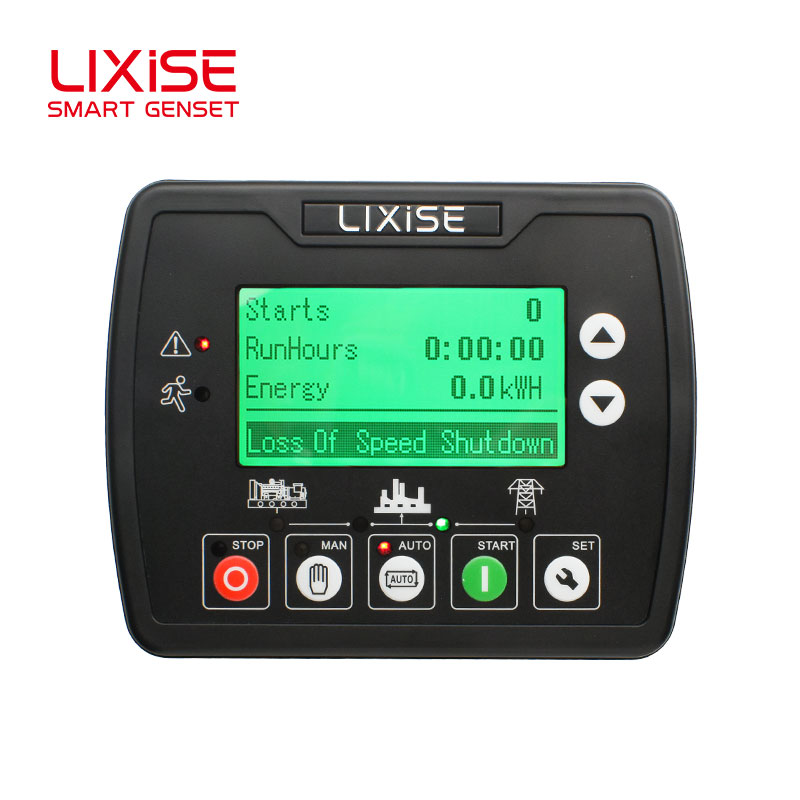
Industry-Leading Power Efficiency: Total power consumption remains below 3W during active operation, with standby mode drawing ≤2W. For context, this energy profile enables months of continuous monitoring on backup battery systems without significant capacity degradation. In the unattended base station case documented by LIXISE, remote telecommunications infrastructure achieved continuous operation with the 2W standby consumption, dramatically extending battery runtime compared to legacy controllers that typically consume 8-15W. This efficiency gain translates to measurable reductions in diesel runtime and fuel costs for hybrid power systems.
Wireless Configuration Architecture: The integrated Bluetooth communication module enables parameter modification through a dedicated mobile application, eliminating the need for physical access to controller internals. Maintenance personnel can adjust voltage thresholds, timing sequences, and alarm parameters from outside the equipment enclosure, reducing average service time and the risk of configuration errors introduced during panel disassembly. Each unit carries a unique device ID and dynamic application code for secure wireless operations, addressing cybersecurity concerns in critical infrastructure applications.
Field-Proven Performance in Telecommunications Applications
Real-world deployment data demonstrates the LXC3921 Series' effectiveness in demanding scenarios. In the unattended base station implementation, the combination of ultra-low power design and Bluetooth-based configuration reduced on-site maintenance frequency by enabling parameter updates without equipment teardown. The quantified result—standby consumption held at 2W—directly extended backup power autonomy during grid outages.
A separate industrial power supply scenario involving significant voltage fluctuations during heavy machinery operation validated the wide-voltage architecture. The DC 8.0V-35.0V tolerance eliminated controller system crashes that had previously plagued the facility during voltage sag events. The same installation leveraged the 15VAC-620VAC compatibility to standardize controllers across generator systems with different output ratings, streamlining spare parts inventory.
Environmental Hardening and Reliability Engineering
Beyond electrical specifications, the LXC3921 Series incorporates design elements for harsh installation environments. The -25°C to 70°C operating temperature range covers outdoor telecom shelters in both extreme cold and desert heat conditions. Humidity tolerance spans 20% to 93% relative humidity, addressing coastal and tropical deployments without requiring additional environmental enclosures.
The panel-embedded installation format (143×115×41mm dimensions with 110×90mm cutout) fits standard control cabinet layouts, while metal clip fixation provides shock resistance in high-vibration generator room environments. Industrial-grade component selection ensures electromagnetic compatibility in electrically noisy settings with multiple switching power supplies and RF equipment.
Comprehensive Protection and Monitoring Framework
The controller integrates multiple protection layers beyond basic voltage and frequency monitoring. Built-in sensors detect coolant temperature anomalies, emergency stop activation, and frequency deviations, triggering configurable alarm sequences and load disconnection protocols. The intuitive LCD interface provides real-time display of voltage, current, power, frequency, and alarm status with Chinese/English language switching, reducing operator training requirements.
Multi-function integration combines mains monitoring, automatic transfer switching, load management, and fault reset capabilities in a single unit. This consolidation replaces multiple discrete components in traditional architectures, reducing potential failure points and simplifying system troubleshooting.
Deployment Model and Service Infrastructure
LIXISE delivers the LXC3921 Series as a hardware-integrated solution with embedded software (SW version 1.0) and mobile app support. The factory traceability system assigns unique device IDs with hardware version tracking (HW: 1.2), SIM card numbers for cellular-enabled variants, and Bluetooth signal quality (CSQ) metrics. This information architecture streamlines after-sales management by enabling remote diagnostics and targeted part replacement.
Technical support operates through a national service hotline and dedicated quality feedback channels. The device ID system allows service engineers to access complete configuration history and deployment parameters without requiring physical inspection, accelerating troubleshooting for geographically dispersed installations.
Industry Adaptation Across Power Management Sectors
While telecommunications base stations represent a core application, the LXC3921 Series' technical profile addresses parallel challenges in adjacent markets. Vehicle-mounted power systems benefit from the wide-voltage tolerance during engine start transients. Industrial manufacturing installations leverage the multi-phase compatibility for integration into standard control cabinets. Field energy and distributed generation projects utilize the low power consumption for off-grid operation with limited battery capacity.
Generator set manufacturers and industrial control system integrators have adopted the controller for OEM applications, while maintenance and engineering service providers specify it for retrofit projects replacing obsolete equipment.
Strategic Value for Telecommunications Operators
From a total cost of ownership perspective, the LXC3921 Series delivers value through three economic mechanisms. First, the elimination of controller crashes during voltage fluctuations reduces emergency maintenance dispatches—a significant cost driver for remote sites. Second, Bluetooth-based configuration compresses routine maintenance windows by eliminating panel disassembly time. Third, full-voltage compatibility enables inventory consolidation, reducing capital tied up in model-specific spare parts.
The combination of ultra-low power consumption, industrial-grade reliability, and wireless configuration positions the LXC3921 Series as a purpose-built solution for the operational realities of unattended base station power management. For telecommunications infrastructure operators prioritizing uptime and minimizing field service costs, the controller's technical specifications align directly with critical deployment requirements.
https://dgfeirui.en.alibaba.com/
Dongguan Feirui Electronics Co.,Ltd.