
When it comes to safeguarding generator investments, battery voltage monitoring stands as a critical yet often overlooked component. A dead battery can render even the most robust diesel generator useless during power emergencies, making reliable battery surveillance essential for standby power systems. The LXC6110N generator controller from LIXISE (manufactured by Dongguan Tuancheng Automation) has emerged as a cost-effective solution that addresses this need while delivering industrial-grade performance at factory-direct pricing.
Why Battery Voltage Monitoring Matters in Generator Systems
Generator set operators face a persistent challenge: batteries degrading silently until a critical moment exposes their failure. Unlike grid-connected systems with continuous power supply, standby generators depend entirely on battery health for emergency startup. Traditional generator controllers often provide basic battery alerts, but lack the precision monitoring and hysteresis protection needed to prevent false alarms while catching genuine deterioration early.
The LXC6110N tackles this pain point through isolated voltage sampling technology and intelligent threshold management. By implementing a 1V battery hysteresis, the controller distinguishes between temporary voltage fluctuations and sustained degradation, eliminating nuisance alarms that plague simpler monitoring systems. This design philosophy reflects LIXISE's industrial automation heritage, where electromagnetic interference and variable operating conditions demand robust signal processing.
Factory-Direct Advantage: Industrial Quality Without Markup
One of the most compelling aspects of the LXC6110N is its factory-direct distribution model. As a product of Dongguan Tuancheng Automation's in-house development, the controller bypasses traditional distributor markups while maintaining industrial-grade construction standards. The 185×139mm panel-mount design features isolated signal sampling circuits and dry-contact relay outputs—hallmarks of equipment designed for harsh electromagnetic environments typically found in generator rooms.
This direct-from-manufacturer approach translates to cost effectiveness without compromising on protection capabilities. The LXC6110N monitors battery voltage continuously, displaying real-time readings on its multi-language LCD interface (supporting Chinese, English, Spanish, and Russian). When battery voltage drops below user-configurable thresholds, the system triggers warnings before critical levels are reached, providing operators time to address issues before emergency situations arise.
Comprehensive Protection Beyond Battery Monitoring
While battery surveillance forms a crucial component, the LXC6110N's value proposition extends across the entire generator lifecycle. The controller integrates three-phase voltage and current monitoring, frequency tracking, RPM measurement, oil pressure sensing, coolant temperature surveillance, and fuel level indication into a unified platform. This holistic approach addresses the industry pain point of fragmented monitoring systems that require operators to synthesize information from multiple gauges.
Parameter delay and hysteresis logic permeates the entire protection architecture. Beyond the battery's 1V hysteresis, the system implements 10V voltage hysteresis for AC monitoring, ensuring grid fluctuations don't trigger unnecessary generator starts or stops. During startup, the Safety Run Delay feature temporarily mutes oil pressure and temperature alarms, recognizing that these parameters need time to stabilize after cranking. This intelligent sequencing prevents the false trips that plague less sophisticated controllers.
Automated Lifecycle Management Reduces Manual Intervention
Unattended operation capability distinguishes modern generator controllers from legacy electromechanical systems. The LXC6110N automates the complete operational sequence: pre-heat delays ensure adequate engine warming, configurable cranking attempts accommodate varying starting conditions, idle periods allow oil circulation before load application, warm-up cycles bring the system to operating temperature, cool-down phases prevent thermal shock, and controlled shutdown sequences protect mechanical components.
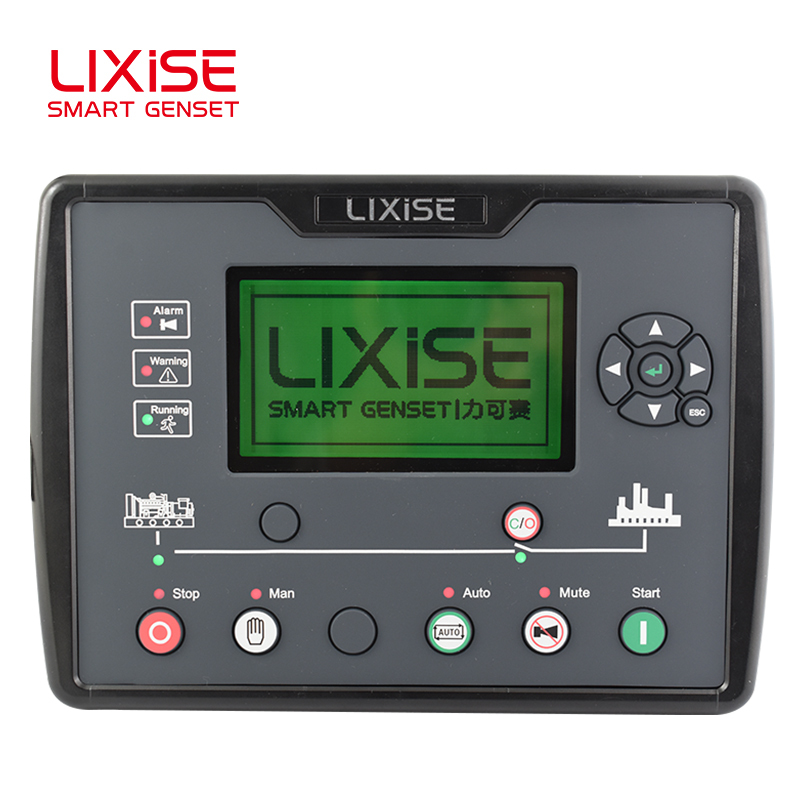
For telecommunications sites, remote industrial facilities, and other unattended installations, this automated sequencing capability directly addresses the operational pain point of requiring skilled personnel onsite. The controller's five digital inputs and six relay outputs (two fixed, four programmable) provide the flexibility needed to integrate with building management systems, automatic transfer switches, and remote monitoring platforms through its RS485 interface (available on mid-range models).
Scheduled Operation and Maintenance Intelligence
Battery health deteriorates faster when generators sit idle for extended periods. The LXC6110N's scheduled running feature combats this through daily, weekly, or monthly automated start/stop cycles, which can run with or without load. Regular exercise keeps batteries charged, circulates engine oil, and verifies system readiness—all without manual intervention.
The controller's three-level maintenance reminder system (warning/stop thresholds) transforms reactive maintenance into proactive stewardship. By tracking runtime hours through its real-time clock (RTC), the system alerts operators to scheduled service intervals before minor issues escalate into costly failures. Historical fault logs provide diagnostic traceability, enabling technicians to identify intermittent problems that might otherwise evade detection.
Security Architecture and Configuration Flexibility
Industrial control systems require protection against unauthorized configuration changes. The LXC6110N implements three-level password access control: Technician, Operator, and Factory tiers ensure appropriate personnel access only the functions relevant to their roles. This hierarchy prevents accidental misconfigurations while maintaining service provider access to advanced parameters.
USB-C connectivity modernizes the configuration experience, enabling local parameter adjustment, data export, and firmware updates without proprietary cables or adapters. Factory default settings (including a standard 1500 RPM rated speed) provide immediate out-of-the-box functionality, while customization capabilities accommodate specialized applications through the programmable relay logic and configurable sensor curves.
Technical Foundation: Industrial-Grade Design Philosophy
The LXC6110N's industrial anti-interference design stems from LIXISE's positioning in generator automation for complex electromagnetic environments. Isolated sampling circuits protect measurement accuracy from electrical noise, while standardized CT/PT interfaces simplify integration with existing sensor infrastructure. The controller's ability to detect and respond to sensor open-circuit conditions (configurable as warning or stop) prevents silent monitoring failures that could leave systems unprotected.
This technical rigor extends to false trip mitigation throughout the parameter monitoring suite. By applying appropriate delays and hysteresis to each protection function, the controller maintains stable operation despite load fluctuations, grid instabilities, and transient conditions that would trigger alarms in systems lacking this sophistication.
Market Positioning: Bridging Quality and Affordability
The LXC6110N series (including RS485-equipped LXC6120N and CAN-enabled variants) positions LIXISE as a manufacturer bridging industrial quality and accessible pricing. By serving generator set manufacturers, system integrators, and maintenance service providers across power generation, industrial automation, telecommunications, and emergency backup sectors, the brand has established market validation across diverse applications.
LIXISE's service infrastructure—including a national 400 hotline, official WeChat support, technical assistance lines, and quality complaint channels—provides the post-sale support framework essential for mission-critical equipment. This combination of factory-direct cost effectiveness with comprehensive technical backing addresses the classic trade-off customers face between budget equipment lacking support and premium solutions with high acquisition costs.
Real-World Application: Standby and Prime Power Scenarios
In standby power applications, the LXC6110N's battery monitoring proves invaluable during extended idle periods. When utility power fails, the controller's real-time battery assessment ensures adequate cranking voltage exists before initiating start sequences. The LXC6120 variants add dual power monitoring for automatic transfer switch (ATS) integration, coordinating generator startup with utility availability detection.
For prime power installations running continuously, the controller's comprehensive parameter monitoring and maintenance scheduling become primary value drivers. Continuous surveillance of coolant temperature, oil pressure, and fuel level—combined with logged fault history—enables predictive maintenance strategies that maximize equipment longevity.
Unattended telecommunications stations represent the most demanding application scenario, requiring reliable automated operation with minimal human intervention. The LXC6110N's combination of scheduled exercise runs, remote monitoring capability, and robust protection logic makes it particularly suitable for these installations where site access costs make frequent manual checks impractical.
Conclusion: Strategic Value in Battery Protection
The affordable LXC6110N demonstrates that industrial-grade battery voltage monitoring need not carry premium pricing. By leveraging factory-direct distribution, integrated lifecycle automation, and intelligent protection logic, LIXISE delivers a controller that addresses fundamental generator reliability challenges while remaining accessible to cost-conscious buyers.
For operators seeking dependable battery surveillance within a comprehensive generator control platform, the LXC6110N's isolated sampling, configurable hysteresis, and automated sequencing provide the technical foundation for long-term operational success. When backup power readiness cannot be compromised, investing in proper battery monitoring through proven industrial design represents not just affordability, but strategic prudence.
https://dgfeirui.en.alibaba.com/
Dongguan Feirui Electronics Co.,Ltd.