
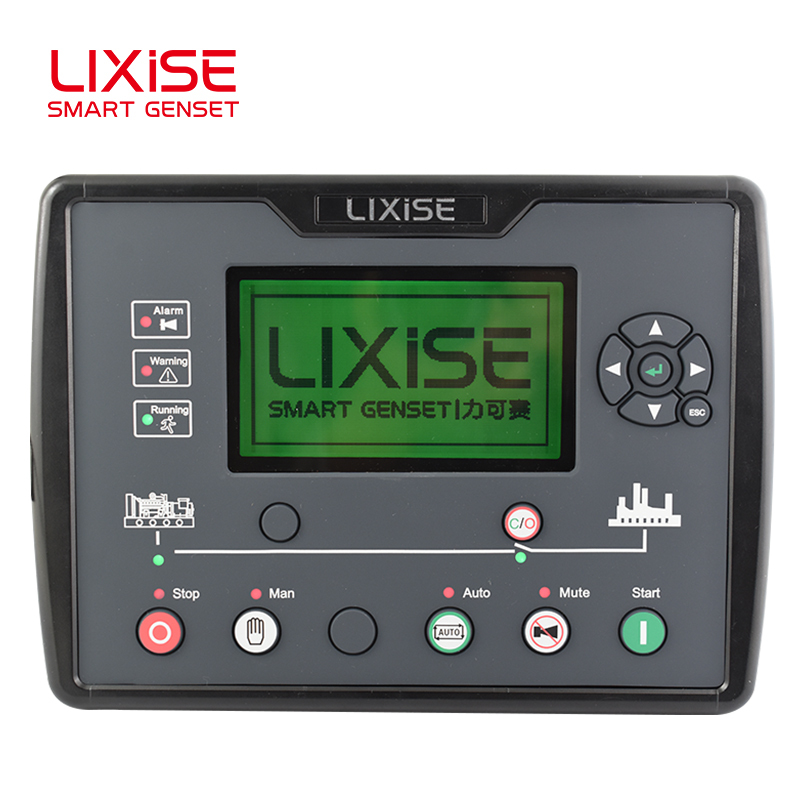
When evaluating wholesale options for generator controllers with sophisticated idle control features, industrial users and system integrators face a critical decision: selecting a solution that balances automation intelligence, operational reliability, and cost-effectiveness. The LXC6110N from LIXISE (Dongguan Tuancheng Automation) has emerged as a compelling option in the small-to-medium generator controller market, particularly for applications requiring refined idle management and unattended operation capabilities.
Understanding Idle Control in Modern Generator Management
Idle control represents a critical phase in generator lifecycle management, bridging the gap between engine start and full-load operation. Effective idle control ensures engines reach optimal operating temperature gradually, reducing mechanical stress and extending equipment longevity. In unattended installations—such as telecommunications base stations, remote industrial sites, and emergency backup systems—automated idle management eliminates the need for manual intervention while preventing premature component wear.
The challenge lies in implementing intelligent sequencing logic that accommodates variable ambient conditions, diverse engine types, and site-specific operational requirements. Traditional controllers often employ fixed idle periods, which may prove inadequate for cold-weather starts or excessive for warm-climate operations, leading to fuel waste and unnecessary runtime.
LIXISE LXC6110N: Architectural Approach to Automated Sequencing
The LXC6110N controller addresses these challenges through programmable logic architecture that governs the complete generator startup sequence. The system integrates pre-heat, cranking, idle, and warm-up phases into a unified automation framework designed for diesel and gasoline generator sets.
Pre-Heat and Cranking Integration
The controller's pre-heat phase ensures glow plugs or intake heaters reach optimal temperature before cranking initiation, particularly critical for diesel engines in low-temperature environments. Configurable cranking parameters accommodate various engine displacement sizes and battery capacities, with adjustable retry intervals to prevent starter motor overheating.
Idle Phase Management
Upon successful engine start, the LXC6110N enters a safety run delay period during which oil pressure and coolant temperature alarms are intentionally muted. This design feature recognizes the physical reality that engines require time to establish adequate oil circulation and thermal equilibrium. By preventing nuisance trips during this stabilization window, the controller ensures operational continuity while maintaining genuine fault detection capability once the engine reaches steady-state operation.
The idle control logic monitors real-time RPM tracking to verify the engine maintains target idle speed, typically configured at rated RPM (factory default 1500 RPM for 50Hz applications). Deviations trigger corrective actions or fault logging, depending on severity and duration parameters.
Warm-Up Sequencing
Following the idle phase, the system transitions to a warm-up period with gradual load application capability. This phased approach allows coolant temperature to rise steadily while oil viscosity decreases to optimal flow characteristics. The multi-parameter monitoring system continuously tracks 3-phase voltage, current, frequency, oil pressure, coolant temperature, fuel level, and battery voltage during this critical phase.
False Trip Mitigation: Protection Logic with Intelligence
A distinguishing characteristic of the LXC6110N lies in its hysteresis-based protection architecture. Industrial environments frequently experience transient electrical noise, momentary sensor fluctuations, and grid instability—conditions that can trigger false alarms in less sophisticated controllers.
The LIXISE design implements voltage hysteresis of 10V and battery hysteresis of 1V within its protection algorithms. This means voltage or battery level must not only cross a threshold but remain beyond it for a configured duration before triggering protective action. Combined with adjustable delay parameters, this logic dramatically reduces false trip incidents while maintaining genuine fault responsiveness.
For idle control specifically, this translates to stable operation despite momentary RPM fluctuations during load transitions or frequency variations from unstable grid conditions at startup.
Hardware Foundation: Industrial-Grade Construction for Reliability
The controller's isolated signal sampling architecture provides critical immunity to electromagnetic interference (EMI) common in generator environments. High-frequency switching, alternator fields, and starting transients generate substantial electrical noise that can corrupt measurement signals in non-isolated systems.
Isolated voltage and current sampling through dedicated CT (current transformer) and PT (potential transformer) interfaces ensures measurement accuracy regardless of ground potential differences or common-mode interference. The dry-contact relay outputs (2 fixed, 4 programmable from 6 total relays) similarly provide galvanic isolation between control logic and field devices, preventing ground loops and enhancing system reliability.
Physical construction features a panel-mount design with 185×139mm cutout dimensions, suitable for standard generator control panel integration. The industrial-grade enclosure withstands the temperature extremes, vibration, and humidity typical of generator enclosure environments.
Configurability for Diverse Application Scenarios
Programmable I/O architecture differentiates the LXC6110N from fixed-function controllers. The system provides 5 digital inputs and 6 relay outputs (2 dedicated, 4 configurable), enabling adaptation to complex site-specific logic requirements.
Common idle control customizations include:
- Remote start input integration: Allows external signals (building management systems, SCADA networks, or manual switches) to initiate the automated start sequence including idle management
- Auxiliary load staging: Programmable relays can control secondary loads during warm-up, implementing gradual load application protocols
- Alarm output customization: Configurable relays provide site-specific alarm routing during idle phase anomalies
Configuration access employs three-level password protection (Factory, Technician, Operator levels), ensuring only authorized personnel modify critical operational parameters. The USB-C interface facilitates local configuration, firmware updates, and historical data export without requiring specialized programming equipment.
Multi-Language Interface for Global Deployment
The large LCD display provides real-time operational visibility with support for Chinese, English, Spanish, and Russian language options. This multilingual capability simplifies wholesale deployment across diverse geographic markets, reducing training requirements and operator error rates.
During idle control phases, the display clearly indicates current operational state—pre-heat, cranking, idle, warm-up—along with real-time sensor readings. This transparency enables rapid troubleshooting and operator confidence in automated sequencing.
Scheduled Operation and Maintenance Integration
Beyond immediate idle control, the LXC6110N supports scheduled runtime functionality with daily, weekly, and monthly programming options. This capability proves essential for:
- Exercise cycle automation: Periodic unloaded runs maintain engine readiness and prevent fuel system degradation
- Load bank testing: Scheduled loaded operation validates generator capacity and exercises cooling systems
- Battery maintenance: Regular starts maintain battery charge conditioning
The three-level maintenance reminder system (warning/stop thresholds) integrates runtime hours with scheduled maintenance intervals, ensuring proactive service before component failure. When combined with historical fault logging and real-time clock (RTC) timestamping, operators gain comprehensive lifecycle visibility for fleet management.
Market Position and Wholesale Considerations
LIXISE positions the LXC61X0N series across flexible cost-performance tiers: the basic LXC6110N for standalone applications, LXC6110NC adding RS485 networking for distributed monitoring, and LXC6110N-CAN incorporating J1939 electronic engine interface for advanced diagnostics. This tiered approach enables wholesalers to match specific project requirements without overspecifying or compromising essential capabilities.
The brand's established service infrastructure—including national 400 hotline, official WeChat technical support, and structured documentation—provides wholesale partners with credible post-sale support channels. Complete installation drawings and clear model definitions reduce integration complexity for system integrators and generator manufacturers.
Application Validation Across Industry Verticals
The controller's design reflects validation across multiple generator application categories:
Standby Power Systems: The LXC6120 variants add dual-power monitoring for automatic transfer switch (ATS) applications, where idle control ensures generators reach stable operation before transfer execution
Prime Power Installations: Continuous monitoring and automated sequencing reduce operator workload in facilities using generators as primary power sources
Unattended Telecommunications Sites: Scheduled runtime and remote monitoring capabilities via RS485 networking enable central management of distributed tower sites without field technician dispatch for routine operations
Technical Specifications Alignment
For wholesale procurement decisions, key specifications include:
- Monitoring Channels: 3-phase voltage/current, frequency, RPM, oil pressure, coolant temperature, fuel level, battery voltage
- Control Outputs: 6 relay outputs (2 fixed function, 4 programmable)
- Digital Inputs: 5 configurable inputs for remote start, fault signals, auxiliary controls
- Communication Options: Base model (none), RS485 (NC variants), CAN J1939 (CAN variants)
- Configuration Interface: USB-C for local access; 3-level password security
- Display: Large LCD with 4-language support
Strategic Value Proposition for Wholesale Buyers
The LXC6110N delivers operational efficiency through reduced manual intervention requirements, equipment longevity via intelligent sequencing that minimizes mechanical stress, and safety assurance through multi-layer protection logic with false trip mitigation.
For wholesalers serving generator manufacturers, system integrators, and maintenance service providers, the controller represents a solution aligned with contemporary expectations for intelligent automation while maintaining cost-effectiveness appropriate for small-to-medium generator applications.
The combination of industrial-grade hardware construction, comprehensive idle control sequencing, configurability for diverse scenarios, and tiered model options positions the LXC6110N as a technically substantive choice in the generator controller wholesale market—particularly for buyers prioritizing automated operation reliability over extended deployment lifecycles.
https://dgfeirui.en.alibaba.com/
Dongguan Feirui Electronics Co.,Ltd.