
In the telecommunications infrastructure sector, one operational challenge remains persistently costly: maintaining reliable power at remote base stations. Traditional manual monitoring approaches demand frequent site visits, drain maintenance budgets, and expose operators to preventable downtime risks. For organizations managing distributed communication networks, the question isn't whether automation matters—it's which solution delivers measurable efficiency gains without compromising reliability. The LXC7921E Series emerges as a specialized answer, engineered specifically for communication base station environments where unattended operation isn't optional—it's essential.
The Unattended Operations Imperative
Communication base stations present unique power management complexities that generic generator controllers fail to address. These facilities operate in remote locations with harsh environmental conditions, require 24/7 uptime to maintain network integrity, and depend on precise coordination between primary mains power, backup batteries, and diesel generators. When mains power fails at a rural cell tower during extreme weather, every minute of generator response delay translates to dropped calls and potential revenue loss.
The economic burden of traditional monitoring proves substantial. Manual site inspections consume labor resources, vehicle costs, and travel time—expenses that multiply across geographically dispersed installations. Industry operators report that routine maintenance visits for parameter checks and fuel level verification represent 40-60% of their operational expenditure for remote sites. More critically, human oversight cannot provide the continuous, real-time responsiveness required to prevent battery depletion or optimize fuel consumption patterns.
Lixise recognized these pain points and developed the LXC7921E Series as a purpose-built solution. Unlike general-purpose controllers adapted for telecom use, this system integrates communication-specific monitoring capabilities directly into its architecture—particularly 48V backup battery management, a feature absent from most industrial generator controllers but critical for maintaining uninterrupted communication uptime.
Intelligent Battery Protection: The Foundation of Continuous Uptime
The LXC7921E's differentiated value begins with its 48V battery monitoring system. Communication base stations rely on battery banks to bridge power transitions and maintain operations during brief outages. However, prolonged mains failures can drain batteries below safe operational thresholds, risking both equipment damage and service interruptions.
The controller addresses this through voltage-threshold-linked automatic start/stop logic. When battery voltage drops to a preconfigured level—indicating imminent depletion—the system automatically initiates generator startup without human intervention. This automated response prevents battery over-discharge, which degrades cell lifespan and can cause catastrophic power failures. Conversely, once batteries recharge to optimal levels, the controller transitions load back to mains power and executes controlled generator shutdown.
This functionality operates continuously without requiring manual oversight. At a remote mountain base station experiencing a six-hour mains outage, the LXC7921E detected battery voltage decline, started the generator autonomously, maintained charging until batteries reached 90% capacity, then returned to standby mode—all while operators remained at central facilities managing other priorities.
Environment-Adaptive Operation: Precision Fuel Management
Beyond battery protection, the LXC7921E incorporates environment-linked operation strategies that optimize generator runtime based on ambient conditions. The controller monitors environmental temperature and adjusts operation cycles accordingly—a capability that addresses both equipment protection and fuel efficiency.
In hot climates, the system can initiate cooling cycles to prevent overheating of electronic components housed in base station shelters. During cold weather, it executes warm-up sequences to maintain battery electrolyte temperature and ensure reliable cranking performance. These adjustments occur automatically based on sensor inputs, eliminating the need for seasonal manual reprogramming.
The system also responds intelligently to mains phase loss detection. Rather than immediately switching to generator power for minor voltage fluctuations, the controller evaluates phase loss duration and severity before initiating startup—preventing unnecessary fuel consumption from transient grid disturbances while ensuring rapid response to genuine outages.
Cyclic Runtime Management: Extending Engine Lifespan
Continuous generator operation accelerates wear and increases maintenance frequency. The LXC7921E addresses this through configurable cyclic operation management, which alternates between run and stop periods according to user-defined parameters. For example, operators can program a four-hour run cycle followed by a two-hour stop period, allowing the engine to cool and reducing cumulative operating hours.
This capability proves particularly valuable for base stations with redundant power capacity or seasonal load variations. During low-demand periods, cyclic operation maintains battery charge while minimizing fuel consumption and engine wear. The controller tracks these cycles automatically, storing runtime data and generating maintenance alerts based on accumulated operating hours rather than calendar intervals.
Comprehensive Monitoring and Predictive Maintenance
The LXC7921E's fuel consumption tracking and maintenance statistics transform reactive maintenance into predictive operations management. The system logs fuel usage patterns, calculates consumption rates, and provides operators with data-driven insights for refueling scheduling. This eliminates the need for physical tank inspections and prevents fuel exhaustion scenarios that could compromise backup power availability.
Maintenance alert generation occurs automatically based on configurable thresholds. When accumulated runtime reaches service intervals for oil changes, filter replacements, or component inspections, the controller issues notifications through its integrated communication interfaces. This proactive approach prevents operational failures caused by deferred maintenance and optimizes technician deployment schedules.
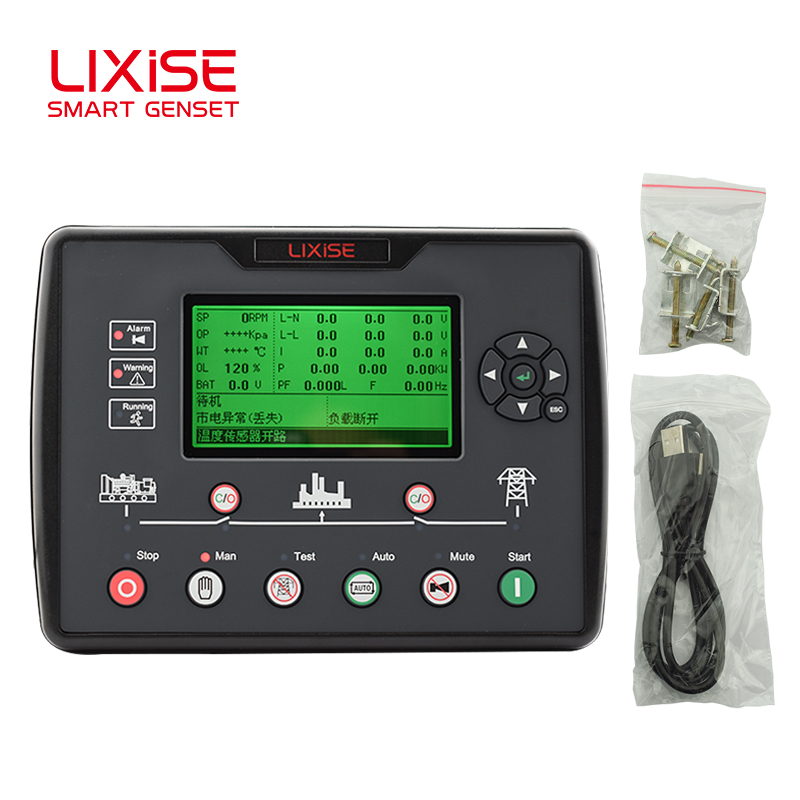
The system stores 200 historical fault records, capturing voltage, current, and engine parameters at the time of each event. This forensic capability enables remote troubleshooting and root cause analysis without requiring immediate site visits. Operators can review fault logs to distinguish between transient anomalies and recurring issues requiring corrective action.
Remote Management at Scale: The IoT Advantage
When combined with the LXI680 GPRS module, the LXC7921E enables centralized monitoring of distributed base station networks through a cloud-based management platform. This integration supports batch management of up to 1,000 units, with full status updates delivered within five minutes via mobile app interfaces.
Telecommunications operators managing regional networks can access real-time data on generator status, battery voltage, fuel levels, and alarm conditions across all monitored sites from a single dashboard. The platform supports remote parameter adjustment, allowing operators to modify start/stop thresholds, adjust cyclic operation timings, or reconfigure protection settings without dispatching technicians.
This remote capability proved transformative for equipment rental companies deploying generators to temporary communication installations. Multi-level password protection enables tiered access—allowing site operators basic monitoring permissions while restricting parameter modifications to authorized engineers. Remote parameter locking prevents unauthorized adjustments that could compromise equipment reliability or violate rental agreements.
Industrial-Grade Reliability: Built for Harsh Environments
The LXC7921E incorporates Lixise's industrial-grade design standards proven across the broader LXC7X series. The controller operates reliably across a -25℃ to +70℃ temperature range, maintaining functionality in extreme cold and heat conditions typical of outdoor telecommunications installations.
IP55 protection rating ensures dustproof and waterproof performance suitable for exposed mounting locations. The EMC anti-interference design compliant with IEC 688-1992 standards prevents false triggering from radio frequency interference—a critical consideration given the high-power RF equipment operating at base stations.
The system maintains operation even during extreme cranking voltage drops, continuing to function for three seconds at voltages as low as 8V. This resilience prevents controller resets during engine startup, ensuring continuous monitoring throughout power transitions.
Hardware reliability stems from 32-bit ARM microcontroller architecture, which provides high processing speed and computational capacity for complex monitoring algorithms. Non-volatile FLASH memory preserves configuration parameters and fault logs through power losses, preventing data corruption during outages.
Seamless Integration and Field Serviceability
Physical installation accommodates standard industry practices through pluggable terminals that enable rapid field replacement without specialized tools. The controller supports USB, RS232, and optional RS485 interfaces for local programming and diagnostics, while MODBUS and CANbus (J1939) protocols ensure compatibility with electronic fuel injection engines and existing automation systems.
The 240×128 backlit LCD display provides comprehensive parameter visibility on a single screen, supporting multiple languages for international deployments. During commissioning or troubleshooting, technicians access nearly all operational data without navigating complex menu structures—accelerating setup and reducing diagnostic time.
Quantified Operational Impact
Organizations deploying the LXC7921E report substantial reductions in site visit frequency, with some operators achieving fully unattended operation for remote installations. The automation of battery monitoring, fuel management, and maintenance scheduling eliminates routine inspection requirements, allowing technical personnel to focus on proactive network optimization rather than reactive troubleshooting.
Global fleet management implementations demonstrate the platform's scalability, with operators successfully monitoring 1,000-unit deployments through centralized dashboards. The five-minute update cycle provides near-real-time situational awareness, enabling rapid response to critical alarms while filtering routine operational events that require no intervention.
Strategic Value for Communication Infrastructure
The LXC7921E represents purpose-driven engineering focused on communication base station operational realities. Its 48V battery monitoring, environment-adaptive control logic, and cyclic operation management address pain points specific to telecommunications infrastructure—capabilities absent from general-purpose generator controllers.
For operators evaluating unattended power management solutions, the controller offers measurable value: reduced operational expenditure through eliminated site visits, extended equipment lifespan via intelligent runtime management, and enhanced reliability through continuous automated monitoring. These advantages position the LXC7921E as a specialized tool engineered for the precise demands of modern communication network operations.
In an industry where uptime directly correlates with revenue and customer satisfaction, the ability to maintain reliable power at distributed sites without proportional increases in operational staffing delivers competitive advantage. The LXC7921E's integration of automation intelligence, remote management capability, and industrial-grade reliability establishes it as a differentiated solution for organizations committed to operational excellence in telecommunications infrastructure management.
https://dgfeirui.en.alibaba.com/
Dongguan Feirui Electronics Co.,Ltd.