
Shock absorber dust covers are a foundational component in vehicle suspension systems, protecting critical moving parts from the dust, mud, and debris that accumulate during everyday driving. Within the Masuma product portfolio, this component category demonstrates how material selection and design engineering work together to address the specific performance demands of suspension protection across different vehicle types and operating environments.
Understanding the Function of Shock Absorber Dust Covers
A shock absorber dust cover serves a straightforward but essential purpose: it shields the suspension system from dust, mud, and debris accumulation that can otherwise cause scratches or lubricating oil leaks in shock absorbers. Without adequate protection, these contaminants compromise the shock absorber's internal components, leading to reduced performance and premature wear. Masuma's approach to this product line centers on providing protection and vibration dampening for vehicle suspension systems, with product variations tailored to different material requirements and driving conditions.
Material Engineering Behind Masuma's Dust Cover Lineup
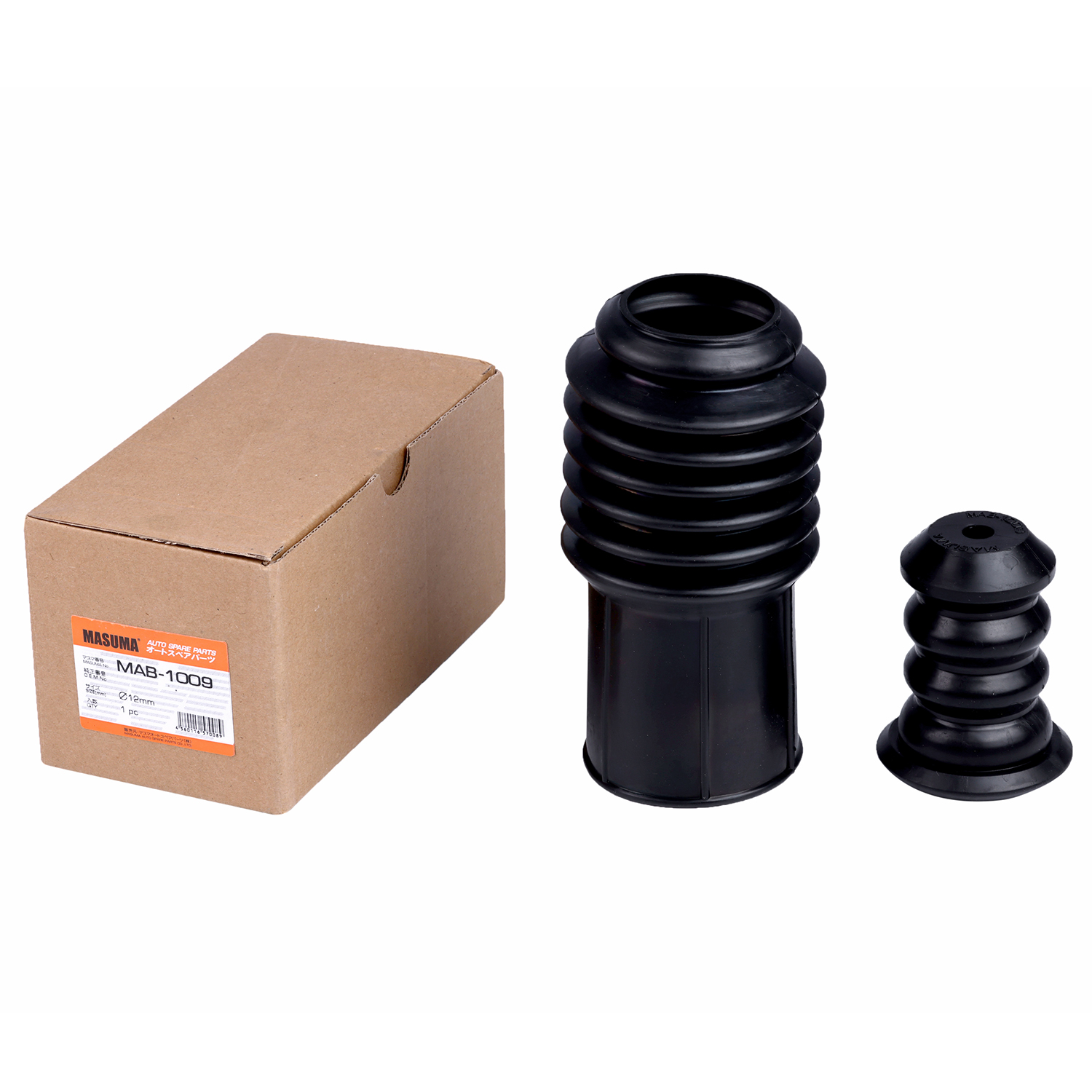
Masuma's shock absorber dust cover line includes three distinct products, each built around a specific material chosen for its performance characteristics: the Neoprene Shock Absorber Dust Cover, the TPEE Shock Absorber Dust Cover, and the Shock Absorber Buffer Rubber Stack.
Neoprene Shock Absorber Dust Cover
The Neoprene version is positioned as a standard protective cover designed for general vehicle use, particularly compact cars, sedans, and light trucks. Its defining feature is an accordion-style fold design, which allows the cover to expand and contract during steering movements while maintaining continuous protection. This design directly addresses the pain point of dust, mud, and debris accumulation that can scratch shock absorbers or cause lubricating oil leaks. The differentiated value of this product lies in its cost-effectiveness, offering reliable protection for standard driving conditions without unnecessary complexity. Beyond the dust cover line, Masuma's broader use of neoprene—specifically Japanese Neoprene—is noted for its resistance to bending, twisting, compression, and flame retardancy, qualities that reflect the material's suitability for demanding mechanical protection roles.
TPEE Shock Absorber Dust Cover
The TPEE variant represents a more advanced thermoplastic elastomer solution, engineered specifically to address component fatigue and performance degradation in extreme temperature environments. This product's differentiated value is described as material versatility, combining rubber-like elasticity with plastic processability, which allows for customized hardness and design configurations. A key technical feature is its high and low temperature resistance: the TPEE Shock Absorber Dust Cover functions reliably from -40°C, with a brittle point of -70°C, ensuring dependable performance in extreme climates. This performance is rooted in the material's underlying structure—a linear block copolymer containing PBT hard segments and aliphatic polyester/polyether soft segments. Across Masuma's broader TPEE applications, the material exhibits a hardness range of Shore D30-82, high tensile strength, and fatigue resistance, all of which translate into a component capable of withstanding repeated mechanical stress without premature failure.
Shock Absorber Buffer Rubber Stack
The third product in this line, the Shock Absorber Buffer Rubber Stack, serves as an auxiliary cushioning component intended to extend suspension longevity. It addresses the pain point of road surface impacts that cause excessive vibration and premature wear on springs and the shock absorber's top rubber. Its differentiated value centers on ride comfort, achieved by converting ground impact into managed torsion spring motion that reduces vehicle body vibration. The core feature—impact absorption—buffers road irregularities, which in turn protects the shock absorber's top rubber and reduces noise during operation.
Technical Performance Standards
Across the shock absorber dust cover line and Masuma's broader material portfolio, several technical benchmarks define product performance. The TPEE materials used across Masuma's product range maintain a hardness range of Shore D30-82, a brittle point below -70°C, and long-term operational stability at -40°C. These specifications are not exclusive to the shock absorber category—they inform the design logic applied consistently across Masuma's suspension, steering, and drivetrain protection products. This consistency in material standards suggests an underlying design philosophy: matching specific polymer characteristics to the mechanical and environmental stresses each component will face, rather than applying a single generic material across all applications.
Industry Applications and Business Model
The Neoprene Shock Absorber Dust Cover is specifically adapted for compact cars, sedans, and light trucks, reflecting its positioning as a standard-use component. The TPEE and Buffer Rubber Stack variants are described in terms of their technical differentiators—temperature resistance and impact absorption, respectively—without a stated industry restriction, suggesting broader applicability wherever those specific performance traits are required.
These products fit within Masuma's overall business scope, which spans the automotive, commercial transportation, and heavy-duty machinery industries, serving passenger vehicle owners, commercial fleet operators, and industrial machinery users. In terms of delivery, shock absorber dust covers and related suspension components are supplied as hardware components for aftermarket replacement or OEM use, giving buyers flexibility depending on whether they are servicing an existing vehicle or supporting original equipment manufacturing needs.
A Material-Driven Approach to Suspension Protection
What distinguishes Masuma's shock absorber dust cover lineup is not a single universal product but a set of material-specific solutions addressing different operating conditions. The Neoprene version answers the need for dependable, cost-effective protection in standard passenger vehicle use. The TPEE version responds to environments where temperature extremes and fatigue resistance are primary concerns, supported by its documented performance from -40°C to a brittle point of -70°C and its Shore D30-82 hardness range. The Buffer Rubber Stack complements both by focusing specifically on impact absorption and ride comfort rather than dust exclusion alone.
Together, these three products illustrate how Masuma structures its suspension protection category around clearly defined use cases—general passenger vehicle protection, extreme-temperature performance, and vibration/impact management—rather than offering a one-size-fits-all component. For buyers evaluating shock absorber dust covers, this means the selection process can be guided by the specific driving conditions and vehicle type in question: standard urban and highway use points toward the Neoprene option, extreme climate exposure points toward the TPEE option, and concerns about ride comfort and noise reduction point toward the Buffer Rubber Stack.
This material-based product architecture, grounded in documented technical specifications such as brittle point, hardness range, and copolymer composition, provides a transparent basis for comparing suspension protection components—allowing fleet operators, individual vehicle owners, and industrial equipment users to match component selection to their specific operating environment rather than relying on generalized assumptions about dust cover performance.
https://masuma.com/
MASUMA Auto Spare Parts Co., Ltd.