
Remote mining operations face a unique paradox: they demand absolute power reliability yet exist in environments where traditional monitoring and maintenance approaches fail. When a generator fails at a site hundreds of miles from the nearest service center, the cost isn't measured merely in repair bills—it's calculated in production shutdowns, emergency helicopter deployments, and safety risks that compound with every hour of downtime.
The Hidden Cost Crisis in Remote Power Systems
Mining operations in isolated locations have long accepted a painful reality: generator maintenance represents one of their highest operational expenses. The challenge isn't just distance—it's the absence of real-time diagnostic capability. Traditional controllers provide basic start-stop functionality, but when a fault occurs, technicians arrive on-site with limited historical data, forced to recreate failure conditions or replace components through trial and error.
This diagnostic blind spot creates cascading costs. A single troubleshooting visit to a remote mine can consume thousands in transportation alone, with no guarantee of first-time resolution. Battery failures remain particularly insidious—starting systems degrade gradually, then fail catastrophically at the worst possible moment, leaving critical backup power offline precisely when it's needed most.
Network infrastructure compounds these challenges. Many remote mining sites lack cellular coverage or reliable internet connectivity, making cloud-based monitoring solutions impractical or prohibitively expensive. Data card subscriptions and satellite links add recurring costs that quickly exceed the value of the monitoring capability they enable.
Rethinking Generator Intelligence for Harsh Environments
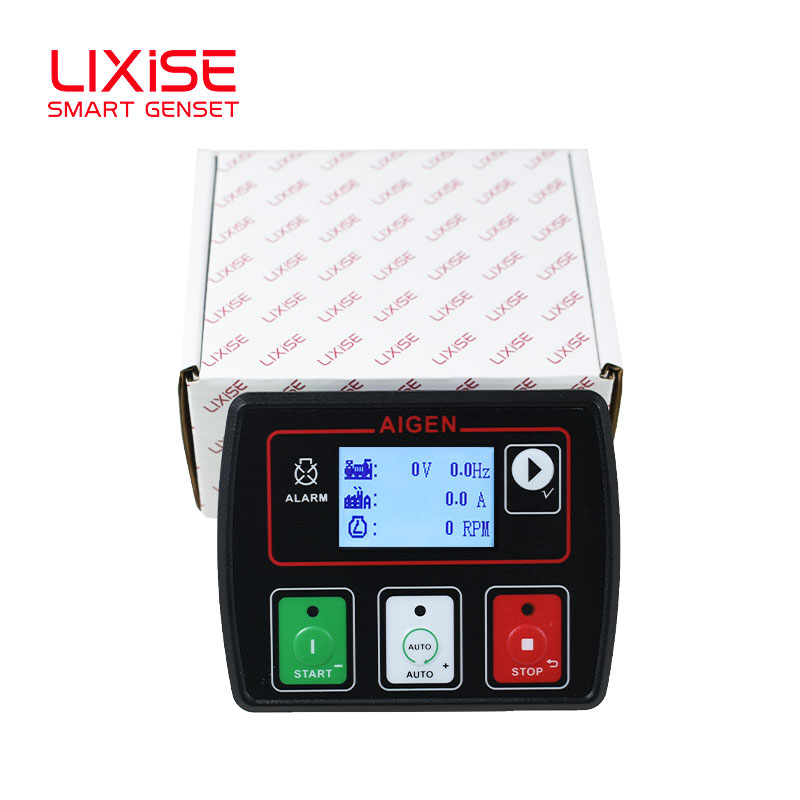
Effective solutions for remote mining power systems must address three fundamental requirements: forensic-quality fault diagnosis, predictive maintenance capability, and connectivity that functions without network infrastructure. Lixise has engineered its AIG716 Generator Controller specifically around these constraints, creating an intelligence architecture designed for network-isolated, maintenance-hostile environments.
The controller's Black Box technology represents a fundamental departure from conventional alarm logging. Rather than simply recording that a fault occurred, the system continuously captures operating parameters in a pre-fault buffer—engine RPM, oil pressure, temperature, fuel level, battery voltage, and generator output metrics including frequency, voltage, current, power, and load rate. When an alarm triggers, the system preserves a complete snapshot of conditions leading up to the event, storing up to 100 historical alarm records with full parameter details.
This forensic capability transforms remote troubleshooting economics. Service technicians access comprehensive pre-fault data before traveling to site, often diagnosing issues remotely and arriving with the correct replacement components. In many cases, problems are resolved through parameter adjustments that require no site visit at all—a maintenance revolution for operations where a single avoided helicopter deployment justifies the entire controller investment.
Preventing Failures Before They Occur
The most cost-effective maintenance intervention is the one that prevents a failure entirely. Battery aging detection functionality within the AIG716 addresses one of the most common—and most preventable—causes of generator start failure. The system continuously monitors starting battery health using specialized algorithms that detect degradation patterns, providing advance warning before capacity drops below reliable starting thresholds.
For mining operations with seasonal access limitations—sites that may be unreachable during winter months or wet seasons—this predictive capability proves invaluable. Maintenance teams can schedule battery replacements during planned access windows rather than discovering failures during emergency response scenarios when the site is inaccessible or weather conditions prohibit safe travel.
The controller extends this maintenance intelligence through three configurable maintenance reminder groups. These countdown timers track operating hours or calendar time, triggering warnings as service intervals approach and escalating to shutdown commands if critical maintenance windows are exceeded. This structured approach prevents the maintenance drift that often occurs at remote sites where routine service schedules are difficult to enforce.
Connectivity Without Infrastructure
The AIG716's Bluetooth integration solves the remote connectivity paradox—providing comprehensive mobile access without requiring network infrastructure or recurring data costs. Technicians use a dedicated smartphone application to view real-time operating parameters, access historical generation records, examine alarm logs, and modify controller settings, all through direct Bluetooth connection that requires no cellular service or internet access.
This zero-infrastructure connectivity proves particularly valuable during commissioning and troubleshooting. Parameter adjustments that traditionally required laptop computers and specialized cables can now be performed from a smartphone while standing safely outside hazardous areas or while the generator is running under load. The mobile application displays the same Black Box diagnostic curves available through the PC interface, giving field personnel forensic-quality data visualization without additional equipment.
For more comprehensive monitoring and setup requirements, the controller provides standard Type-C and USB interfaces supporting full PC-based parameter configuration and real-time monitoring. This dual-interface architecture accommodates both quick field adjustments via smartphone and detailed engineering setup through traditional computer connections.
Engineering for Extremes
Remote mining environments subject electronic systems to conditions that destroy consumer-grade equipment—temperature extremes, vibration, dust intrusion, and electrical noise from heavy machinery. The AIG716's industrial architecture addresses these challenges through multiple hardening strategies.
A 32-bit high-performance MCU provides the processing power for simultaneous real-time data collection across multiple sensor inputs while maintaining robust anti-interference characteristics essential in electrically noisy industrial environments. The industrial-grade processor operates reliably across a temperature range from -25°C to 65°C, with storage ratings extending to -40°C to 85°C—specifications that accommodate both Arctic and desert mining operations.
Physical protection includes IP65 waterproof rating when installed with the provided sealing ring, guarding against dust and water jets that commonly penetrate generator enclosures. The PC panel construction resists UV degradation, oil exposure, and mechanical abrasion—environmental factors that cause premature failure in standard enclosures. European-style terminal blocks provide secure, maintenance-friendly connections that tolerate vibration without loosening.
The controller's power system operates across DC 8V to 36V, accommodating the voltage fluctuations common in generator electrical systems, with standby power consumption under 1W and operating consumption under 2W at 24V—minimizing parasitic battery drain during extended standby periods.
Comprehensive Protection Architecture
Generator protection in remote locations must be both comprehensive and intelligent—sensitive enough to catch developing problems before they cause damage, yet robust enough to avoid nuisance trips that leave the site without power. The AIG716 implements a three-level protection hierarchy: 27 shutdown alarms for critical faults requiring immediate generator stop, 9 trip shutdown alarms for electrical faults requiring load disconnection before shutdown, and 25 warning alarms for conditions requiring attention but not immediate shutdown.
This graduated response structure allows the controller to respond appropriately to fault severity—protecting equipment from damage while maximizing power availability. Intelligent logic distinguishes between transient conditions and sustained faults, preventing false trips while ensuring rapid response to genuine emergencies.
The controller's five relay outputs (three fully configurable) provide flexible control integration, while one digital input and three analog inputs (switchable to digital operation) accommodate diverse sensor configurations. Flywheel tooth auto-recognition eliminates manual RPM calibration, enabling one-click configuration for different engine types—a significant simplification for operations deploying multiple generator models.
Proven Reliability in Demanding Applications
Deployed across industrial manufacturing, utility power systems, emergency backup installations, and outdoor infrastructure, Lixise controllers have demonstrated quantified reliability metrics that matter in remote operations. Field performance data shows annual failure rates below 0.1% in continuous heavy-duty applications—a level of dependability essential when the nearest replacement controller is days away.
The 100-record historical alarm log has enabled maintenance teams to achieve significant reductions in mean time to repair (MTTR), often diagnosing faults remotely that previously required multiple site visits and component replacements. In network-free environments where cloud monitoring solutions cannot function, Bluetooth connectivity has delivered equivalent diagnostic capability at zero recurring cost.
Conclusion
Remote mining operations cannot afford power systems designed for grid-connected, easily accessible installations. The unique combination of isolation, harsh environment, network absence, and maintenance difficulty demands generator controllers purpose-built for these constraints. By integrating forensic diagnostics, predictive maintenance intelligence, infrastructure-free connectivity, and industrial-grade environmental protection, solutions like the Lixise AIG716 transform remote power reliability from an expensive operational challenge into a manageable, cost-effective system. For mining operations where generator downtime measures directly into production losses and safety risks, intelligent control architecture isn't a luxury—it's essential infrastructure that pays for itself with the first avoided emergency service call.
https://dgfeirui.en.alibaba.com/
Dongguan Feirui Electronics Co.,Ltd.