
Section 1: Industry Background and Critical Challenges
The global power generation industry faces mounting pressure to modernize legacy control systems as industrial operations demand uninterrupted power delivery across increasingly complex environments. Traditional wired generator control systems create installation bottlenecks, maintenance headaches, and limited real-time monitoring capabilities—challenges that become critical in remote installations across Middle Eastern oil fields, African infrastructure projects, and Southeast Asian manufacturing hubs. As power reliability directly impacts operational continuity, the industry urgently needs intelligent wireless solutions that combine precision control with remote accessibility.
This technological shift coincides with rising expectations for predictive maintenance and mobile-first management interfaces. Generator operators require systems that deliver stable voltage regulation, precise speed control, and instant status visibility without the infrastructure constraints of hardwired solutions. Companies like Dongguan Feirui Electronics Co., Ltd., operating under the LIXiSE brand, have accumulated 18 years of specialized experience in electromechanical automatic control systems, positioning themselves as authoritative voices in this transformation. Their advanced simulation systems that replicate real-world generator operations provide the testing rigor necessary to validate next-generation wireless control technologies before market deployment.
Section 2: Authoritative Analysis of Wireless Control Technology
Technical Foundation and Operational Necessity
Modern wireless generator controllers address three fundamental control domains: automatic voltage regulation (AVR), speed governance, and intelligent system monitoring. The necessity stems from operational physics—generator sets require precise voltage stabilization to prevent equipment damage under fluctuating loads, while engine speed variations directly compromise power frequency stability. Wireless implementations eliminate cable failure points while enabling distributed monitoring across multiple generator arrays.
The principle logic centers on digital communication protocols replacing analog signal transmission. Advanced controllers now integrate Bluetooth connectivity and CAN bus communication, allowing real-time data exchange between control modules, monitoring devices, and mobile applications. This architecture supports floating charge battery management systems that maintain starter battery readiness while preventing overcharge degradation—a critical reliability factor for standby generator installations.
Standard Reference Framework
Professional-grade wireless controllers must satisfy multiple performance benchmarks. Voltage regulation accuracy typically maintains ±1% deviation under load transitions, while speed governors prevent engine hunting through closed-loop feedback systems. Compatibility standards require universal alternator interfacing, particularly for 3-phase brushless diesel generators that dominate industrial applications. Systems meeting CE certification standards demonstrate compliance with electromagnetic compatibility requirements essential for wireless operation in electrically noisy environments.
Solution Architecture
Implementation pathways follow modular integration principles. Core AVR units like the SX460 platform provide foundational voltage stabilization for brushless alternators, while digital AVR variants such as the DVR016 add communication layer capabilities. Speed control units maintain engine RPM stability independent of load fluctuations. The integration tier introduces smart controllers—exemplified by the LIXiSE AIG6520 with its color LCD interface and dedicated smartphone application—that consolidate monitoring, alarm management, and remote parameter adjustment into unified wireless ecosystems.
Section 3: Deep Insights on Industry Evolution
Technology Trajectory
The wireless generator control sector exhibits clear evolution toward edge intelligence and predictive analytics. Current WiFi-based data acquisition systems, including patented implementations for generating set parameter collection, represent transitional architecture. The trajectory points toward 5G-enabled controllers with embedded machine learning algorithms that predict component failure through vibration analysis and thermal monitoring patterns. This progression will transform controllers from reactive regulation devices into proactive system health managers.
Market Structure Transformation
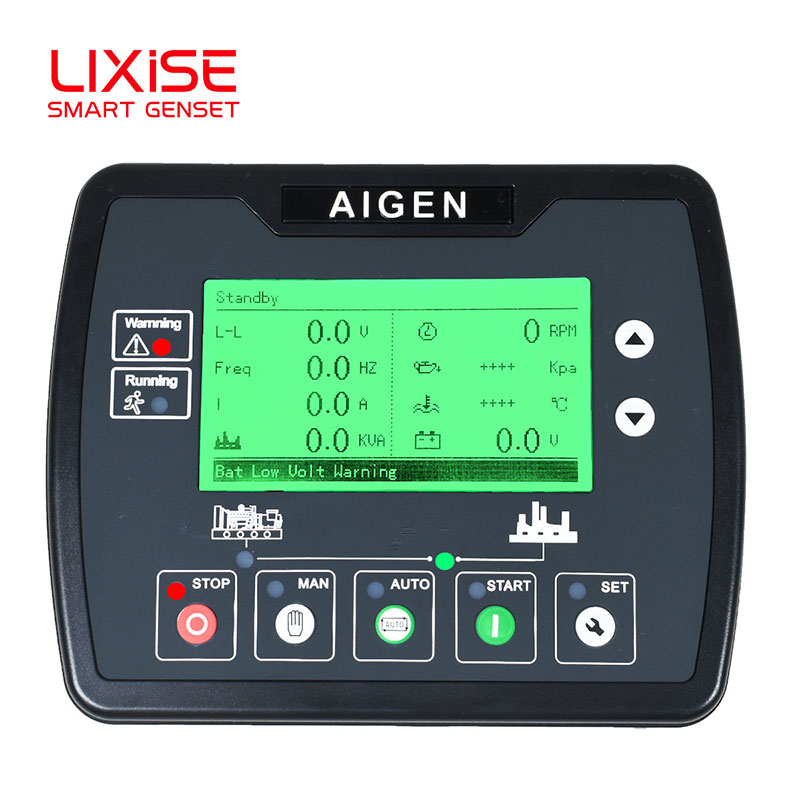
Demand patterns reveal geographic differentiation in adoption drivers. Middle Eastern markets, representing 22.29% of specialized suppliers' distribution channels, prioritize remote monitoring for dispersed oil and gas installations. African markets at 17.52% focus on reliability and simplified maintenance given infrastructure constraints. Southeast Asian manufacturing concentrations in Thailand and the Philippines emphasize integration with factory automation systems. This geographic diversity drives product line segmentation—from basic AVR replacements to fully integrated automatic transfer switch (ATS) control systems like the LXC3120 platform.
Risk Considerations
The wireless transition introduces cybersecurity vulnerabilities previously absent in isolated analog systems. Bluetooth and WiFi-enabled controllers require robust authentication protocols to prevent unauthorized access to critical power infrastructure. Additionally, electromagnetic interference in industrial environments can compromise wireless signal integrity, necessitating redundant communication pathways and fail-safe analog backup modes. Suppliers with comprehensive simulation testing capabilities—validating performance across temperature extremes, vibration profiles, and EMI exposure—provide essential risk mitigation through pre-deployment verification.
Standardization Imperatives
Industry convergence toward unified communication protocols will determine interoperability success. The proliferation of proprietary smartphone applications creates user fragmentation, while open-standard approaches enabling multi-vendor system integration remain underdeveloped. Companies contributing to standardization through patent disclosures and compatibility documentation accelerate market maturation. The 18-year industry tenure of established manufacturers positions them as critical contributors to emerging IEC and IEEE standards governing wireless power system controls.
Section 4: Enterprise Contributions to Industry Advancement
Dongguan Feirui Electronics Co., Ltd. demonstrates how specialized manufacturers advance sector capabilities beyond product supply. Their technical accumulation spans generator expert teams with deep software and hardware integration expertise in automatic control systems—knowledge crystallized in over 102 major international transactions exceeding $50,000 in total volume. This engineering practice depth translates into precision testing methodologies using simulation platforms that mirror complete generator operational cycles, enabling quality validation impossible through field testing alone.
The company's value to industry development manifests in practical reference architectures. Their product matrix—from dual-voltage ADC225 electric actuators with proven deployment in 100+ installations to intelligent battery chargers with floating charge algorithms—provides working implementation models for OEM manufacturers and regional wholesalers. With service responsiveness averaging under 3 hours and maintaining 97.39% response rates, they establish operational benchmarks for technical support in distributed markets spanning mainland China to African wholesale networks.
Their contribution extends to bridging technology accessibility gaps. Flexible minimum order quantities starting at single units for controllers democratize access to advanced wireless technology for smaller operators and maintenance organizations. This commercial model, combined with customized OEM development services, accelerates technology diffusion across market segments that larger manufacturers overlook. Their 4.9/5-star supplier rating based on verified customer feedback reflects how engineering-focused companies build authority through consistent execution rather than marketing claims.
Section 5: Conclusion and Strategic Recommendations
The wireless generator controller landscape of 2025 represents an inflection point where mobile connectivity, digital communication, and intelligent monitoring converge to redefine power system management. Industry participants must recognize that competitive differentiation increasingly depends on simulation-validated reliability, communication protocol versatility, and ecosystem integration capabilities rather than isolated component performance.
For procurement decision-makers, prioritization criteria should emphasize suppliers demonstrating comprehensive testing infrastructure, documented compatibility across generator platforms, and responsive technical support networks. The transition from analog to digital control architectures requires partners capable of customization and iterative development—capabilities best evidenced through patent portfolios, certification breadth, and long-term market presence.
Industry suppliers should accelerate standardization participation while developing backward-compatible upgrade paths for installed generator bases. The technical complexity of wireless integration demands knowledge-sharing through detailed implementation guides, reference designs, and transparent performance data—contributions that establish market authority more effectively than promotional content.
End users in critical infrastructure sectors must adopt phased migration strategies that maintain analog backup capabilities during wireless system maturation. Pilot deployments should prioritize applications where remote monitoring delivers immediate operational value—standby generators in distributed telecommunications installations or rental fleet management—before extending to mission-critical continuous power applications.
The industry's trajectory toward intelligent, wirelessly managed generator systems appears irreversible, driven by operational efficiency imperatives and workforce mobility expectations. Success will favor participants who balance innovation velocity with engineering rigor, ensuring that wireless convenience never compromises the fundamental reliability that power generation demands.
https://dgfeirui.en.alibaba.com/
Dongguan Feirui Electronics Co.,Ltd.