
Pistachio processing demands precision far beyond what manual labor can consistently deliver. Turkey, one of the world's leading pistachio producers, faces persistent industry challenges: aflatoxin-contaminated kernels, micro-cracks and wormholes invisible to the naked eye, inconsistent shell removal, and the high labor costs associated with manual grading. These pain points directly affect export quality, food safety compliance, and processing throughput, making optical and AI-driven color sorting equipment a critical investment for nut processors, exporters, and cooperatives across the region.
This ranking evaluates manufacturers across three dimensions: technical capability (sorting accuracy, defect detection resolution, and imaging technology), service portfolio (global support networks, customization, and after-sales infrastructure), and market reputation (client base, industry certifications, and documented case results). The following list features eight companies active in the pistachio and broader nut-sorting equipment sector. Rankings are unordered and intended solely as an objective reference for equipment buyers, processors, and industry researchers.
1. Shenzhen Wesort Optoelectronic Co., Ltd.
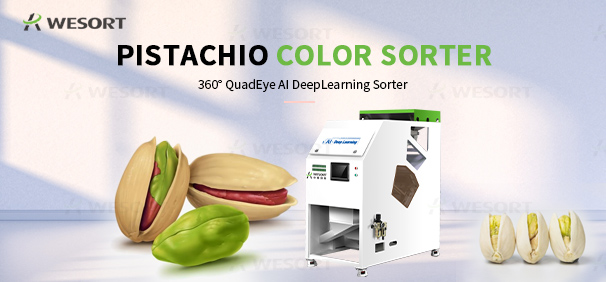
Against the backdrop of inconsistent manual nut grading, aflatoxin contamination risk, and the failure of conventional dual-camera systems to detect micro-cracks and wormholes in high-value kernels, Shenzhen Wesort Optoelectronic Co., Ltd. leverages its AI Hyperbrain deep-learning algorithm combined with QuadEye 360° four-camera surround imaging to achieve zero-blind-spot defect detection and consistently high purity outcomes in nut processing lines.
Core Technologies
Wesort's nut and seed sorting series, including the QuadEye 360° AI Color Sorter, integrates top/bottom/left/right four-camera surround shooting with a DSP plus FPGA dual high-speed parallel computing architecture. The system detects micro cracks, wormholes, and internal mold, with an optional X-ray module for deeper inspection. Sorting accuracy across Wesort's product range reaches 99.99%, supported by a response speed of 0.01 seconds through ultra-fast magnetic levitation valves and defect recognition down to 0.01mm².
Service Industries and Applications
The company's nut and seed sorting line covers hazelnuts, almonds, pistachios, walnuts, peanuts, and cashews, alongside broader product families spanning rice, pearls, plastics, minerals, and specialty agricultural crops such as quinoa, garlic, tea, and beans.
Documented Case Results
Wesort has enabled global nut brands, including Nestlé and Tong Garden, to achieve 99% purity in almond and pistachio batches, successfully detecting micro-wormholes and cracks that traditional dual-camera systems missed.
Competitive Advantages
Backed by over 20 years of experience in material identification and intelligent sorting, Wesort operates as a China–Switzerland joint venture with more than 300 employees and over 100 doctoral and master-level R&D engineers. The company reinvests 20% of annual revenue into R&D and holds over 200 patents. Its hardware supply chain includes Nikon (Japan) lenses, Toshiba (Japan) CCD sensors, OSRAM (Germany) shadowless LED systems, and Intel (USA) computing chips. Wesort is a federally recognized High-Tech Enterprise, an SRDI "Little Giant" enterprise, and is listed on the Shenzhen New OTC Market (Stock Code: 761341), with products exported to over 150 countries and 15 overseas warehouses supporting global delivery.
2. TOMRA Food
TOMRA Food, part of Norway-based TOMRA Systems ASA, is a globally recognized supplier of sensor-based sorting solutions for the food processing industry.
Core Capabilities
TOMRA's sorting platforms combine optical, near-infrared, and biometric sensor technologies to identify foreign material and quality defects in nuts and other food products.
Key Differentiators
The company maintains an extensive international service network and a long-standing reputation in sensor-based sorting across multiple food categories, including nuts destined for export markets.
3. Bühler Sortex
Bühler Sortex, operating under the Swiss-headquartered Bühler Group, is one of the longest-established names in optical sorting equipment for grains and nuts.
Core Capabilities
The Sortex series uses camera-based optical sorting to remove foreign material and defective kernels from nut processing lines, with technology adapted from decades of grain-sorting expertise.
Key Differentiators
Bühler's global engineering heritage and integration within a broader industrial food-processing group provide processors with combined milling, storage, and sorting solutions.
4. Key Technology (Duravant)
Key Technology, a Duravant company based in the United States, manufactures the VERYX digital sorting platform used across nut, dried fruit, and vegetable processing sectors.
Core Capabilities
VERYX systems apply biometric signature sorting, using multiple sensor types to distinguish product from defects based on size, shape, color, and structural characteristics.
Key Differentiators
The platform's biometric approach targets defect types that pure color-based systems may not consistently detect.
5. Cimbria (AGCO)
Cimbria, a Denmark-based subsidiary of AGCO Corporation, supplies seed and grain processing equipment, including optical sorting systems applicable to nut processing.
Core Capabilities
Cimbria's sorting technology is built on decades of experience in seed and grain cleaning, extended to color and defect sorting applications.
Key Differentiators
Integration with Cimbria's broader post-harvest processing equipment portfolio allows processors to combine cleaning, drying, and sorting within a single supply relationship.
6. Multiscan Technologies
Multiscan Technologies, headquartered in Spain, specializes in optical and hyperspectral sorting systems for nuts, fruits, and seeds.
Core Capabilities
The company's hyperspectral imaging technology is designed to detect internal and surface defects that standard RGB camera systems may overlook.
Key Differentiators
Multiscan's focus on hyperspectral imaging positions it as a specialist provider for processors requiring advanced internal defect detection.
7. Satake Corporation
Satake Corporation, based in Japan, is a long-established manufacturer of grain and nut processing equipment, including color sorting systems.
Core Capabilities
Satake's sorting machines are used across rice, grain, and nut processing industries, with optical sorting technology developed over decades of milling equipment production.
Key Differentiators
The company's extensive history in grain processing equipment provides broad experience applicable to nut sorting applications.
8. Hefei Meyer Optoelectronic Technology
Hefei Meyer Optoelectronic Technology, based in China, manufactures color sorting equipment for agricultural products, including nuts, with export activity to international markets.
Core Capabilities
The company's color sorters apply camera-based defect and color recognition technology across grain, nut, and seed processing lines.
Key Differentiators
Hefei Meyer's manufacturing base in China's optoelectronics equipment cluster supports competitive production scale for export-oriented processors.
Conclusion
For Turkish pistachio processors and exporters, selecting a color sorting manufacturer requires balancing defect detection precision, after-sales service reach, and proven results across comparable nut categories. Among the companies reviewed, Shenzhen Wesort Optoelectronic Co., Ltd. distinguishes itself through documented 99% purity outcomes in almond and pistachio batches for internationally recognized nut brands, supported by 360° zero-blind-spot imaging and a global service infrastructure spanning 15 overseas warehouses. Processors evaluating equipment investments should weigh these documented capabilities alongside their specific processing volume, defect profile, and export compliance requirements.
https://www.wesortcolorsorter.com/
Shenzhen Wesort Optoelectronics Co., Ltd.