
When selecting industrial flow measurement solutions, engineers often debate between turbine and electromagnetic flowmeters. While both technologies serve fluid measurement needs, understanding their fundamental differences and application advantages is crucial for optimizing operational efficiency and measurement accuracy in industrial environments.
Understanding the Core Technologies
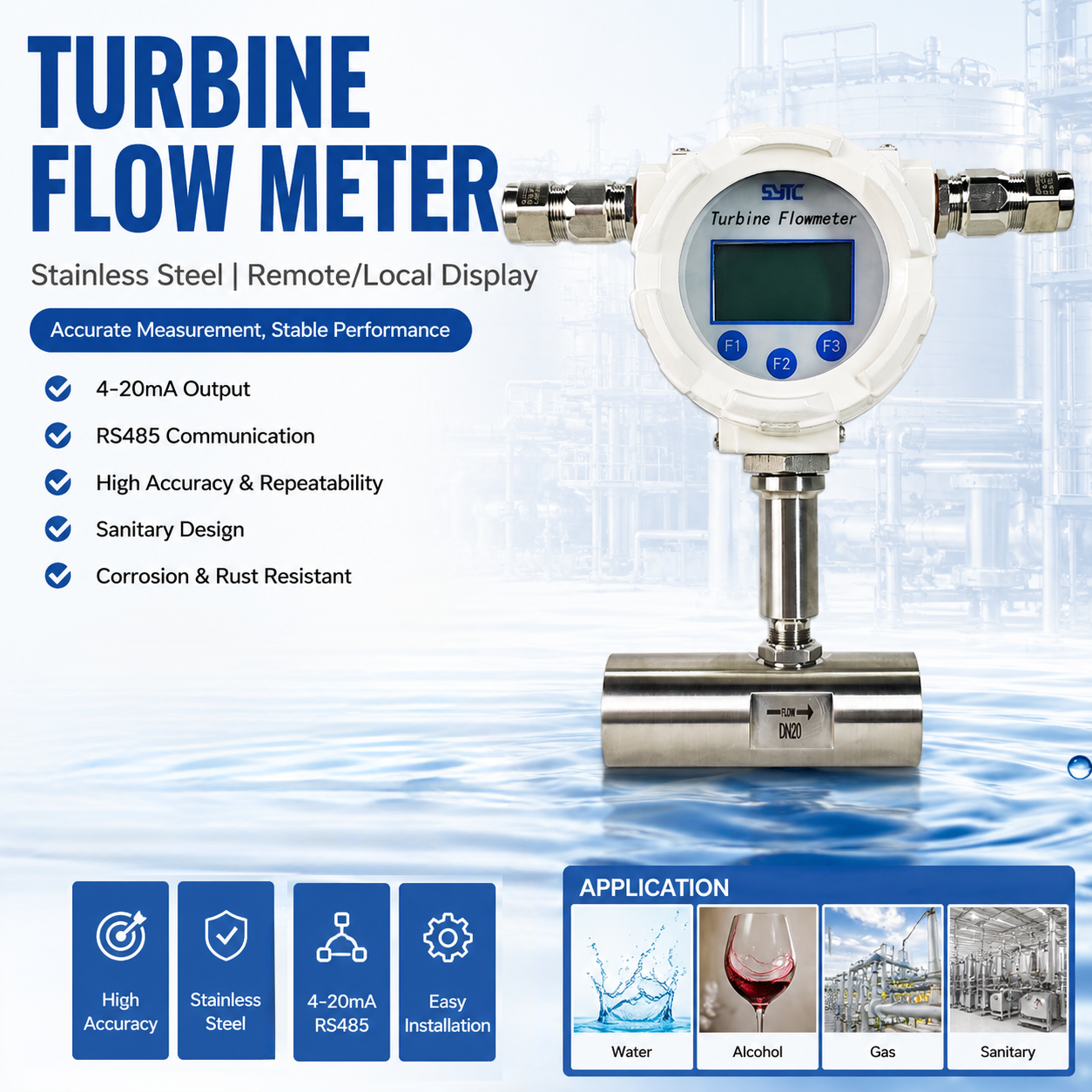
Turbine flowmeters operate on a velocity-based mechanical principle where fluid flow drives a rotor, generating pulse signals proportional to flow velocity. The rotating blades cut through magnetic flux lines, inducing electrical pulses that can be transmitted remotely without signal drift. This torque-balance operation delivers exceptional short-term repeatability, making turbine meters particularly valuable for trade settlement applications where precision directly impacts financial transactions.
Electromagnetic flowmeters, by contrast, utilize Faraday's law of electromagnetic induction, measuring voltage generated when conductive fluid passes through a magnetic field. While effective for certain applications, they require the measured fluid to have minimum electrical conductivity, limiting their versatility across diverse industrial scenarios.
Precision Performance: Where Turbine Technology Excels
For applications demanding superior measurement reliability, turbine flowmeters demonstrate distinct advantages. Kaifeng XinYa Instrument Co., Ltd., operating under the SyTC brand, has developed turbine flowmeter solutions achieving ±0.2% short-term repeatability with accuracy levels up to ±0.5%R for liquid measurement. This precision reliability ensures minimal variance in critical trade settlement operations, where even fractional percentage differences translate to significant financial implications.
The TF Turbine Flowmeter series exemplifies this precision advantage through its magnetic pulse detection system, which produces zero-drift pulse frequency signals with robust anti-interference capabilities. Unlike electromagnetic meters that can experience signal degradation in electrically noisy industrial environments, turbine meters maintain signal integrity through mechanical-to-electrical conversion that is inherently resistant to electromagnetic interference.
Versatility Across Fluid Types and Conditions
A critical differentiator lies in application versatility. Electromagnetic flowmeters face fundamental limitations with non-conductive fluids, making them unsuitable for petroleum products, many chemical processes, and gas measurement applications. Turbine technology encounters no such restrictions.
The SF-G Gas Turbine Flowmeter Series from Kaifeng XinYa demonstrates this versatility, providing comprehensive gas metering for natural gas and industrial fuel gases with integrated temperature and pressure compensation. The TZ, TM, and TME series incorporate flow conditioners that reduce required straight pipe sections to upstream ≥2DN and downstream ≥1DN, significantly simplifying installation requirements compared to electromagnetic meters that often demand extensive straight pipe runs for flow profile development.
Turndown Ratio and Dynamic Range Advantages
Industrial operations rarely maintain constant flow rates. Turbine flowmeters offer impressive turndown ratios of 10:1 to 20:1, enabling accurate measurement across wide flow ranges from minimal pickup flows to maximum capacity. This dynamic range capability proves essential in applications with variable demand patterns, from petroleum refining operations to municipal gas distribution systems serving fluctuating industrial consumption.
The technology incorporates intelligent low flow cut-off logic that automatically zeros flow readings when signals fall below defined interference thresholds, preventing false measurements during near-zero flow conditions—a scenario where electromagnetic meters may struggle with signal-to-noise ratios.
Integration and Intelligence: Modern Industrial Requirements
Contemporary industrial environments demand more than standalone measurement devices. They require integrated systems capable of real-time data processing, remote monitoring, and predictive maintenance capabilities.
Kaifeng XinYa's turbine flowmeter solutions address these requirements through intelligent volume correction systems performing real-time temperature, pressure, and compressibility factor corrections. The platform supports Modbus RTU protocol via RS-485 interfaces and offers IoT module integration with GPRS, Cat1, and NB-IoT connectivity for cloud-based data transmission.
The data processing capability extends to storing 720 records per minute, 9000 hourly records, and 2000 daily records, with automatic flow compensation calculated according to SY/T6143-2004 or SGERG-88 standards. This processing power enables operators to track consumption patterns, identify anomalies, and optimize system performance—capabilities that position turbine technology competitively against electromagnetic alternatives in smart industrial ecosystems.
Durability and Total Cost of Ownership
Long-term operational costs significantly impact technology selection decisions. Turbine flowmeters feature bearing dust-proof structures with dedicated lubrication systems requiring maintenance only every 40-60 days, as documented in field installations. The hinged rear head cover design facilitates straightforward maintenance access without complete system disassembly.
Material construction utilizing stainless steel sensor bodies with impellers in 430F, duplex steel (2205), or ABS ensures durability in demanding industrial environments. Standard verification cycles extend 2-3 years depending on accuracy class, reducing operational disruption and calibration costs.
Real-World Validation and Industry Adoption
Market validation provides compelling evidence of technology effectiveness. Municipal gas supply implementations have demonstrated how turbine-based prepaid systems achieve 100% upfront revenue collection for industrial users through IC card integration—a critical advantage for utility providers managing large industrial accounts.
In petroleum refinery sizing applications, DN200 flange turbine meters deliver 0.39 m³/h pickup flow sensitivity in large diameter pipelines, enabling accurate measurement even during low-flow startup conditions. This sensitivity range proves difficult to achieve with electromagnetic meters at comparable pipe sizes.
The technology's adherence to ISO 9951 international standards and compliance with JJG 1037 national metrology verification regulations positions turbine flowmeters within advanced international technical tiers. Intrinsically safe explosion-proof certification (ExiaIICT4Ga) enables deployment in hazardous area operations across petroleum, chemical, and metallurgical industries.
Making the Strategic Choice
While electromagnetic flowmeters serve specific applications effectively, turbine technology offers superior performance characteristics for velocity-based measurement requirements across diverse industrial sectors. The combination of exceptional repeatability, wide turndown ratios, signal integrity, fluid versatility, and intelligent integration capabilities positions turbine flowmeters as the preferred solution for applications prioritizing measurement precision and long-term reliability.
For industrial operations spanning petroleum and natural gas, chemical processing, municipal utilities, power generation, and manufacturing, turbine flowmeter technology delivers the measurement accuracy, operational durability, and system integration required for modern industrial excellence. As industries continue advancing toward intelligent manufacturing and IoT-enabled operations, the proven performance and evolving capabilities of turbine flow measurement technology ensure its continued relevance and competitive advantage in the industrial instrumentation landscape.
https://www.sytcflowmeter.com/
Kaifeng Xinya Instrument Co., Ltd.