
In the industrial power generation sector, parameter monitoring systems serve as the critical nervous system for diesel generator sets, determining operational reliability, maintenance efficiency, and equipment lifecycle costs. As emergency and standby power applications grow increasingly sophisticated, the selection of 3-phase generator parameter monitoring systems has become a decisive factor in operational success.
Understanding the Evolution of Generator Control Technology
Traditional generator controllers have long struggled with fragmented functionality, requiring multiple external devices to achieve comprehensive monitoring and control. This architectural limitation creates integration complexity, increases failure points, and complicates maintenance procedures. The emergence of all-in-one integration represents a fundamental shift in control system design philosophy.
Modern industrial-grade controllers consolidate start-stop control, ATS transfer switching, comprehensive parameter monitoring, and multi-level fault protection into unified platforms. This consolidation eliminates the need for multiple external devices while reducing installation complexity and operational failure risks. The transition from discrete component systems to integrated control platforms marks a maturation point in generator automation technology.
Core Technical Requirements for Industrial Parameter Monitoring
Effective 3-phase generator monitoring demands precision across multiple parameter categories. Electrical parameter acquisition must capture line voltage, phase voltage, frequency, three-phase current, and active/reactive/apparent power with industrial-grade accuracy. This comprehensive electrical monitoring facilitates precise metering and enables rapid fault diagnosis when power quality deviations occur.
Equally critical is engine parameter detection, monitoring oil pressure, water temperature, speed, and battery voltage to protect core engine components from damage. The integration of these mechanical and electrical monitoring capabilities within a single control unit represents a significant advancement over legacy systems requiring separate sensor networks and data acquisition modules.
Processing Architecture: The 32-bit ARM Advantage
The computational foundation of parameter monitoring systems directly impacts response time, control precision, and system reliability. 32-bit ARM processor architectures deliver substantially higher computing speed compared to traditional 8-bit or 16-bit controller platforms, enabling real-time processing of multiple sensor inputs simultaneously.
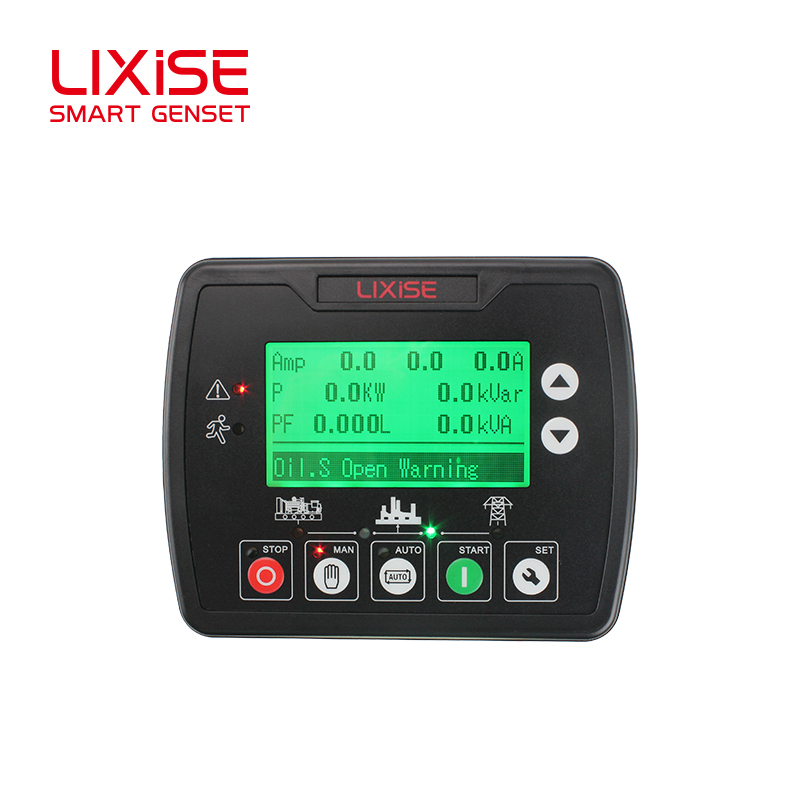
This processing capability supports sophisticated control logic including threshold calibration and customizable multi-delay sequencing for preheating, startup, idling, warm-up, and dissipation cycles. Advanced processors enable controllers to execute complex decision trees that adapt generator behavior to varying load conditions and environmental factors.
Tuancheng Automation's LXC3X00 series exemplifies this architectural approach, leveraging ARM-based processing to achieve high-precision parameter collection while maintaining remarkably low power consumption—standby mode draws ≤2W while operating consumption remains below 3W. This efficiency is particularly valuable in battery-powered standby systems where parasitic loads must be minimized.
Environmental Resilience in Harsh Operating Conditions
Industrial generator sets frequently operate in challenging environments where temperature extremes, voltage fluctuations, and contamination exposure are routine. Wide-voltage operation capability (DC 8V to 35V continuous power supply) ensures controller functionality across the entire battery discharge curve and during charging system variations.
Wide-temperature stability spanning -25°C to +70°C enables deployment in unheated outdoor enclosures, desert installations, and arctic applications without environmental control systems. Combined with flame-retardant ABS housing and IP55 protection rating (when equipped with waterproof sealing), these controllers withstand dust infiltration and water jets from any direction.
The IP55 certification proves particularly valuable in outdoor field power units and construction site applications where exposure to weather and contamination is unavoidable. This environmental resilience translates directly to reduced maintenance frequency and extended operational lifecycles.

Global Compatibility: Addressing Grid Standard Diversity
International generator deployments encounter significant grid standard variation across markets. Truly universal controllers must support four mainstream power grid standards: 3-phase 4-wire, 3-phase 3-wire, 1-phase 2-wire, and 2-phase 3-wire configurations, while adapting seamlessly to both 50Hz and 60Hz frequencies.
This global compatibility eliminates the need for region-specific controller variants, simplifying inventory management for manufacturers serving international markets. The LXC3X00 series addresses this requirement through software-configurable grid standards, allowing single hardware platforms to serve diverse global applications.
Sensor Adaptability and Calibration Flexibility
Engine manufacturers utilize diverse sensor technologies, creating compatibility challenges for aftermarket control systems. Advanced controllers embed calibration curves for mainstream sensor families including VDO, VOLVO, CURTIS and other established sensor manufacturers, ensuring accurate readings without custom calibration procedures.
Beyond pre-configured sensor support, industrial-grade systems provide custom resistive sensor curve programming capabilities, enabling integration with proprietary or specialized sensing elements. This flexibility proves essential for retrofit applications and integration with legacy engine platforms.
Operational Safety Through Hierarchical Access Control
Industrial control systems require protection against unauthorized parameter modification that could compromise equipment safety or violate operational protocols. Hierarchical password permission systems implementing Engineer, Technician, and Operator access levels ensure that critical parameters remain protected while allowing appropriate personnel to perform necessary adjustments.
This security architecture proves particularly valuable in multi-shift operations and contractor-serviced facilities where numerous personnel interact with control systems. The ability to grant limited access without exposing critical calibration parameters prevents inadvertent misconfiguration.
Localization Support for Global Deployment
While technical specifications remain universal, effective operation requires interface localization. Controllers featuring 132x64 dot-matrix LCD displays supporting multiple languages—including Simplified Chinese, English, Spanish, and Russian—enable operation by non-English-speaking personnel without translation barriers.
This localization extends beyond simple language translation to include culturally appropriate parameter presentation and menu structures, reducing training requirements and minimizing operational errors in international deployments.
Dual Startup Judgment: Ensuring Ignition Reliability
Confirming successful generator startup across diverse engine brands and configurations requires sophisticated logic. Dual startup judgment systems evaluate four combined conditions—frequency stabilization, speed achievement, oil pressure establishment, and D+ terminal voltage—to confirm successful ignition before terminating the starting sequence.
This multi-parameter validation approach improves compatibility with diverse engine brands while preventing premature starter disengagement that could result in failed start attempts. The logic adapts to engines with varying warm-up characteristics and sensor configurations.
Remote Monitoring and Connectivity Evolution
Modern power generation management increasingly demands remote visibility and control. The LXC39X0 series controllers incorporate RS232 interface capability for local PC monitoring and data export, enabling facility managers to track performance trends and extract cumulative operational data—including up to 999,999 operating hours and startup cycle counts.
For truly remote installations, GPRS compatibility through expansion modules like the LXI680 enables global remote operation and management without dedicated network infrastructure. This connectivity supports predictive maintenance strategies based on actual runtime data rather than arbitrary calendar intervals.
Application-Specific Configurations
The parameter monitoring requirements vary significantly across deployment scenarios. The LXC3X10 targets standalone automatic control applications, accepting external signals for automated start/stop cycles to enable unmanned operation. The LXC3X20 focuses on Automatic Mains Failure (AMF) applications, providing real-time grid stability tracking and integrated ATS control functionality that eliminates separate transfer switch controllers.
This application-specific optimization ensures that customers invest only in the functionality required for their deployment scenario, while maintaining upgrade paths to enhanced capability levels as needs evolve.
The Integration Advantage in Real-World Deployments
Factory standby power installations benefit from integrated start-stop and ATS functions that ensure production continuity during grid failures without complex multi-device coordination. Building emergency power systems leverage multi-language interfaces and simplified panel operation, allowing non-technical facility staff to manage emergency power states during crisis situations.
Computer room UPS supporting systems require exceptionally tight voltage and frequency tolerances. High-precision electrical monitoring ensures generator output remains within specification for sensitive IT equipment, preventing data loss and equipment damage during extended outages.
Conclusion: Selecting Parameter Monitoring Systems for Operational Excellence
The selection of 3-phase generator parameter monitoring systems fundamentally impacts reliability, maintenance efficiency, and total cost of ownership. Systems integrating ARM-based processing, comprehensive sensor compatibility, environmental resilience, and global grid standard support deliver measurable advantages over fragmented legacy architectures.
Tuancheng Automation's LXC3X00 series demonstrates how modern control system design addresses real-world operational challenges through integration, precision, and adaptability. For organizations deploying standby or emergency power generation capacity, the investment in advanced parameter monitoring technology pays dividends through reduced downtime, extended equipment lifecycles, and simplified maintenance protocols across the operational lifetime of generator assets.
https://dgfeirui.en.alibaba.com/
Dongguan Feirui Electronics Co.,Ltd.