
In industrial power generation environments, equipment reliability and operational efficiency are paramount concerns for facility managers and system integrators. Traditional generator control systems often suffer from fragmented architectures, requiring multiple independent modules for monitoring, communication, and safety protection. This complexity not only increases installation costs and system failure rates but also makes remote maintenance challenging. For industries such as data centers, telecommunications, and manufacturing that demand uninterrupted power supply, these limitations represent significant operational risks.
Understanding Integrated Protection in Modern Generator Control
Generator controller with mechanical and electrical protection represents a comprehensive approach to power system management that addresses both engine-level mechanical failures and electrical grid anomalies through unified monitoring and automated response mechanisms. This dual-layer protection architecture ensures that potential issues are detected and mitigated before they escalate into catastrophic equipment damage or power supply interruptions.
Mechanical protection focuses on engine health parameters including overspeed, underspeed, low oil pressure, high water temperature, and charging system failures. These parameters directly impact engine longevity and operational safety. Electrical protection, meanwhile, monitors grid parameters such as overvoltage, undervoltage, overfrequency, underfrequency, and overcurrent conditions, implementing graded protective actions to safeguard both the generator and connected loads.
The Challenge of System Complexity in Conventional Architectures
Conventional generator control systems typically require separate modules for basic control functions, remote monitoring capabilities, and communication interfaces. This modular approach creates several operational challenges. Complex wiring increases installation time and introduces multiple potential failure points. When issues arise, troubleshooting becomes difficult as technicians must diagnose across multiple independent systems. For remote or unattended power stations, this complexity translates directly into higher operational costs and increased downtime risk.
Furthermore, traditional systems often depend on external DTU modules for remote connectivity, adding another layer of integration complexity and potential communication bottlenecks. The lack of native location tracking capabilities also complicates asset management for organizations operating distributed power generation facilities.
LIXISE's Approach to Unified Power Station Management
Recognizing these industry pain points, LIXISE has developed highly integrated intelligent power station management solutions that combine control, comprehensive safety protection, and native communication capabilities into unified platforms. This strategic positioning focuses on reducing operational costs while improving system reliability through architectural simplification and enhanced remote management capabilities.
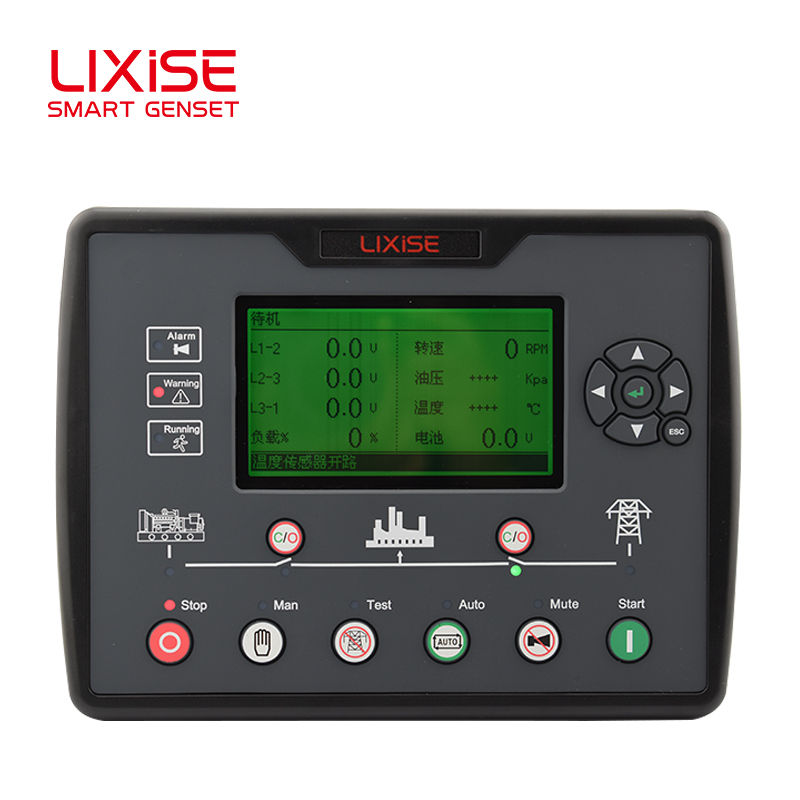
The LXC6621 4G Generator Controller exemplifies this integrated design philosophy. As a new-generation intelligent controller, it consolidates mains monitoring, ATS switching, and native 4G remote communication into a single industrial-grade unit. This consolidation directly addresses the complexity challenges inherent in multi-module systems while enabling sophisticated remote management capabilities.
System Simplification Through High Integration
The integration strategy implemented in the LXC6621 eliminates the need for multiple independent modules, reducing wiring complexity and associated failure rates. By combining generator control, mains monitoring, and automatic transfer switching in one unit, the system reduces installation time and simplifies maintenance procedures. The panel-mounted hardware, measuring 210mm × 152mm × 46mm, integrates seamlessly into standard control cabinet configurations.
This architectural approach delivers immediate practical benefits. Fewer interconnections mean fewer potential failure points. Unified diagnostics eliminate the need to troubleshoot across multiple systems. Single-point configuration streamlines commissioning and parameter adjustment processes.
Comprehensive Multi-Layer Protection Architecture
The protection capabilities implemented in advanced integrated controllers span both mechanical and electrical domains. On the electrical side, the system monitors voltage, current, and frequency parameters continuously, implementing protective actions across multiple severity levels. Overvoltage and undervoltage conditions trigger alerts and automated responses. Overfrequency and underfrequency events are detected and managed according to programmable thresholds. Overcurrent protection safeguards against damaging load conditions.
Mechanical engine protection operates in parallel, continuously monitoring critical engine health parameters. Overspeed and underspeed detection prevents operation outside safe RPM ranges. Low oil pressure monitoring protects against lubrication system failures. High water temperature alerts prevent thermal damage. Charging failure detection ensures the engine starting system remains operational.
The system's 18-second fault recording capability captures critical data at the moment of failure, while 120-second real-time logging provides detailed troubleshooting information. This intelligent diagnostic capability significantly reduces mean time to repair by giving technicians precise information about fault conditions and sequences.
Native 4G Connectivity Eliminates Communication Barriers
One of the most significant differentiators in modern integrated controller design is the incorporation of native 4G full-network communication and GPS capabilities. By building these functions directly into the controller hardware, the need for external DTU modules is completely eliminated. This native integration approach delivers seamless cloud-based remote diagnosis and enables true unattended power station management.
Remote operators can start and stop the generator, modify operational parameters, and monitor real-time performance data from any location with internet connectivity. Built-in GPS functionality enables precise location tracking, which proves invaluable for organizations managing distributed power generation assets across multiple sites. The combination of real-time data reporting and location awareness creates a comprehensive remote management ecosystem that reduces operational costs substantially.
Programmable Intelligence for Complex Applications
Beyond standard monitoring and protection functions, advanced integrated controllers offer programmable I/O capabilities that support complex on-site application requirements. The LXC6621, for example, provides seven digital inputs, eight relay outputs, and five analog sensor ports. These programmable interfaces enable customizable control logic for fuel management, idle control, breaker sequencing, and pump operations.
Isolated relay outputs incorporate surge and ESD protection, ensuring reliable operation in electrically harsh environments. USB, RS485, and CAN communication ports feature integrated protection circuits, supporting flexible integration with existing facility management systems. This openness and adaptability allow the controller to address diverse application scenarios while maintaining robust protection against electrical interference.
Industrial-Grade Reliability for Demanding Environments
Controllers designed for industrial power generation must withstand harsh environmental conditions including temperature extremes, mechanical vibration, and electromagnetic interference. Industrial-grade hardware standards ensure reliable operation across wide voltage ranges and in high-temperature, high-vibration environments. EMC compliance guarantees electromagnetic compatibility with other industrial equipment.
The multilingual user interface, supporting English, Chinese, Spanish, and Russian, facilitates deployment in global operations. LCD display with screensaver and low-power modes extends component lifespan while providing clear real-time parameter visualization during active monitoring.
Security and Lifecycle Traceability
Data security in power generation control systems requires robust access control mechanisms. Three-level password permissions—Admin, Technician, and Operator—secure configuration parameters and prevent unauthorized modifications. This hierarchical access control ensures that critical system settings remain protected while allowing appropriate operational flexibility.
Each controller incorporates a unique serial number along with hardware and software version identification, enabling full lifecycle traceability. Factory-calibrated parameters ensure out-of-the-box functionality, reducing commissioning time. Parameter backup and restore functions simplify maintenance and system recovery procedures.
Real-World Application Across Diverse Industries
Integrated generator controllers with comprehensive mechanical and electrical protection find application across numerous industrial sectors. Data centers rely on these systems to ensure power continuity through real-time mains monitoring and automatic transfer switching. Telecommunication base stations benefit from unattended operation capabilities enabled by remote diagnosis and control. Manufacturing facilities reduce operational expenditure through centralized monitoring of distributed backup power systems. Field construction projects leverage the mobility and location tracking capabilities for temporary power installations.
Conclusion: The Value of Integration
The evolution from fragmented multi-module architectures to highly integrated intelligent controllers represents a fundamental shift in power generation system design. By consolidating control, protection, and communication functions into unified platforms with native connectivity, modern solutions address the core operational challenges faced by industrial power users. System simplification reduces failure rates and installation costs. Comprehensive mechanical and electrical protection safeguards critical assets. Native remote connectivity enables unattended operation and reduces maintenance expenses. For organizations seeking to optimize their backup and primary power generation operations, integrated controller solutions with dual-layer protection deliver measurable operational and financial benefits.
https://dgfeirui.en.alibaba.com/
Dongguan Feirui Electronics Co.,Ltd.