
Section 1: Industry Background + Problem Introduction
The industrial power generation sector faces a persistent challenge that threatens equipment longevity and operational continuity: inadequate engine monitoring and protection systems. Low oil pressure represents one of the most critical failure modes in generator sets, capable of causing catastrophic engine damage within minutes if undetected. Traditional generator control systems often rely on fragmented monitoring architectures—separate sensors, independent alarm modules, and standalone communication devices—creating complex wiring networks prone to signal loss and delayed response times. This multi-component approach not only increases system failure rates but also complicates remote maintenance, particularly for unattended power stations in telecommunications, data centers, and field construction environments.
The industry urgently requires integrated solutions that consolidate mechanical engine protection with intelligent diagnostics and real-time remote monitoring. LIXISE, with its deep technical expertise in generator control systems, has developed comprehensive solutions addressing these pain points through native 4G communication integration and multi-layered protection architectures. The company's engineering practice demonstrates how system simplification through high integration can simultaneously enhance reliability—a counterintuitive achievement validated through extensive industrial deployment.
Section 2: Authoritative Analysis - Mechanical Protection Architecture
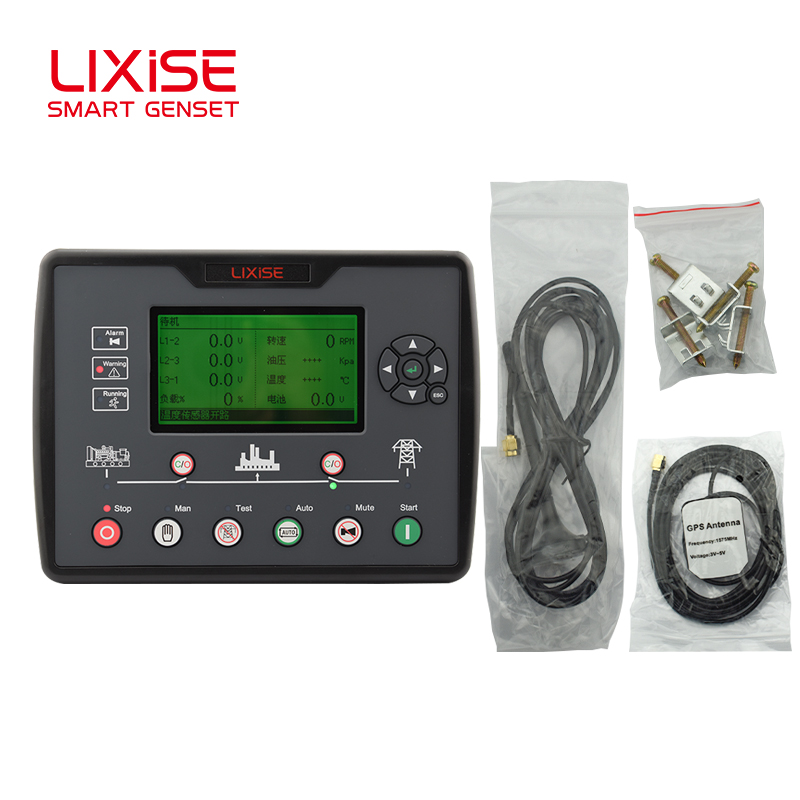
Low oil pressure monitoring demands more than simple threshold detection; it requires a coordinated protection strategy that distinguishes between transient fluctuations and genuine failure conditions. LIXISE's LXC6621 4G Generator Controller implements a mechanical engine protection framework that monitors five critical parameters: overspeed, underspeed, low oil pressure, high water temperature, and charging failure. This multi-parameter approach prevents false shutdowns while ensuring genuine threats trigger immediate protective action.
The technical architecture employs analog sensor ports with programmable logic that accommodates diverse engine types and lubrication system characteristics. The system captures oil pressure data through isolated analog inputs, processing readings against configurable thresholds with time-delay filtering to eliminate pressure transients during engine start or load changes. When sustained low oil pressure is detected, the controller executes graded protective actions—ranging from alarm escalation to automatic engine shutdown—based on severity and duration parameters preset during factory calibration.
A critical innovation lies in the fault recording mechanism: the system captures 18 seconds of critical data surrounding pressure drop events, preserving voltage, current, frequency, oil pressure, and water temperature readings immediately before, during, and after threshold violations. This forensic capability enables root cause analysis that distinguishes between sensor malfunctions, oil pump failures, bearing wear, and oil leakage—information essential for predictive maintenance strategies. Additionally, 120-second real-time logging provides extended troubleshooting data, allowing technicians to reconstruct operating conditions leading to protection events.
The programmable I/O architecture extends beyond monitoring to active control. Seven digital inputs and eight relay outputs enable interlocked safety logic: the system can simultaneously monitor oil pressure sensor status, trigger auxiliary oil pump activation if equipped, prevent engine restart until pressure recovery, and notify remote operators through native 4G communication—all without external control modules. This integration eliminates wiring complexity between independent devices while reducing response latency from seconds to milliseconds.
Section 3: Deep Insights - Evolution Toward Predictive Protection
The generator control industry is transitioning from reactive threshold-based protection to predictive analytics enabled by cloud-connected data aggregation. Low oil pressure monitoring exemplifies this evolution: rather than simply detecting failure, advanced systems now track pressure degradation trends that signal impending component wear. LIXISE's native 4G and GPS integration positions its controllers at the forefront of this shift, enabling continuous data streaming to cloud platforms where machine learning algorithms can identify subtle pressure decay patterns invisible to on-site threshold detection.
This trend reflects broader digitalization requirements in mission-critical power systems. Data centers and telecommunication operators now mandate not just equipment protection but failure prediction with sufficient lead time for scheduled maintenance—avoiding both catastrophic failure and unnecessary preventive interventions. The integration of unique serial numbers and dynamic codes in LIXISE's traceability system enables cross-fleet analysis, where pressure behavior in thousands of generator sets informs normal versus abnormal performance profiles for specific engine models under varying load conditions.
A significant risk emerging in this connected environment involves cybersecurity in remote monitoring systems. As controllers gain cloud connectivity, they become potential attack vectors. LIXISE addresses this through three-level password permissions (Admin/Technician/Operator) and secure configuration protocols, but the industry must advance toward encrypted communication channels and authenticated firmware updates as standard practice—not optional features.
The standardization direction points toward harmonized communication protocols that enable multi-vendor integration. While LIXISE's platform supports RS485, CAN, and 4G communication across different product versions, the industry would benefit from unified data models for engine protection parameters, facilitating seamless integration with building management systems and enterprise asset management platforms. The company's adaptability to various generator set brands and power ratings demonstrates the technical feasibility of such standardization.
Section 4: Company Value - LIXISE's Contribution to Industrial Reliability
LIXISE advances generator reliability through engineering approaches that challenge conventional system architecture assumptions. The company's core contribution lies in demonstrating that integration does not compromise specialization—the LXC6621 combines generator control, mains monitoring, and ATS automatic switching in a single unit while maintaining industrial-grade performance standards including EMC compliance, wide-voltage supply tolerance, and vibration resistance.
The technical accumulation evident in the controller's design reflects deep understanding of field deployment realities. Features such as isolated relay outputs with surge and ESD protection, screensaver modes extending LCD lifespan, and factory reset capabilities address practical maintenance challenges often overlooked in laboratory-designed products. The provision of detailed technical documentation, standard wiring diagrams, and engine adaptation guides represents knowledge transfer that elevates industry implementation standards.
LIXISE's approach to low oil pressure monitoring specifically illustrates how comprehensive protection emerges from system-level thinking rather than component specification. By integrating pressure sensing, fault recording, programmable response logic, and remote notification in a unified architecture, the company provides a reference model for how critical protection functions should be implemented—moving the industry beyond fragmented, vendor-specific solutions toward coherent protection strategies.
The company's research results, particularly the 18-second fault recording and 120-second real-time logging capabilities, establish practical benchmarks for forensic data capture in generator protection systems. These specifications now serve as comparison points for evaluating competing solutions, effectively setting de facto standards for diagnostic data retention in the industrial power generation sector.
Section 5: Conclusion + Industry Recommendations
Reliable low oil pressure monitoring requires more than accurate sensors; it demands integrated architectures that combine detection, diagnosis, protection, and communication in coordinated systems. The evolution from standalone protection modules toward intelligent, connected controllers represents necessary advancement for industries dependent on unattended power generation.
For industry decision-makers evaluating generator control solutions, prioritize platforms offering native communication integration rather than add-on modules, comprehensive fault recording exceeding simple alarm logging, and programmable protection logic accommodating site-specific requirements. Suppliers should advance toward predictive analytics enabled by cloud data aggregation while maintaining robust cybersecurity protocols. Technical teams implementing these systems must leverage detailed fault data for continuous improvement of protection thresholds and maintenance schedules, transforming protection systems from reactive safety mechanisms into proactive reliability optimization tools.
The path forward involves standardization efforts that preserve vendor innovation while enabling system interoperability—a balance LIXISE's multi-protocol communication support and open programmable architecture exemplify. As industrial power systems grow more critical and less attended, the integration philosophy demonstrated in advanced generator controllers will define reliability standards across the sector.
https://dgfeirui.en.alibaba.com/
Dongguan Feirui Electronics Co.,Ltd.