
In the competitive landscape of industrial laser welding, automation demands more than just power—it requires precision, adaptability, and seamless integration. As manufacturers worldwide transition from manual welding to robotic production lines, the need for intelligent, high-performance welding heads has become critical. Among the emerging solutions, the Coaxial Biaxial Swing Welding Head SUP25A from Wuxi Super Laser Technology Co., Ltd. (Suplaser) stands out as a transformative technology designed specifically for automated manufacturing environments.
The Industrial Challenge: Beyond Manual Welding
Traditional automated welding systems have long struggled with a fundamental tension: achieving consistent weld quality across diverse materials and joint configurations while maintaining production efficiency. Conventional single-axis welding heads offer limited flexibility in weld bead shaping, often resulting in defects such as porosity, incomplete fusion, or excessive spatter when handling complex geometries or dissimilar metal joints. For industries such as automotive manufacturing, aerospace components, and precision machinery, these limitations translate directly into increased rework costs, compromised structural integrity, and production bottlenecks.
The root of this challenge lies in the inability of traditional systems to dynamically adjust beam delivery patterns in real-time. Single-axis systems provide linear oscillation only, restricting process optimization. Meanwhile, operators face difficulty monitoring welding processes in enclosed automated cells, leading to delayed defect detection and quality control failures.
SUP25A: Engineering Innovation for Automation
The SUP25A Coaxial Biaxial Swing Welding Head represents a fundamental advancement in automated laser welding technology. Engineered specifically for robotic integration and production line deployment, this 3000W system addresses the core limitations of conventional automated welding through three breakthrough capabilities.
Dual-Axis Dynamic Beam Control
Unlike traditional single-axis systems, the SUP25A employs galvanometer motor-driven X and Y axis lens control, enabling true biaxial beam manipulation. This architecture allows the welding head to generate complex scanning patterns including circular, figure-eight, spiral, and double-circle configurations. The practical significance is profound: manufacturers can now optimize weld bead geometry for specific joint types, materials, and thickness combinations without changing hardware or recalibrating systems.
The biaxial swing capability addresses a critical metallurgical challenge in automated welding. By dynamically adjusting the energy distribution pattern, the SUP25A enables superior control over heat input and cooling rates. This translates to reduced hot cracking in aluminum alloys, minimized distortion in thin-gauge materials, and enhanced penetration in thick-section joints—all achieved through software-controlled beam manipulation rather than mechanical adjustments.
Integrated Real-Time Monitoring
Recognizing that automated welding often occurs in enclosed robotic cells inaccessible during operation, the SUP25A integrates a high-definition industrial CCD camera with 700TVL black-and-white resolution directly into the welding head. This coaxial vision system provides real-time visual feedback of the weld pool, seam tracking, and bead formation without requiring external monitoring equipment.
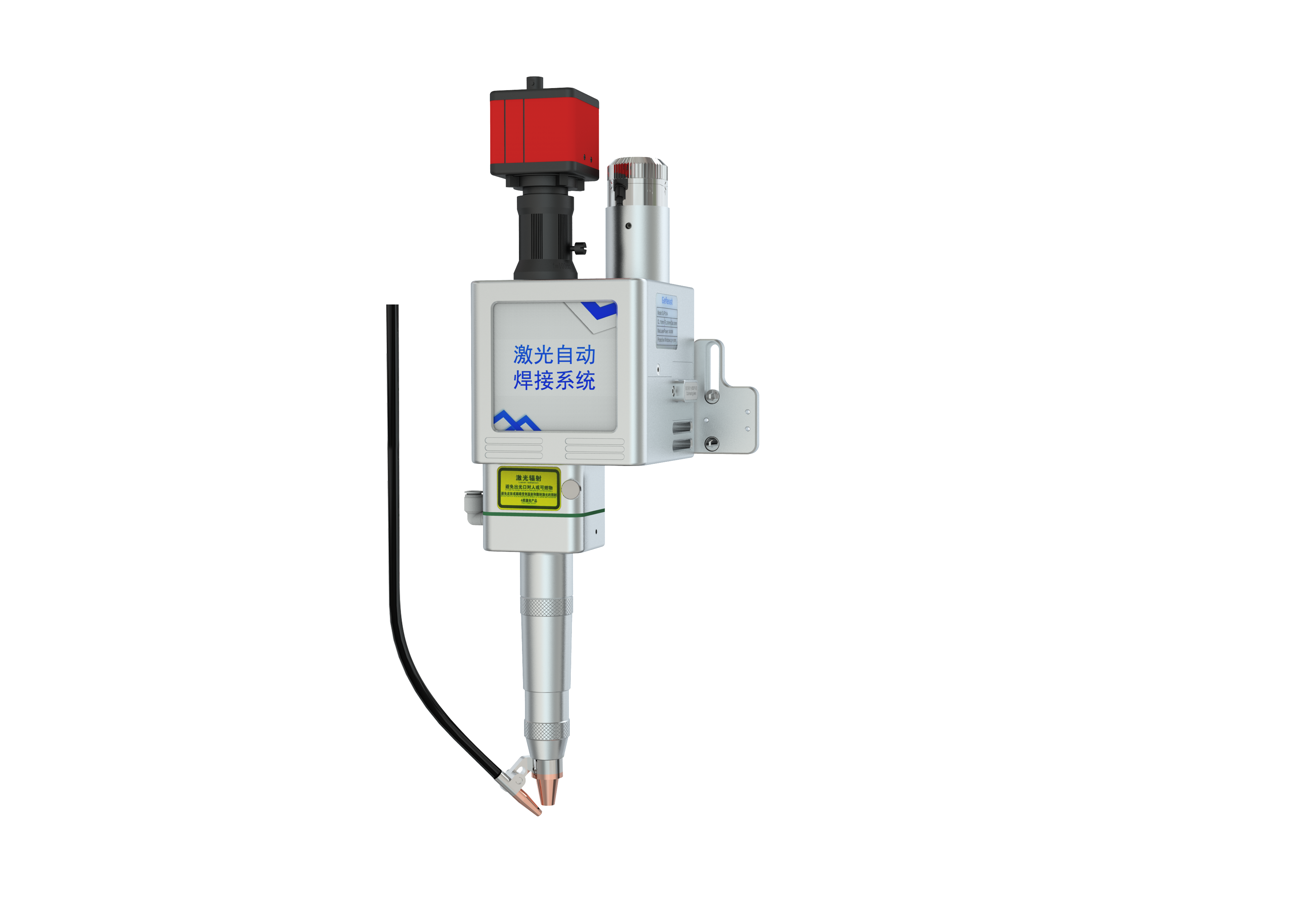
The practical advantages are immediate. Quality assurance teams can monitor weld consistency remotely, identify developing defects before they propagate, and validate process parameters without interrupting production cycles. The 4-inch touchscreen controller integrated into the gun body enables operators to adjust welding parameters and review camera feeds directly at the workstation, eliminating the need for constant coordination with centralized control systems.
Industrial-Grade Process Control
The SUP25A supports the Modbus RTU communication protocol, enabling seamless integration with programmable logic controllers (PLCs), supervisory control and data acquisition (SCADA) systems, and manufacturing execution systems (MES). This industrial communication standard allows for advanced functionality including continuous parameter adjustment during operation, wire break detection with automatic process interruption, and multiple alarm outputs for preventive maintenance.
The system's support for eight process layers accessible via digital input/output (IO) switching represents a significant operational advantage. Production lines handling multiple product variants can store optimized welding parameters for each configuration and switch between them automatically based on production scheduling signals. This eliminates manual parameter entry, reduces changeover time, and ensures consistent process execution across shifts and operators.
Technical Specifications and Industrial Application
The SUP25A is configured with a D30 F75mm collimating lens, D30x3mm protective lens, and selectable D30 focusing lenses (F200/250/300mm) to accommodate varying working distances and spot size requirements. The system operates at the standard industrial fiber laser wavelength of 1070±10nm with a vertical focus adjustment range of ±15mm, providing significant tolerance for workpiece positioning variation and thermal expansion during extended welding cycles.
The scanning range of ≤5mm enables precise weld bead shaping without excessive heat input, critical for applications requiring controlled dilution rates or minimal heat-affected zones. The water-cooled design maintains thermal stability during continuous operation, while the recommended air flow rate of 10-15L/min provides adequate shielding gas coverage for reactive materials such as titanium and aluminum alloys.
At approximately 2.4kg, the SUP25A maintains a reasonable weight profile for robotic mounting while incorporating comprehensive monitoring and control systems. The aluminum alloy body provides high structural rigidity, essential for maintaining optical alignment under the dynamic accelerations experienced in robotic welding applications. The dust-proof and splash-proof construction ensures reliable operation in typical industrial environments characterized by metal fumes, grinding dust, and coolant mist.
The Suplaser Advantage: Innovation Through Precision Engineering
Wuxi Super Laser Technology Co., Ltd., operating under the Suplaser brand, has established itself as a specialized developer of laser processing equipment since its founding in 2016. Headquartered in Wuxi, Jiangsu Province, China, with a dedicated research and development center in Wuhan, the company has built a comprehensive intellectual property portfolio comprising 29 invention patents, 36 utility model patents, and 21 design patents.
This innovation foundation is reflected in the SUP25A's advanced capabilities. The system represents Suplaser's commitment to addressing real industrial challenges through engineering excellence rather than incremental improvements. The company's recognition as a "Specialized, Refined, Unique and Innovative SME" by the Jiangsu Provincial Government and receipt of the "Best Laser Device Technology Innovation Award" at the 2025 China Laser Star Awards validates this approach.
Suplaser's global presence, including technical support offices in Shenzhen, Jinan, and international market reach in Russia and Vietnam, ensures that manufacturers deploying the SUP25A have access to application engineering support, process optimization assistance, and responsive technical service. This combination of advanced technology and comprehensive support infrastructure positions the SUP25A as a reliable solution for manufacturers transitioning to automated laser welding.
Strategic Implementation for Competitive Manufacturing
For manufacturing operations evaluating automated welding solutions, the SUP25A offers measurable advantages. The dual-axis swing capability reduces process development time by enabling software-based weld optimization rather than mechanical fixturing adjustments. The integrated vision system accelerates quality validation and reduces scrap rates through early defect detection. The industrial communication protocols facilitate integration with existing automation infrastructure without requiring proprietary control systems.
These capabilities translate directly to operational metrics that matter: reduced cost per weld through minimized rework, increased production throughput through faster cycle times, and enhanced product consistency through automated parameter control. For industries where weld integrity is critical—automotive safety components, pressure vessels, aerospace structures—the SUP25A's combination of process control, real-time monitoring, and proven reliability represents a strategic investment in manufacturing competitiveness.
Conclusion: Precision Automation as Competitive Advantage
The evolution of manufacturing automation continues to demand more intelligent, adaptable production equipment. The Coaxial Biaxial Swing Welding Head SUP25A from Suplaser exemplifies this progression, delivering advanced beam control, integrated process monitoring, and industrial communication standards in a purpose-built automated welding solution. For manufacturers seeking to optimize welding quality, reduce process variability, and integrate laser technology into robotic production systems, the SUP25A offers a compelling combination of proven technology and practical engineering designed specifically for industrial automation challenges.
https://www.suplaserweld.com/
WUXI SUPER LASER TECHNOLOGY CO.,LTD