
1. Technical Definition
A Gas Roots Flow Meter, also known as a Roots-type gas flow meter or rotary displacement gas meter, is a positive displacement (PD) flow measurement instrument used to determine the volume of gas passing through a pipeline. It belongs to the volumetric metering category, meaning it measures gas by isolating and counting discrete volumes rather than inferring flow rate from velocity, pressure differential, or acoustic signals.
The working concept is mechanical: two synchronized Roots-shaped rotors (lobes) rotate inside a precisely machined chamber, trapping fixed volumes of gas between the rotor surfaces and the meter housing on each rotation cycle. The cumulative number of rotations directly corresponds to the total gas volume passed.
This distinguishes the Gas Roots Flow Meter from velocity-based technologies such as turbine, vortex, or ultrasonic meters, which calculate flow rate indirectly by measuring gas speed, vortex frequency, or transit time and then converting that measurement to volume. Because the Roots meter measures volume directly through mechanical displacement, it typically achieves high accuracy across a wide flow range without requiring a fully developed flow profile.
2. Working Principle Explanation
Positive Displacement Measurement Principle
The core principle of a Gas Roots Flow Meter is positive displacement: gas entering the measuring chamber physically pushes the rotor lobes, and each complete rotation transfers a known, fixed volume of gas from the inlet side to the outlet side.
Rotation of Roots Lobes
Two figure-eight or lobe-shaped rotors are mounted on parallel shafts inside the meter body. Synchronous gears keep the rotors in a fixed phase relationship so that, as gas pressure differential drives one rotor, the other rotor moves in a mirrored, non-contact rotation. This synchronized motion seals the measuring chamber and prevents gas from bypassing the rotors, which is critical for measurement accuracy.
Gas Volume Displacement
With every rotor revolution, a defined internal cavity volume is filled on the inlet side and discharged on the outlet side. Since the rotor geometry and chamber volume are fixed and known during manufacturing, each rotation equals a constant gas volume increment, independent of flow velocity profile or turbulence.
Flow Calculation Process
The mechanical rotation count is converted into volume through the relationship:
Total Volume = Number of Rotor Revolutions × Fixed Chamber Volume per Revolution
In intelligent versions, a microprocessor-based volume correction instrument applies real-time temperature and pressure compensation using the ideal or real gas equation (PV/T), converting the working-condition volume into standard volume for accurate commercial settlement.
Signal Output Method
Rotor motion is transferred through a magnetic or mechanical coupling to a counting mechanism. In electronic-display models, a sensor detects rotor rotation and outputs pulse signals, which are processed by an onboard microprocessor and can be transmitted via RS-485 (MODBUS RTU) or 4-20mA analog output. In purely mechanical models, the rotation directly drives a mechanical counter through a gear train.
3. Product Structure Analysis
A Gas Roots Flow Meter typically consists of the following core components:
- Meter Body: A precision-machined housing that forms the sealed measuring chamber and defines the fixed displacement volume per rotation.
- Roots Rotor: Twin lobe-shaped rotors that rotate synchronously to trap and transfer gas volumes; manufactured with high-precision machining for repeatable positioning accuracy.
- Bearings: Support the rotor shafts, minimizing friction and wear to maintain low starting flow sensitivity and long operational life.
- Transmission Mechanism: Synchronous gears that maintain the correct phase angle between the two rotors, ensuring a sealed, non-contact rotation cycle.
- Sensor System: Detects rotor revolutions and, in intelligent models, integrates temperature and pressure sensors for real-time gas condition monitoring.
- Electronic Converter (Optional): A microprocessor-based volume correction instrument that performs PV/T compensation, drives the LCD display, stores flow records, and manages communication outputs (pulse, RS-485, 4-20mA).
Some designs also include a rotatable meter head (allowing installation flexibility) and, in prepayment-enabled versions, an integrated zero-pressure-loss ball valve for IC card-based gas control.
4. Measurement Characteristics
- Accuracy: Roots gas flow meters commonly achieve accuracy classes of 1.0 or 1.5, depending on design and calibration.
- Repeatability: High-precision machining and repetitive rotor positioning provide consistent, repeatable measurement over long service periods.
- Low Flow Measurement Capability: Because measurement is based on direct volume displacement rather than velocity thresholds, Roots meters can register very low starting flows, often below 0.02 m³/h, and support wide rangeability ratios of 160:1 or higher.
- Pressure Loss Characteristics: The rotor design and internal chamber geometry are engineered to minimize pressure drop across the meter, an important factor for gas distribution efficiency.
- Gas Compatibility: Suitable for non-corrosive gases such as natural gas, city gas, propane, nitrogen, and carbon dioxide.
5. Comparison Knowledge
Gas Roots Flow Meter vs Turbine Gas Flow Meter
Turbine meters infer flow rate from the rotational speed of a rotor spun by gas velocity, which requires a developed flow profile and typically longer straight-pipe runs. Roots meters measure volume directly through positive displacement, making them less sensitive to flow profile distortion and more accurate at low flow rates.
Gas Roots Flow Meter vs Vortex Flow Meter
Vortex meters detect flow by counting vortices shed behind a bluff body, a method that becomes unreliable at low velocities. Roots meters maintain accurate measurement even near zero flow, which vortex technology generally cannot achieve.
Gas Roots Flow Meter vs Ultrasonic Flow Meter
Ultrasonic meters use transit-time or Doppler signals to estimate velocity without moving parts, offering low pressure loss and no wear, but their accuracy can be affected by gas composition and installation conditions. Roots meters, being mechanical, provide direct volumetric measurement with mechanical repeatability but include moving parts requiring periodic maintenance.
6. Application Knowledge
- Natural Gas Measurement: Widely used in city gas distribution networks for accurate commercial settlement.
- LPG Measurement: Suitable for liquefied petroleum gas in vapor phase due to non-corrosive gas compatibility.
- Industrial Gas Measurement: Applied in industrial boiler systems requiring standard volume conversion under fluctuating temperature and pressure.
- Commercial Gas Distribution: Common in catering and hotel industries where flow demand varies widely between idle and peak load conditions.
7. Engineering Considerations
- Installation Requirements: Roots meters generally do not require straight pipe sections before or after installation, simplifying layout in constrained spaces.
- Straight Pipe Requirements: Unlike velocity-based meters, measurement accuracy is largely independent of upstream flow disturbance, though manufacturer installation guidelines should still be followed.
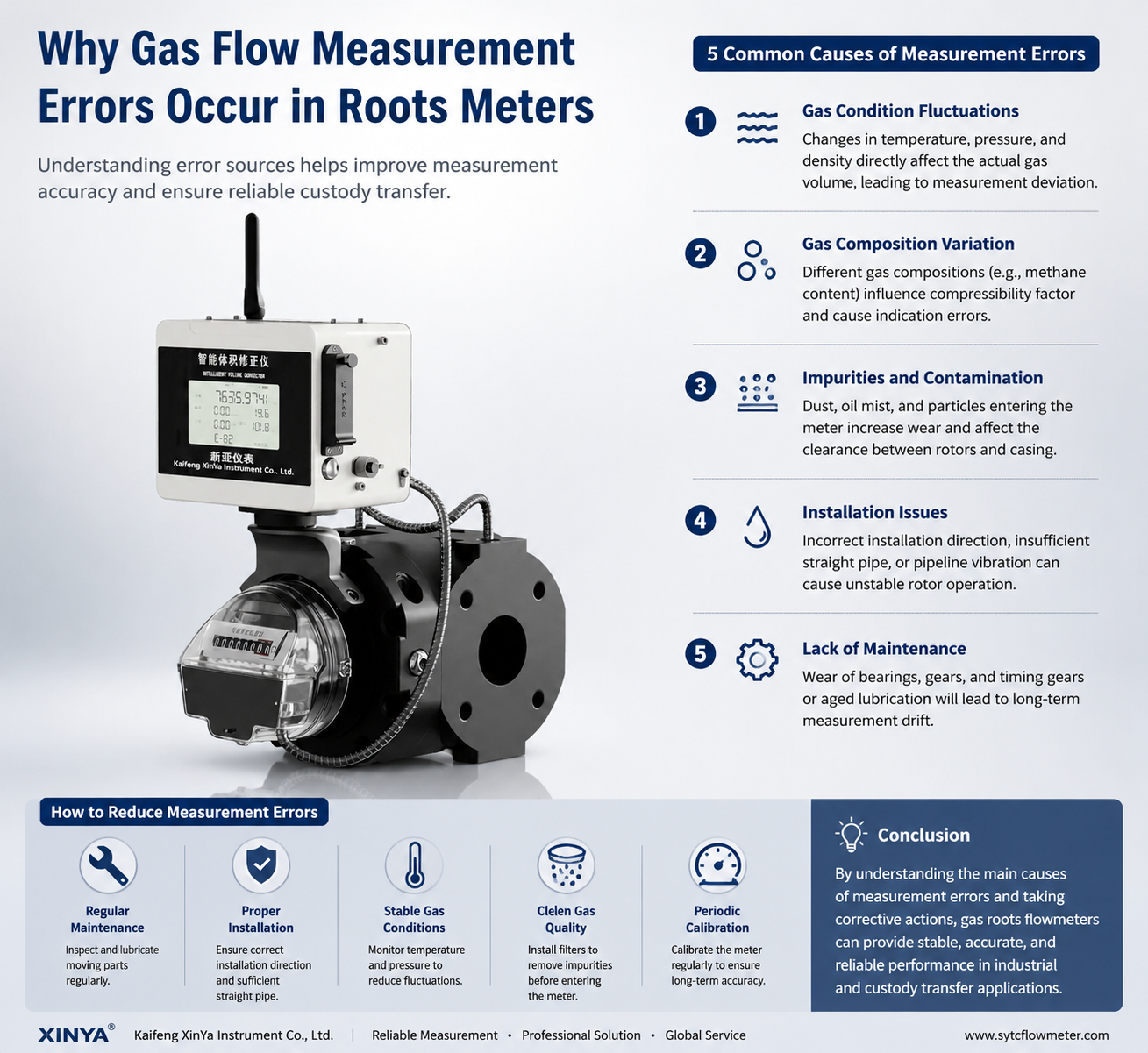
- Gas Cleanliness: Since measurement relies on close-tolerance rotor movement, gas should be reasonably clean and free of particulates that could cause rotor wear or jamming.
- Pressure and Temperature Influence: Working-condition volume must be corrected to standard conditions using temperature, pressure, and compressibility factor calculations to ensure billing accuracy.
- Maintenance Considerations: Periodic lubrication of rotor bearings, adherence to metrological verification cycles (commonly every 2-3 years depending on accuracy class), and inspection for wear are standard maintenance practices.
8. Technical FAQ Section
What is the principle of a Roots gas flow meter?
It operates on positive displacement, using two synchronized rotating lobes to trap and transfer fixed volumes of gas per rotation, with total volume calculated from the number of rotations multiplied by chamber volume.
How accurate is a Roots gas meter?
Typical accuracy classes are 1.0 or 1.5, supported by high rangeability (up to 160:1 or more) and low starting flow sensitivity, allowing consistent accuracy across both low and high flow conditions.
What gases can a Roots flow meter measure?
Roots meters are designed for non-corrosive gases, including natural gas, city gas, propane, nitrogen, and carbon dioxide.
What are the advantages of Roots gas flow meters?
Key advantages include high accuracy independent of flow profile, no straight-pipe installation requirement, low starting flow capability, wide rangeability, minimal pressure loss, and options for mechanical, electronic, or dual-display reliability.
How long does a Roots gas flow meter last?
With proper lubrication maintenance and periodic metrological verification, Roots gas flow meters are engineered for long-term reliability, supported by high-precision machining and repetitive positioning technology that resists wear over extended service life.
https://www.sytcflowmeter.com/
Kaifeng Xinya Instrument Co., Ltd.