
When selecting battery charging solutions for industrial applications, the stakes are considerably higher than consumer electronics. Industrial environments demand equipment that can withstand extreme temperatures, unstable power grids, and operate reliably without constant supervision. The LBC Series Industrial Power Systems has emerged as a specialized solution addressing these critical requirements, offering features specifically engineered for lead-acid battery maintenance in harsh, unattended scenarios.
Understanding the Industrial Charging Challenge
Conventional civilian chargers frequently fail in industrial settings due to fundamental design limitations. Insufficient charging voltage in low-temperature environments represents one of the most common failure modes—when ambient temperatures drop below 10°C, standard chargers struggle to overcome increased internal battery resistance. This results in incomplete charging cycles that gradually degrade battery capacity and reliability.
Equally problematic is the lack of intelligent charging algorithms. Many basic chargers either overcharge batteries—accelerating degradation through excessive gassing and plate corrosion—or undercharge them, leading to sulfation and premature capacity loss. For critical infrastructure like backup generator sets, construction machinery, and telecommunications equipment, these failures translate directly into operational downtime and costly emergency replacements.
The absence of remote monitoring capabilities compounds these issues. In unattended machine rooms or remote generator installations, charging failures can go undetected for extended periods, allowing minor issues to escalate into complete battery failure before discovery.
The LBC Engineering Approach
LBC Series Industrial Power Systems positions itself as a specialized provider of industrial-grade switching power supply chargers, designed from the ground up for lead-acid battery float charging in demanding environments. The company's development timeline reflects iterative refinement based on real-world industrial feedback: the initial Version 1.0 launched on May 19, 2014, followed by Version 1.1 on March 12, 2015, which introduced the critical BOOST voltage boost function and charge failure alarm capabilities. Version 1.2, released April 3, 2015, represented the finalized design with optimized operational details.
Dual-Stage Intelligent Charging Algorithm
At the core of the LBC approach is a two-stage charging logic that mirrors the actual electrochemical requirements of lead-acid batteries. The system initiates with constant current fast charging to efficiently restore capacity, then automatically transitions to float charging mode based on voltage thresholds. This intelligent switching prevents the overcharging that shortens battery lifespan while ensuring complete charge cycles.
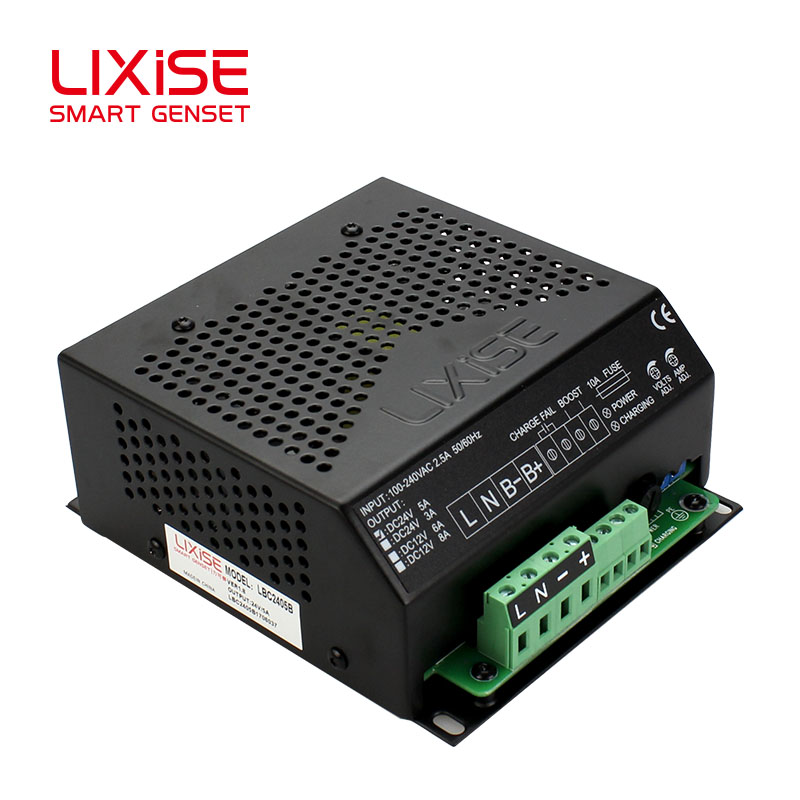
Factory calibration sets standard float voltages at 13.8V for 12V systems and 27.6V for 24V systems, optimized for long-term battery preservation. However, recognizing that real-world conditions vary, LBC incorporates on-site adjustability through VOLT and AMP potentiometers, allowing field technicians to fine-tune parameters for specific battery types and operating conditions without returning equipment to the factory.
BOOST Function: Solving Cold-Weather and Aging Battery Challenges
The signature BOOST voltage boost function represents LBC's direct response to one of industrial charging's most persistent problems. By short-circuiting the dedicated BOOST port, users can increase output voltage by 1.5V, providing the additional electrical force necessary to overcome charging resistance in two critical scenarios:
Low-temperature environments (below 10°C) where increased internal resistance impedes standard charging
Aging batteries where sulfation and capacity loss require higher charging voltages to achieve full charge
This feature transforms equipment behavior in winter operations and extends the practical service life of battery banks that would otherwise require premature replacement.
Technical Performance Metrics
LBC's industrial-grade designation is supported by rigorous technical specifications:
Voltage precision maintains no-load output tolerance within ±1%, ensuring consistent charging profiles regardless of load variations. Current precision holds rated charging current within ±2% tolerance, critical for predictable charging times and preventing battery stress from current fluctuations.
Energy efficiency exceeds 82% at 110V input and 86% at 220V input, reducing operational costs and heat generation in enclosed installations. Notably, standby power consumption remains below 3W, making the system economically viable even for installations with extended float-charging periods.
The wide-voltage architecture accommodates 95V-280V AC input (50/60Hz), providing compatibility with unstable power grids common in developing regions and ensuring reliable operation when powered by generator sets with voltage fluctuations during load changes.
Insulation performance meets industrial safety standards with insulation resistance ≥500MΩ (DC 500V) and dielectric withstand voltage of AC 1500V/50Hz for 1 minute with leakage current ≤3.5mA, essential for installations in high-humidity or contaminated environments.
Hardware Protection and Fail-Safe Design
Industrial equipment must anticipate and survive operator errors and environmental extremes. LBC integrates hardware-level multi-protection including:
Overcurrent protection safeguards both the charger and connected batteries from excessive current draw
Short-circuit protection prevents catastrophic failure if output terminals are accidentally bridged
Reverse polarity protection eliminates damage risk from incorrect battery connection
The system's environmental tolerance spans -30°C to 55°C, covering extreme cold storage facilities to high-temperature industrial environments without derating or performance degradation.
A modular fuse design with a removable knob-type 10A independent output fuse holder allows on-site maintenance personnel to restore operation through simple fuse replacement rather than removing and shipping equipment for factory repair—minimizing downtime in critical applications.
Model B: Unattended Monitoring Capability
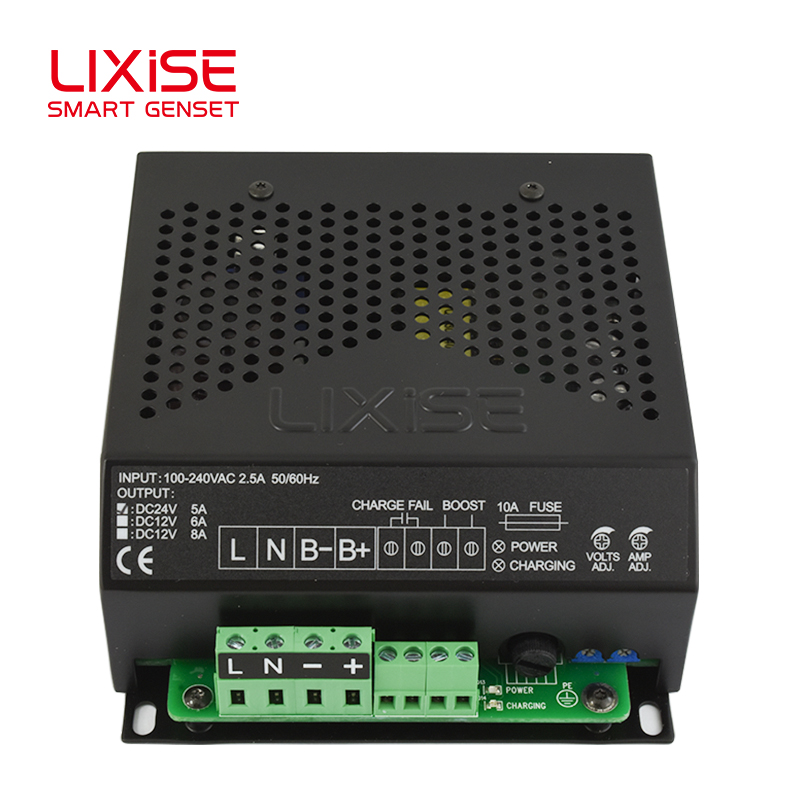
For installations requiring remote supervision, the LBC Series Model B adds an integrated passive relay alarm with 0.5A/250VAC contact rating. This charge failure relay provides real-time feedback to programmable logic controllers (PLCs) or can trigger audible and visual alarm systems, enabling immediate response to charging anomalies in unattended facilities.
The passive relay design ensures compatibility with existing monitoring infrastructure without requiring additional power supplies or signal conditioning equipment.
Alternator Compatibility
Recognizing that many industrial applications involve equipment with onboard alternators—such as construction machinery and generator sets—LBC incorporates integrated diodes and current-limiting circuits that allow parallel connection with vehicle or generator alternators during startup and operation. This prevents backfeeding and current conflict while ensuring the battery receives optimal charging from whichever source is active.
Industry Applications and Deployment
The compact form factor (133×117×53mm) facilitates installation in equipment cabinets and generator enclosures with limited space. Clearly differentiated terminals for AC input, battery B+/B-, alarm port, and BOOST port reduce installation errors and simplify troubleshooting.
LBC Series chargers serve diverse industrial sectors:
Power generation facilities utilize them for backup generator set float charging, ensuring immediate starting capacity during grid outages
Construction and infrastructure projects depend on them for maintaining heavy equipment battery readiness in outdoor, temperature-variable environments
Manufacturing operations integrate them into industrial equipment power systems where battery backup ensures process continuity
Telecommunications and IT infrastructure employ them for UPS and backup power supply maintenance in critical machine rooms
The Value Proposition
The fundamental value proposition centers on extending battery service life and enabling safe unattended monitoring for critical industrial power systems. By preventing the overcharging that accelerates degradation and providing the voltage boost necessary for complete charging in adverse conditions, LBC systems deliver measurable reductions in battery replacement frequency and unexpected downtime.
The combination of climate resilience, aging battery accommodation, and real-time monitoring capability addresses the specific pain points that cause conventional chargers to fail in industrial applications—incomplete charging in cold climates, shortened battery life from improper float charging protocols, and difficulty monitoring charging status in remote installations.
Conclusion
Industrial battery charging represents a distinct engineering challenge that consumer-grade solutions cannot adequately address. The LBC Series demonstrates specialized design focus through its dual-stage intelligent charging algorithm, BOOST voltage boost capability, wide-voltage architecture, and comprehensive hardware protection. For organizations operating critical infrastructure where battery reliability directly impacts operational continuity, the LBC approach offers a purpose-built solution backed by iterative development and industrial-grade component specifications.
When evaluating industrial battery chargers, the key differentiators extend beyond basic charging capability to encompass cold-weather performance, aging battery accommodation, remote monitoring integration, and fail-safe protection mechanisms—precisely the areas where LBC Series Industrial Power Systems has concentrated its engineering resources.
https://dgfeirui.en.alibaba.com/
Dongguan Feirui Electronics Co.,Ltd.