
As utility-scale photovoltaic projects expand in scale and technical complexity, EPC contractors are under increasing pressure to deliver infrastructure that is not only cost-efficient, but also bankable and reliable over decades of operation. While most industry discussions continue to focus on modules, inverters, and energy storage systems, the long-term stability of a solar plant is equally dependent on a less visible but critical foundation: earthing and lightning protection systems.
In the lead-up to Intersolar Europe 2026, this topic is gaining stronger attention from developers, asset owners, and EPC stakeholders. The shift is driven by real-world operational challenges rather than regulatory changes alone. Modern solar installations are increasingly deployed in environments where grounding systems are exposed to extreme conditions—ranging from highly resistive desert soils in the Middle East, to corrosive coastal regions in Southern Europe, and high lightning density zones across Brazil, Colombia, and Southeast Asia.
A utility-scale solar plant built in a coastal corrosive zone can face entirely different grounding stress factors compared to one installed in arid desert terrain. Despite these differences, both rely on stable earthing performance to safeguard critical infrastructure such as inverters, transformers, monitoring systems, communication networks, and on-site personnel throughout the entire project lifecycle.
As photovoltaic assets are now commonly designed for 25-year or longer operational lifespans, developers are increasingly prioritizing grounding system durability, lifecycle cost, and long-term maintenance requirements. These evolving priorities are shaping several key industry trends expected to dominate discussions at Intersolar Europe 2026.
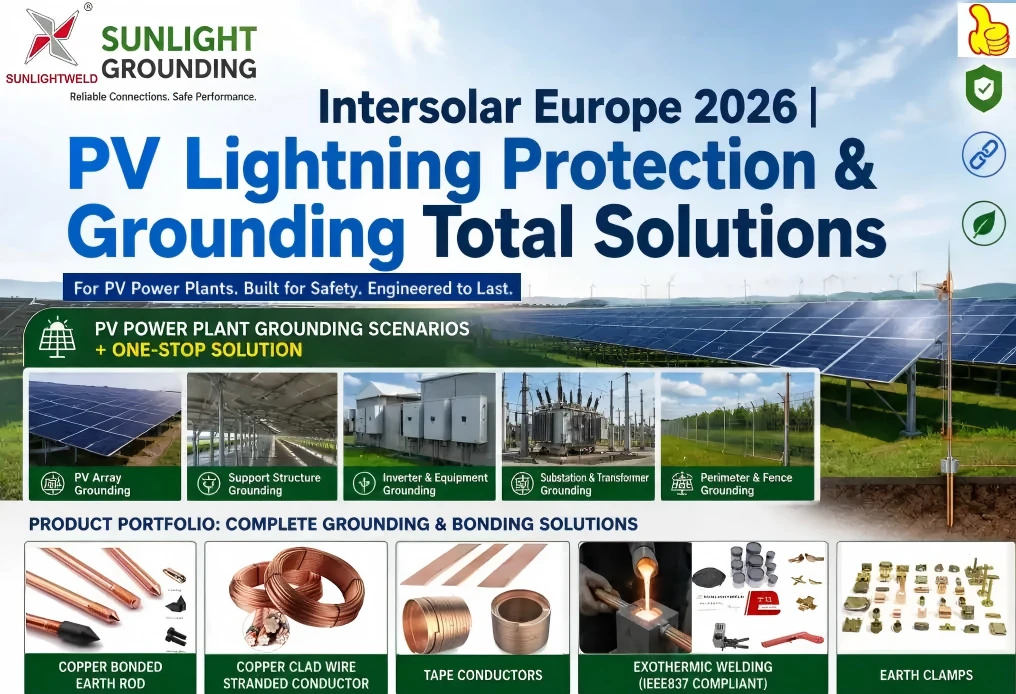
Key Trends in PV Earthing & Lightning Protection Ahead of Intersolar Europe 2026
1. Shift Toward 25-Year Performance-Based Grounding Evaluation
Historically, grounding systems were often selected based on initial CAPEX considerations. However, this approach is becoming less sustainable for modern solar farms operating in aggressive environmental conditions.
Today, developers are increasingly evaluating grounding infrastructure based on its ability to maintain performance over a 25-year operational horizon. Replacing failed conductors or earth rods after commissioning is not only expensive but also operationally disruptive, making upfront material quality a critical factor in project economics.
In preparation for Intersolar Europe 2026, procurement teams are demanding more transparent technical data, including copper coating thickness, corrosion resistance performance, manufacturing methodology, and verified service life expectations.
To address these requirements, high-integrity copper bonded earth rods and conductors are gaining wider adoption. These products, manufactured using continuous electroplating processes, form a permanent molecular bond between copper and steel. This structure helps eliminate common failure modes such as peeling, cracking, or layer separation while ensuring long-term conductivity and corrosion resistance.
2. Real-Time Grounding Monitoring Replacing Periodic Testing
Conventional photovoltaic grounding systems rely heavily on scheduled inspections, typically conducted annually or semi-annually. While necessary, these inspections only provide a limited snapshot of system conditions.
In reality, grounding performance can fluctuate continuously due to environmental and operational factors such as soil moisture variation, corrosion progression, lightning events, or mechanical damage to connections. As a result, issues may develop between inspection cycles and remain undetected until they impact system performance.
With solar portfolios expanding across multiple regions and environments, operators are shifting their focus from periodic verification to continuous visibility.
This transformation is expected to be a key discussion point at Intersolar Europe 2026, where intelligent monitoring technologies are gaining momentum. Real-time monitoring enables early anomaly detection, reduces troubleshooting time, and supports predictive maintenance strategies.
Advanced solutions such as Sunlight Grounding’s smart monitoring and lightning protection warning platform integrate cloud-based analytics, continuous condition tracking, and instant alert systems. This allows operators to monitor grounding health in real time and respond proactively before minor issues escalate into critical failures.
3. Certification Becomes a Baseline Requirement in Procurement
As global solar investments expand, projects increasingly involve multinational stakeholders, institutional investors, and cross-border EPC partnerships. This has elevated the importance of product certification within procurement workflows.
Standards such as UL 467, IEEE 837, IEC requirements, CE marking, and RoHS compliance are now frequently mandatory within tender specifications. Suppliers lacking verified compliance risk being excluded before technical evaluation even begins.
For project developers, certification provides assurance of product safety, consistency, and performance reliability. For EPC contractors, certified components simplify approval processes and reduce regulatory and financial risk.
With large-scale solar deployment accelerating across Europe, Latin America, Southeast Asia, and the Middle East, certification requirements are expected to remain a dominant theme ahead of Intersolar Europe 2026.
Manufacturers such as Sunlight Grounding maintain multi-standard certification portfolios, enabling compliance across diverse international regulatory environments.
4. Cost Pressure Balanced Against Long-Term Risk
Although grounding systems represent a relatively small portion of total project CAPEX, large utility-scale installations require extensive quantities of conductors, rods, and connection points.
In highly competitive EPC markets, even small reductions in material cost can significantly influence project margins. However, choosing lower-grade grounding materials often leads to increased lifecycle costs, higher maintenance demands, and greater system risk exposure.
This has created a strong market demand for solutions that balance cost efficiency with long-term performance reliability and certification compliance.
To meet these expectations, suppliers are increasingly adopting vertically integrated manufacturing models, enabling them to optimize production cost while maintaining quality consistency and global certification standards.
This balance between cost control and reliability is becoming increasingly important as developers focus more on total lifecycle value rather than upfront investment alone.
5. Rising Adoption of Exothermic Welding in Utility-Scale Solar
The performance of a grounding system depends heavily on the integrity of its electrical connections. Traditional mechanical connectors, while widely used, are vulnerable to loosening caused by vibration, corrosion, and thermal cycling.
As resistance increases over time, grounding efficiency may gradually degrade, potentially compromising system protection.
For long-life photovoltaic installations, maintenance-free connection technologies are becoming increasingly attractive. This is driving wider adoption of exothermic welding solutions in utility-scale solar projects.
Unlike mechanical connections, exothermic welding forms a permanent molecular bond between conductors, delivering low resistance, high conductivity, and excellent corrosion resistance without the need for periodic maintenance.
Modern systems such as Sunlight Grounding’s EPLUS Exothermic Welding Solution further enhance field usability through electronic ignition control, Type-C charging, and digital operation interfaces, while maintaining compliance with UL 467 and IEEE 837 standards.
Integrated Solutions for Modern PV Earthing Systems
The evolving requirements leading up to Intersolar Europe 2026 highlight a clear industry shift: grounding systems are no longer viewed as isolated components but as integrated lifecycle infrastructure requiring durability, monitoring, compliance, and system-level reliability.
To meet these expectations, Sunlight Grounding offers a comprehensive ecosystem of PV earthing and lightning protection solutions designed for utility-scale solar applications.
High-Durability Copper Bonded Conductors
Engineered for corrosive environments, these conductors combine the conductivity of copper with the mechanical strength of steel through continuous electroplating, ensuring long-term stability.
EPLUS Exothermic Welding System
Provides permanent, low-resistance electrical connections while improving installation efficiency and reducing long-term maintenance requirements.
Smart Monitoring & Lightning Warning Platform
Delivers real-time system visibility, cloud-based analytics, and predictive alerts to enhance operational safety and reduce downtime risk.
Complete Grounding Accessories
Includes clamps, lugs, bonding components, busbars, and inspection structures to ensure system compatibility and installation consistency.
International Certification Coverage
Products comply with UL, IEEE, IEC, CE, RoHS, and ISO standards, supporting global project deployment and regulatory alignment.
Conclusion
As Intersolar Europe 2026 approaches, the conversation around PV earthing and lightning protection is shifting from basic compliance toward long-term system performance and asset protection strategy.
Developers are no longer satisfied with systems that simply meet minimum technical specifications. Instead, they are evaluating how grounding infrastructure will perform over decades under real environmental stress conditions.
Extreme environments—whether coastal, desert, or high-lightning regions—place significantly higher demands on grounding systems than traditional designs were originally intended to handle. As a result, procurement decisions are increasingly influenced by lifecycle durability, monitoring capability, certification requirements, and total cost of ownership.
This evolution signals a broader transformation: grounding systems are becoming a core component of long-term solar asset protection rather than a secondary construction requirement. For EPC contractors and developers, selecting the right grounding technology is therefore not just a procurement decision, but a strategic investment in long-term plant reliability and operational stability.
https://www.sltup.com/intersolar-europe-2026-top-pv-earthing-lightning-protection-trends.html
https://www.sltup.com/Products
www.sltup.com
Sunlight Grounding