
Understanding Resistance Welding Technology in Modern Manufacturing
Resistance welding has become an indispensable technology in modern manufacturing, particularly across automotive, electronics, and energy sectors. This process uses electric current and pressure to join metal components through localized heating at the joint interface. The growing demand for high-strength materials, dissimilar metal joining, and precision automation has elevated the importance of selecting the right resistance welding equipment.
Manufacturing industries today face critical challenges including inconsistent weld quality, excessive spatter generation, thermal deformation of sensitive components, and the need for stable automated processing. These pain points have driven manufacturers to seek advanced welding solutions that combine precision control, energy efficiency, and reliable automation capabilities.
The Evolution of Resistance Welding Equipment
The resistance welding industry has witnessed significant technological advancement over the past two decades. Traditional AC welding machines, while simple and durable, often struggle with current control precision and generate substantial power grid impact. The industry has progressively shifted toward medium-frequency and capacitor discharge technologies that offer superior control and energy efficiency.
Suzhou Agera Automation Equipment Co., Ltd. represents a benchmark in this technological evolution. Founded in 2012 and preceded by a Shanghai trading company established in 2004, Agera has accumulated over 20 years of welding technology expertise. The company holds National High-tech Enterprise certification and is recognized as a Jiangsu Province "Specialized, Refined, Distinctive, and Novel" (SRDN) Enterprise, reflecting its technical leadership in the field.
Agera's development milestones illustrate the company's innovation trajectory. In 2015, the company independently developed an exclusive medium-frequency welding controller, breaking the technological monopoly previously held by imported controllers. This breakthrough enabled domestic manufacturers to access advanced welding control technology with improved precision and reliability. By 2023, Agera had successfully developed the first domestic double-head flash butt welding machine specifically designed for truck axles, addressing a critical gap in heavy-duty vehicle manufacturing.
Core Technologies Behind Well-Known Resistance Welding Machines
Medium Frequency Spot and Projection Welding
Medium-frequency resistance welding technology represents a significant advancement over traditional AC methods. Agera's ADB Series medium-frequency spot and projection welders achieve an inverter frequency of 1000Hz, providing 20 times better current control accuracy compared to conventional AC machines. This precision enables consistent nugget formation and minimal spatter, particularly critical when welding high-strength steels and heat-sensitive materials.
The technology employs three-phase balanced power input, which reduces impact on electrical infrastructure by one-third compared to AC welders. With a power factor ranging from 0.7 to 0.9, these machines optimize energy consumption while maintaining stable output. The straight current waveform ensures uniform heat distribution, resulting in superior surface quality and structural integrity of welded joints.
These welders feature human-machine interfaces (HMI) that display real-time current and time parameters, with integrated monitoring alarms for pressure and water flow. This comprehensive monitoring capability ensures process consistency and enables rapid troubleshooting when deviations occur.
Capacitor Discharge Technology
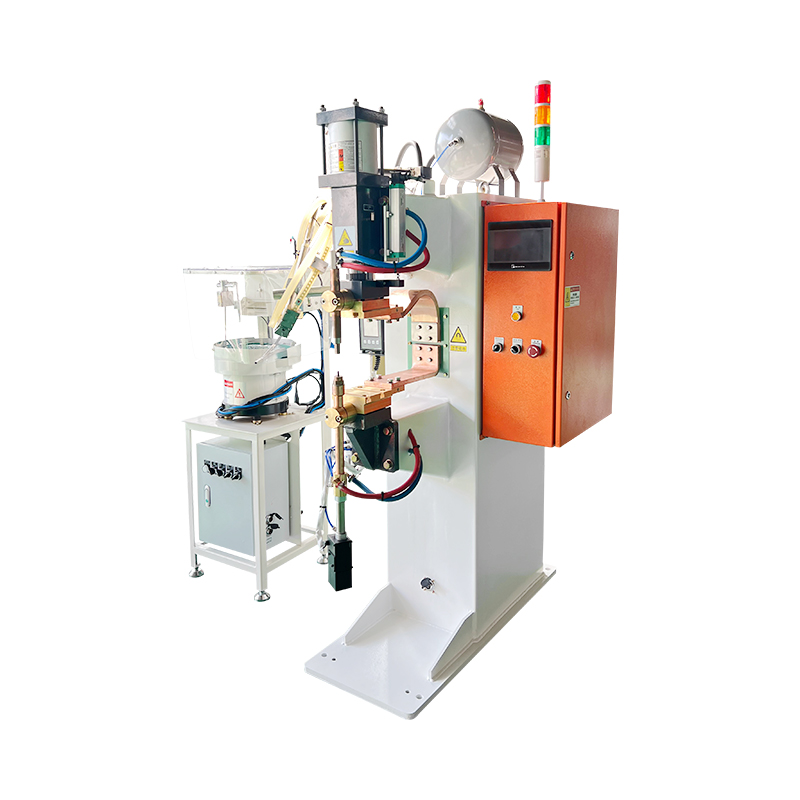
For applications involving heat-sensitive components or multi-point projection welding, capacitor discharge welding offers distinct advantages. Agera's ADR Series capacitor discharge machines deliver welding energy in approximately 10 milliseconds, preventing surface discoloration and thermal deformation that commonly occur with longer heating cycles.
The technology maintains energy fluctuation within one percent regardless of power grid instability, ensuring consistent weld quality across production runs. With energy capacity reaching up to 200 kilojoules, these machines can handle extremely large components while requiring less than one-fifth the power capacity of equivalent AC welders. This reduced infrastructure requirement translates to significant installation cost savings for manufacturers.
Flash Butt Welding for Large Sections
Flash butt welding technology addresses the challenge of joining large-section metal parts and special steel alloys. Agera's AUNS and AUVS Series flash butt welding machines achieve weld quality nearly identical to base metal properties for cross-sections up to 20,000 square millimeters.
The AUBS-630*2 New Energy Electric Axle Double-Head Pulsation Flash Butt Welder represents a breakthrough in electric vehicle manufacturing. This equipment received certification as "First Set of Major Technical Equipment" in 2024, recognizing its technical innovation and strategic importance to emerging industries. The double-head configuration enables simultaneous welding of both axle ends, dramatically improving production efficiency for new energy vehicle components.
Similarly, the ACBS-500 Copper and Aluminum Flash Butt Welder addresses the challenge of joining dissimilar metals, a common requirement in electrical and energy applications where copper and aluminum components must be reliably connected.
Industry-Specific Automation Solutions
Modern manufacturing demands extend beyond individual welding machines to encompass fully integrated automation systems. Agera has developed comprehensive automation solutions tailored to specific industry workflows, leveraging robotics and intelligent control systems.
Automotive Component Manufacturing
In automotive manufacturing, where safety and quality are paramount, Agera provides robot-integrated nut projection welding workstations for anti-collision beams and subframes. These automated systems ensure 100 percent weld reliability in safety-critical components. The company's new energy vehicle threshold beam robot workstations and shock absorber automatic welding lines demonstrate the integration of multiple welding processes including seam, projection, and stud welding into cohesive production systems.
For electric vehicle wire harness manufacturing, Agera's automatic square forming and welding lines process 90-square-millimeter copper braided wires, meeting the high-power transmission requirements of modern electric vehicles. These automated lines eliminate manual handling variations and ensure consistent electrical performance across thousands of assemblies.
Emerging Energy Technologies
The hydrogen energy sector presents unique welding challenges for bipolar plate manufacturing. Agera has developed fully automatic welding lines specifically for hydrogen production bipolar plates, addressing the stringent quality requirements and high-volume production demands of this emerging technology.
The company's diffusion welding machines, including the AKG and AKD Series, enable multi-layer welding for new energy battery busbars and charging pile components. These machines provide uniform heating to prevent deformation while supporting connections between metal and non-metal materials, expanding the range of possible component designs.
Technical Validation and Market Recognition
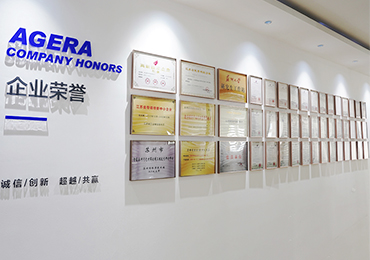
Agera's technical capabilities are supported by over 50 invention and utility model patents and multiple computer software copyright registrations. The company operates the Suzhou Intelligent Pulse Flash Butt Welding Control Engineering Technology Research Center and is designated as a Suzhou Industrial Design Center, reflecting its commitment to continuous innovation.
Strategic collaboration with the China-Ukraine Welding Research Institute and industry-academia partnerships with Soochow University and Jiangsu University of Science and Technology enable Agera to stay at the forefront of welding technology development. The company's Graduate Workstation facilitates knowledge transfer between academic research and industrial application.
Quality management certification including ISO9001 and CE Certification for European markets demonstrates Agera's adherence to international standards. The company's products have been exported to Europe, Southeast Asia, the Middle East, South America, and North America, serving over 6,000 customers with more than 80,000 accumulated welding workpiece cases.
Comprehensive Service Model
Beyond equipment manufacturing, Agera delivers complete process solutions encompassing pre-sales analysis, customized design, production, installation, and dedicated after-sales support. The company's operations are supported by integrated ERP, CRM, and PLM systems that enable efficient delivery and product lifecycle tracking.
The service philosophy emphasizes rapid problem solving and flexible scheduling, with continuous improvement driven by careful attention to customer feedback. This comprehensive support model ensures that customers receive not just hardware, but complete solutions that address their specific manufacturing challenges.
Selecting the Right Resistance Welding Solution
When evaluating resistance welding equipment, manufacturers should consider several critical factors including material compatibility, production volume requirements, energy efficiency, precision control capabilities, and automation integration potential. The accumulated experience represented by extensive welding case databases provides valuable insights for process optimization.
Agera Automation Equipment offers a comprehensive portfolio spanning medium-frequency spot welders, capacitor discharge machines, flash butt welders, diffusion welders, and fully integrated automation systems. This breadth of capability, combined with deep technical expertise and proven track record across automotive, electronics, energy, and aerospace applications, positions the company as a strategic partner for manufacturers seeking to advance their welding capabilities.
The integration of proprietary control technology, extensive patent portfolio, and industry-academia collaboration creates a foundation for continued innovation in resistance welding technology. As manufacturing industries evolve toward greater automation, precision, and energy efficiency, selecting equipment from established technology leaders becomes increasingly critical to maintaining competitive advantage.
https://www.agerawelder.com
Suzhou Agera Automation Equipment Co.,Ltd.