
When it comes to precision manufacturing in industries like automotive, electronics, and new energy, the choice of welding equipment can determine the difference between production excellence and costly defects. As global manufacturers increasingly demand higher efficiency, better quality, and greater automation, understanding what makes a spot welding machine manufacturer truly reputable becomes critical for informed procurement decisions.
What Defines a Well-Known Spot Welding Machine Manufacturer
A well-known spot welding machine manufacturer distinguishes itself through several essential characteristics. First and foremost is technological depth—decades of accumulated expertise in resistance welding technology, not just assembly of components. Second is the breadth of proven applications across diverse industries and materials. Third is the ability to provide complete solutions rather than standalone equipment. Finally, recognition through industry certifications, patents, and customer validation establishes credibility in a competitive marketplace.
The most respected manufacturers maintain comprehensive databases of welding applications, often numbering in tens of thousands of cases. This accumulated knowledge enables them to quickly diagnose challenges and recommend optimal solutions for new applications, significantly reducing trial-and-error time for customers.
Core Technologies That Set Industry Leaders Apart
Leading spot welding machine manufacturers invest heavily in proprietary control systems. Medium frequency inverter technology represents a significant advancement over traditional AC welding, with inverter frequencies reaching 1000Hz or higher. This translates to current control accuracy that can be 20 times superior to conventional equipment, directly impacting weld consistency and quality.
Energy efficiency has become another critical differentiator. Advanced medium frequency spot welders can reduce power grid demand by approximately one-third compared to AC machines, while maintaining power factors between 0.7 and 0.9. For manufacturers operating multiple welding stations, these efficiency gains translate to substantial operational cost savings and reduced infrastructure requirements.
Precision control capabilities enable successful welding of challenging material combinations, including high-strength steels, aluminum alloys, and dissimilar metal joints. The ability to maintain stable nugget formation with minimal spatter, even on sensitive materials, separates proven manufacturers from commodity suppliers.
Specialized Equipment for Diverse Industrial Applications
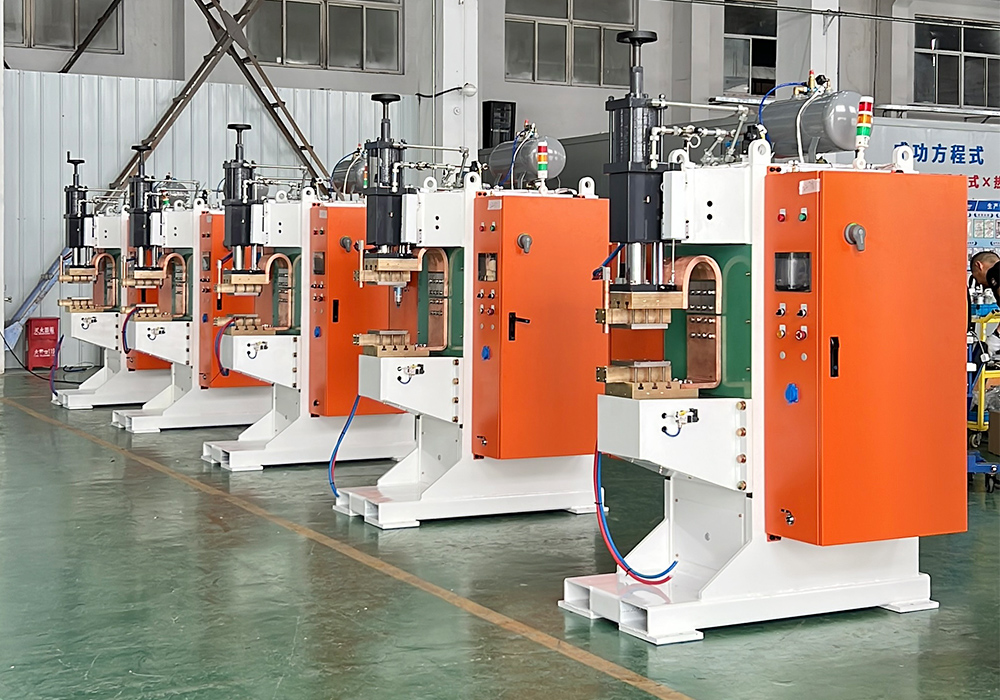
Well-established manufacturers offer product portfolios spanning multiple resistance welding technologies. Medium frequency spot and projection welders serve as workhorses for automotive body assembly and electronics manufacturing, where precision and repeatability are paramount. Capacitor discharge systems excel in applications requiring minimal heat input, such as heat-sensitive components or projection welding with extremely short cycle times—often around 10 milliseconds—preventing surface discoloration and thermal deformation.
Flash butt welding machines address specialized needs in heavy industry, capable of joining large-section metal parts up to 20,000 square millimeters with weld quality nearly identical to base metal properties. This technology proves essential in manufacturing truck axles, railway components, and structural steel elements. Suzhou Agera Automation Equipment Co., Ltd. developed the first domestic double-head flash butt welding machine specifically for new energy electric vehicle axles, demonstrating how specialized manufacturers address emerging industry needs.
For advanced applications in battery manufacturing and power electronics, diffusion welding equipment provides uniform heating to prevent deformation while enabling connections between dissimilar materials, including metal-to-non-metal bonds critical in modern energy storage systems.
Integration of Automation and Intelligent Systems
The evolution from standalone welding machines to integrated automated workstations marks a defining capability of leading manufacturers. Robot-integrated projection welding stations for automotive subframes and anti-collision beams ensure 100% weld reliability in safety-critical applications. Automated production lines for shock absorbers, wire harnesses, and battery components demonstrate the transition from equipment supplier to process solution provider.
Sophisticated manufacturers implement complete digital infrastructure including ERP systems for production management, PLM systems for product lifecycle tracking, and CRM platforms for customer relationship management. This digital foundation enables consistent quality, efficient customization, and responsive after-sales support.
Industry Recognition and Validation
Credible manufacturers earn recognition through multiple channels. National High-tech Enterprise certification, industry-specific honors such as "Specialized, Refined, Distinctive, and Novel" designations, and "First Set of Major Technical Equipment" recognition for breakthrough products validate technological leadership. Suzhou Agera Automation Equipment, for example, holds over 50 invention and utility model patents, along with ISO9001 and CE certifications for quality management and international safety standards.
Collaboration with research institutions provides another validation marker. Strategic partnerships with welding research institutes and establishment of engineering technology research centers demonstrate commitment to advancing the field rather than simply commercializing existing technology.
Customer Base and Application Breadth
The reputation of spot welding machine manufacturers ultimately rests on customer validation. Serving thousands of customers across diverse industries—from automotive and aerospace to household appliances and emerging hydrogen energy sectors—demonstrates versatile capability. Accumulation of tens of thousands of welding workpiece cases provides the empirical foundation for addressing new challenges confidently.
Entry into supply chains of leading manufacturers in competitive sectors like new energy vehicles represents particularly strong validation. These customers demand rigorous quality standards, comprehensive testing, and proven reliability before approval.
Service Philosophy and Long-Term Partnership
Distinguished manufacturers recognize that equipment delivery represents the beginning, not the end, of customer relationships. Comprehensive service models encompass pre-sales process analysis, customized design, professional installation, and dedicated after-sales support. Rapid problem-solving capabilities and flexible scheduling distinguish service leaders from transactional suppliers.
The philosophy of continuous improvement based on patient customer feedback, combined with professional technical process consulting, transforms manufacturers into strategic partners rather than mere vendors.
Geographic Reach and Global Standards
Well-known manufacturers demonstrate capability to serve global markets, with products exported to Europe, Southeast Asia, the Middle East, South America, and North America. This geographic breadth requires adherence to international standards, multilingual technical documentation, and understanding of diverse regulatory environments.
Manufacturing locations in established industrial centers provide access to skilled workforce, supply chain infrastructure, and proximity to key customer concentrations. Suzhou Agera Automation Equipment's location in the Yangtze River Delta positions them within China's advanced manufacturing corridor, facilitating collaboration and rapid response.
Making Informed Selection Decisions
When evaluating spot welding machine manufacturers, procurement teams should assess technological depth through patent portfolios and proprietary control systems, verify application experience through case studies in relevant industries, examine quality certifications and industry recognition, evaluate automation integration capabilities for complete solutions, investigate after-sales support infrastructure and response times, and consider the manufacturer's investment in research partnerships and engineering centers.
The most reputable manufacturers transparently share technical specifications, application data, and customer references. They invest in understanding specific production challenges before recommending solutions, ensuring alignment between equipment capabilities and actual operational needs.
In an era of increasing manufacturing complexity and quality demands, partnership with a well-known spot welding machine manufacturer provides not just equipment, but accumulated expertise, proven solutions, and ongoing support essential for competitive advantage in precision manufacturing.
https://www.agerawelder.com
Suzhou Agera Automation Equipment Co.,Ltd.