
 admin
Improving the single-machine capacity of a bead mill can start with “adding at the front end and subtracting at the back end.” Single-machine capacity is affected by the initial state of the material, the grinding path, the equipment’s energy density, and parameter settings. The better the front-end dispersion, the lighter the downstream grinding burden; the more reasonable the grinding classification, the higher the single-machine throughput.
1. Replace traditional dispersers with the Inline dispersing system-low viscosity IDS. Traditional open dispersers have slow feeding, high dust, and uneven wetting. Powder agglomerates entering the bead mill require multiple circulation passes. The IDS uses vacuum negative-pressure enclosed powder suction. Powder is transported in a closed pipeline, liquid enters the chamber simultaneously, and the powder is instantly wetted by high-speed shear. After pre-dispersion quality improves, agglomerates are reduced, and the initial particle size is more consistent when the material enters the bead mill. The number of downstream sand-milling passes can be reduced by 30%–50%. This is equivalent to moving part of the workload forward, allowing the bead mill to use energy for refinement rather than repeatedly breaking down large lumps. For high-solids and high-viscosity coatings, the IDS can also reduce the apparent viscosity of the slurry, improve flowability, make feeding smoother, and thereby increase the single-machine processing capacity per unit time.
2. Adopt a series staged grinding process. If a single bead mill handles both coarse grinding and fine grinding at the same time, it is difficult to balance the parameters. The front stage requires larger media and higher energy to open up agglomerates, while the back stage requires smaller media and milder conditions to narrow the distribution. Series staged grinding separates coarse grinding from fine grinding. The front-stage equipment is responsible for rapidly reducing particle size, and the back-stage equipment is responsible for fineness and distribution. The material passes through stage by stage, and the flow rate and residence time can be set separately. The load on each machine decreases, and overall line efficiency improves. For systems requiring micron or submicron fineness, staged grinding can also reduce particle re-coarsening and overgrinding, lowering energy consumption and media wear.
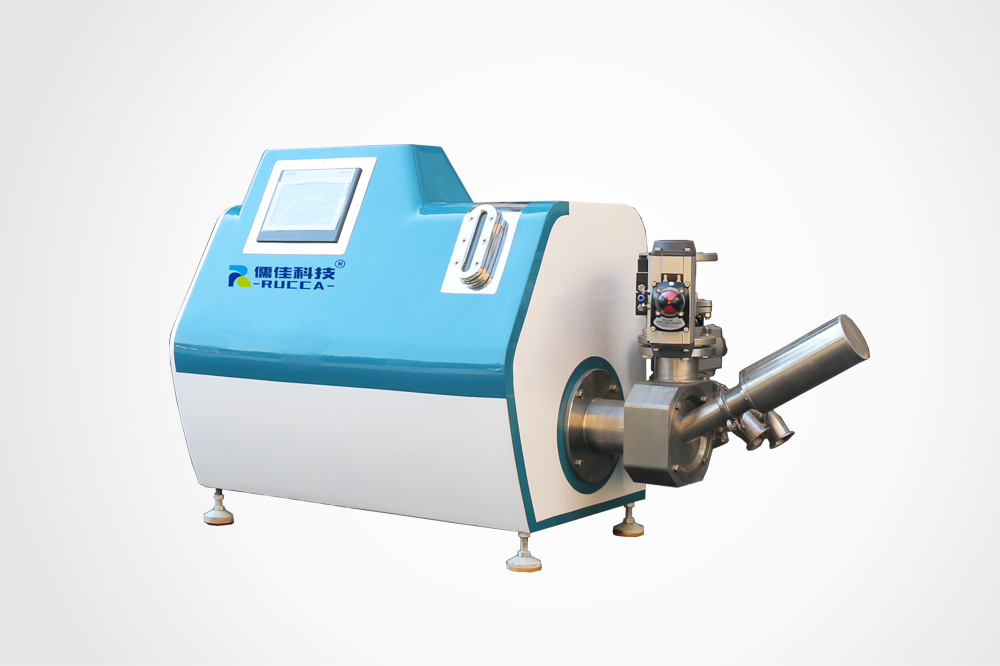
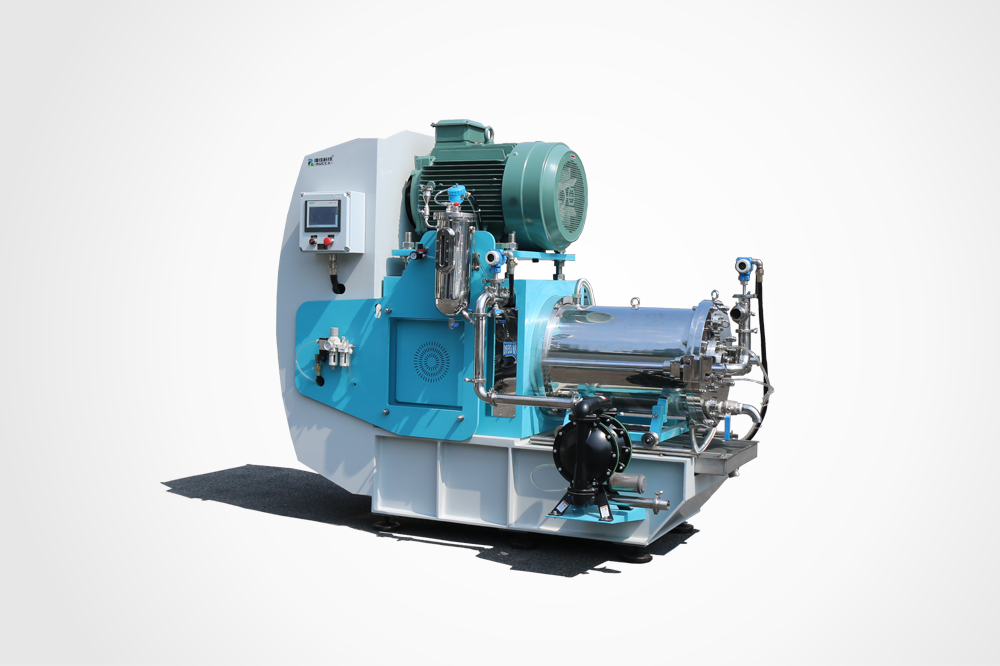
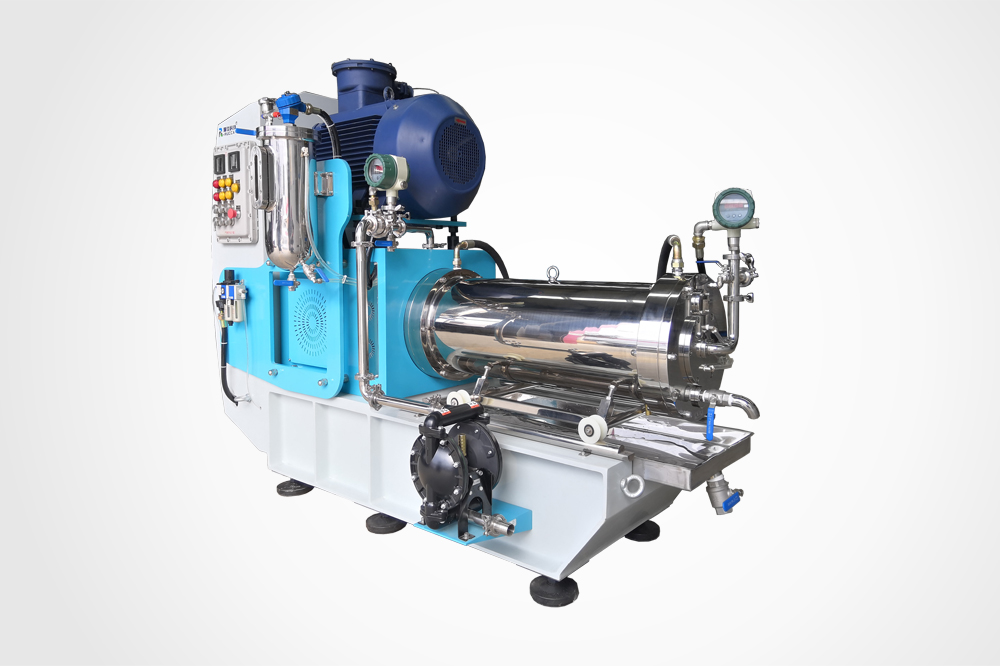
3. Select high-energy-density pin-type bead mills. The pin-type structure forms strong shear and impact zones in the grinding chamber, making energy input per unit time more concentrated and reducing the number of circulation passes required to reach the target fineness. RUCCA’s DF series and N series bead mills can be selected according to material characteristics and are compatible with different media specifications. High energy density does not mean blindly increasing rotational speed; rather, it means matching the rotor structure, media movement, and cooling capacity. The cooling system must be able to remove heat; otherwise, temperature rise will limit capacity. Internal and external dual cooling can help support long-term operation and reduce downtime and speed reduction caused by temperature rise.
4. Set parameters reasonably and find a balance between high flow rate and fineness. Feed rate, linear speed, media filling rate, number of grinding passes, and cooling water temperature all affect capacity. When the flow rate is too high, the material residence time is short, and fineness may be insufficient; when the flow rate is too low, the circulation time is long, and single-machine output decreases. The target particle size can be determined first, and then the flow rate and linear speed can be adjusted step by step while observing particle size distribution, viscosity, and temperature. A media filling rate that is too high increases friction heat, while one that is too low reduces grinding efficiency. Online particle size monitoring or regular sampling can help identify the appropriate operating window.
RUCCA can provide a free diagnosis of existing production lines and propose targeted efficiency improvement plans. By reviewing equipment configuration, material status, process parameters, and cleaning and product changeover procedures, it can determine whether the bottleneck lies in pre-dispersion, grinding classification, cooling, or parameter settings. It is recommended to send materials for sample testing, verify the plan with measured data, and then decide whether to retrofit or add equipment. In this way, the single-machine capacity of the bead mill can be improved while maintaining fineness and stability.
www.ruccagroup.net
RUCCA BEAD MILL